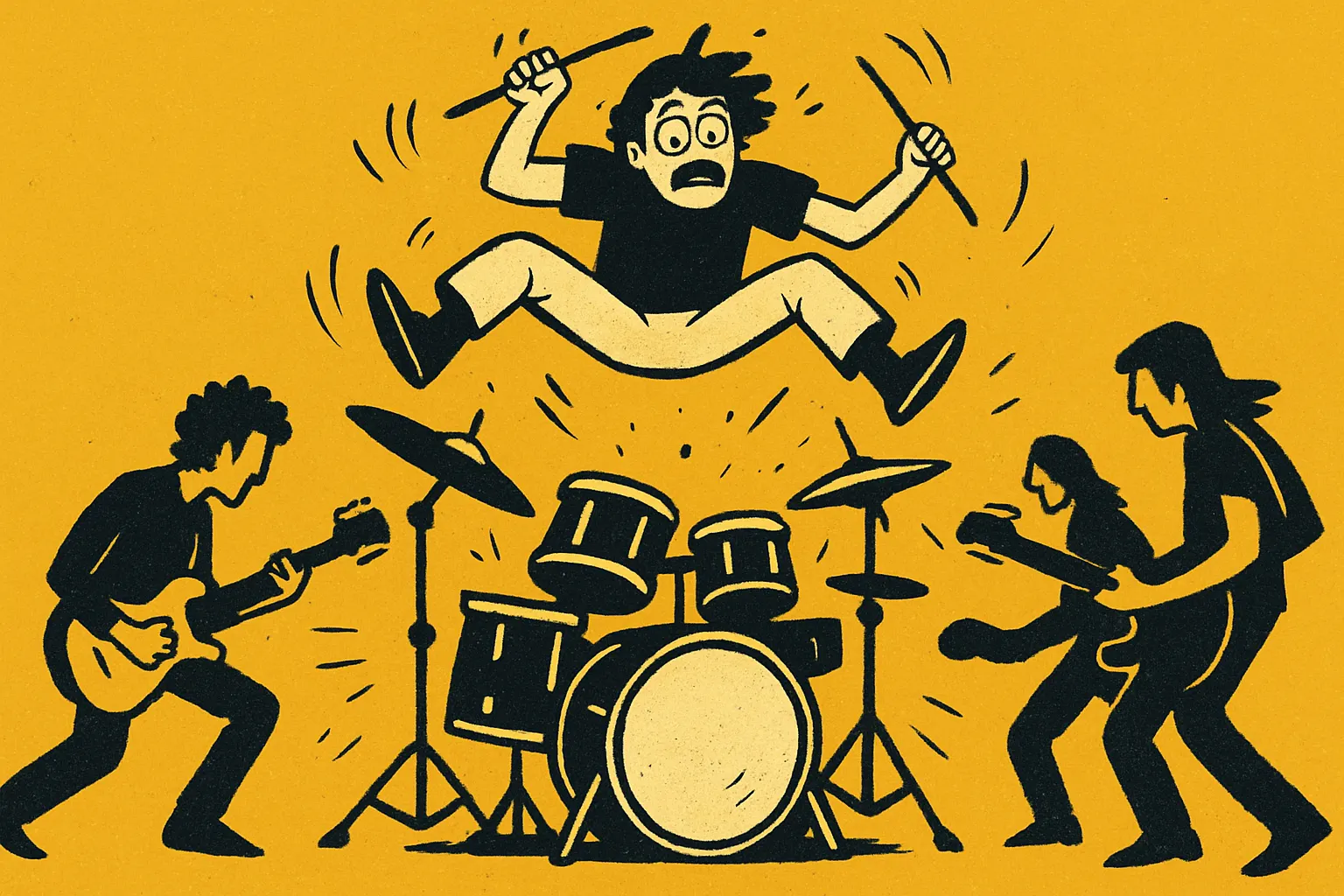
The freeze isn't about the fill notes
If you can play a fill perfectly on its own but fall apart the second you try to play it inside a groove, that's a strong sign the problem is the transition, not your hands. Moving from "playing the beat" to "playing the fill" and back again is its own skill — separate from either pattern alone. It's trainable, but it has to be practiced as its own thing, not assumed to happen automatically once you know both pieces.
Which part of the freeze sounds like you?
Freezing shows up a few different ways. Figure out which one is yours before you pick a drill:
- You forget to start the fill on time → the groove-to-fill entry point is the bottleneck. Practice the bar right before the fill until the entry feels automatic.
- You play the fill fine but lose beat 1 coming back → the fill-to-groove exit is the bottleneck. This is worth treating as its own drill, not an afterthought.
- You freeze specifically on fills that start mid-bar (like beat 3) → this is usually confusion about which groove notes still get played before the fill starts, not a hand problem. See below.
- You freeze on longer fills but not short ones → start with quarter-bar fills and work up; a full-bar fill has more places to get lost.
The drill: loop the groove-to-fill transition
Learn the fill by itself first, slowly, until the timing is exact. Then don't move on to a new fill — put a bar of groove in front of it and loop the two bars back to back, over and over, without stopping to fix mistakes mid-loop. That repetition is what builds the changeover, not repeating the fill alone.
The hi-hat and kick keep the groove through beats 1–3. On beat 4, everything drops out except four snare hits — that's the whole fill. Loop this pattern until it's comfortable and boring, then speed it up. A practice pad is fine for drilling the sticking of the fill itself before you bring it to the kit.
Fill lengths: know when to start and stop
Part of freezing is not knowing how long the fill is supposed to be. Rock fills usually come in three lengths, and knowing which one you're playing tells you exactly when to start and when to get out:
| Fill length | How much of the bar | Good starting point? |
|---|---|---|
| Quarter bar | Just beat 4 | Yes — easiest to control, start here |
| Half bar | Beats 3–4 | Try once quarter-bar fills feel automatic |
| Full bar | The whole bar | Move here after half-bar fills feel comfortable |
Why fills that start mid-bar feel confusing
If a fill starts on beat 3, it only replaces beats 3 and 4 — everything on beats 1 and 2 of that bar still gets played exactly as normal. So if your groove has a kick on the "and" of beat 2, that kick still happens right before the fill kicks in. A lot of freezing on mid-bar fills is really just not being sure which groove notes survive and which get replaced — work that out slowly, one bar at a time, before adding speed.
Common mistakes
- Only ever practicing the fill in isolation. It'll feel solid alone and then vanish the moment a groove leads into it — because you never trained the join.
- Treating the fill as the finish line. Landing back on beat 1 cleanly is the actual goal — practice it as deliberately as the fill itself.
- Jumping straight to fast tempo. Loop the two-bar groove-and-fill phrase slowly until it's automatic, then speed up — not the other way around.
- Only learning a fill against one groove. Try the same fill at a few tempos and over a couple of different groove patterns so it isn't glued to one context.
Related
If the freeze happens specifically when the kick pattern changes underneath your hands, that's more of a coordination issue than a transition issue — worth treating as a separate problem. And if you're still deciding on drum sticks or a practice pad for slow, quiet fill drilling away from the kit, both help with exactly this kind of repetition work.