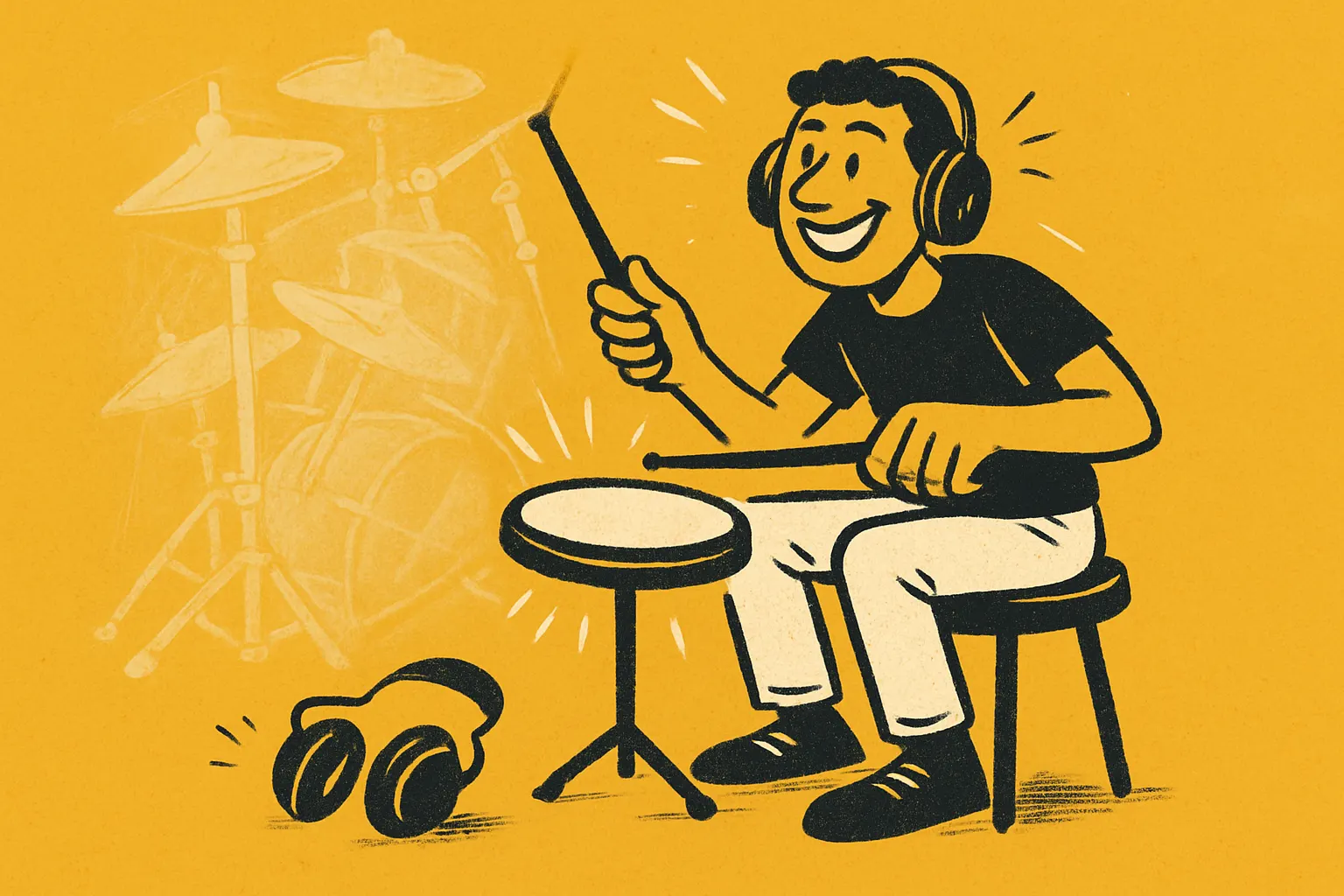
You need four things to start: a pair of sticks, something to hit, ear protection, and somewhere to sit. That's it. Everything else — cymbals, a double pedal, a five-piece acoustic kit — can wait until you know what you actually want to play.
A lot of the gear marketed to beginners is aimed at parents buying a kit as a gift, not at someone trying to learn efficiently on a budget. This page skips that noise and tells you what to buy first, what to skip, and why.
The minimum setup to start learning
Before you spend money on a kit at all, get these:
- A pair of beginner-friendly drum sticks
- A practice pad to build hand technique without needing drums yet
- Ear plugs, even if you're only practicing on a pad
A practice pad and a pair of sticks let you build basic stick control — grip, rebound, evenness between hands — in a room with no noise complaints and no gear budget. This is a real, useful stage of learning, not a compromise. Plenty of beginners spend their first weeks almost entirely on a pad before they ever sit at a kit.
Ear protection matters from day one, even on a quiet pad, because the habit of protecting your hearing is worth building before you're sitting behind a full kit at volume.
Sticks: don't overthink this one
Stick choice is one of the lower-stakes decisions in drumming. A standard 5A pair is a normal, forgiving place to start — not too heavy, not too light. What matters more than the exact model is that you have a pair that feels comfortable in your hand and that you replace when the tips wear down or a stick cracks. See our beginner stick picks if you want a specific starting point instead of guessing at a music store wall.
Something to hit: pad, electronic kit, or acoustic kit?
This is the real decision, and it depends on your space and your neighbors more than your budget.
A practice pad is the cheapest and quietest option. It won't teach you coordination between hands and feet, but it's the right tool for building hand technique early on.
An electronic drum set is the more apartment-friendly full-kit option compared to an acoustic kit. Play through headphones and your neighbors hear almost nothing. You'll also need headphones built for electronic drums — regular headphones work, but ones designed for this are more comfortable over long sessions and block more of the kit's own mechanical noise.
An acoustic kit sounds and feels like a real drum kit because it is one, but it's loud, and in many apartments the low-frequency thump of the kick drum travels through the floor to people below you regardless of how quietly you play. If you're in a house with some distance from neighbors, this is less of an issue. If you're in an apartment, an anti-vibration mat or riser can reduce how much of that thump transfers into the floor — it won't eliminate the sound in the room, but it helps with the vibration that travels through walls and floors.
If you're not sure yet whether drumming is something you'll stick with, starting on a pad, then moving to an electronic kit, is a lower-risk path than buying an acoustic kit first.
A pedal, if you're playing kick drum
If you move to any kind of kit — electronic or acoustic — you'll need a bass drum pedal unless one's included. Beginner kits often ship with a basic pedal that's fine to start on; you don't need to upgrade this immediately. A smoother, better-built pedal becomes more noticeable once your kick foot technique develops, not before.
Somewhere to sit
A proper drum throne matters more than it looks like it should. Sitting on a kitchen chair or a stool that's the wrong height puts you in an awkward position relative to the kit, which makes it harder to move your limbs freely and can leave you sore after a session. A throne that adjusts to the right height and has some padding is a small purchase that removes a real source of friction early on.
Protecting your ears and your neighbors
Ear protection isn't optional gear — treat it as part of the kit, not an accessory. Ear plugs made for musicians let you still hear the kit clearly while reducing volume, which matters more than it sounds because straining to hear yourself over the ringing in your ears is its own problem.
If you're worried about noise reaching neighbors, one major lever is often the choice between electronic and acoustic (see above), not accessories. An anti-vibration mat helps with an acoustic kit's floor vibration specifically — it's not a fix for airborne cymbal or snare volume.
What you don't need yet
- A double pedal. This is a technique you build after single-pedal kick control is solid, not a beginner purchase.
- Extra cymbals. A basic setup (hi-hat, one crash, one ride) is more than enough while you're learning grooves and fills. More cymbals won't speed up how fast you learn timing.
- An expensive kit. The gap between a beginner kit and a professional one shows up in tone and durability over years of use, not in whether you can learn a groove this month.
- A metronome app with every feature. A basic click is enough starting out; you don't need adjustable subdivisions or accents until you're already comfortable counting along to a plain beat.
A sensible order to buy in
- Sticks and a practice pad — start building hand technique immediately, cheaply, quietly.
- Ear plugs — get in the habit before you're at full kit volume.
- Decide: electronic kit (apartment, neighbors, need quiet) or acoustic kit (more space, more tolerance for noise).
- Throne, sized to you.
- Headphones (electronic) or an anti-vibration mat (acoustic, if noise is a concern).
- Pedal upgrade — later, once kick technique is developed enough to notice the difference.
You don't need to buy all of this in one trip, and you don't need the most expensive option in any category to start playing real songs. Get the basics, start playing, and upgrade the piece that's actually bothering you once you know what that is.