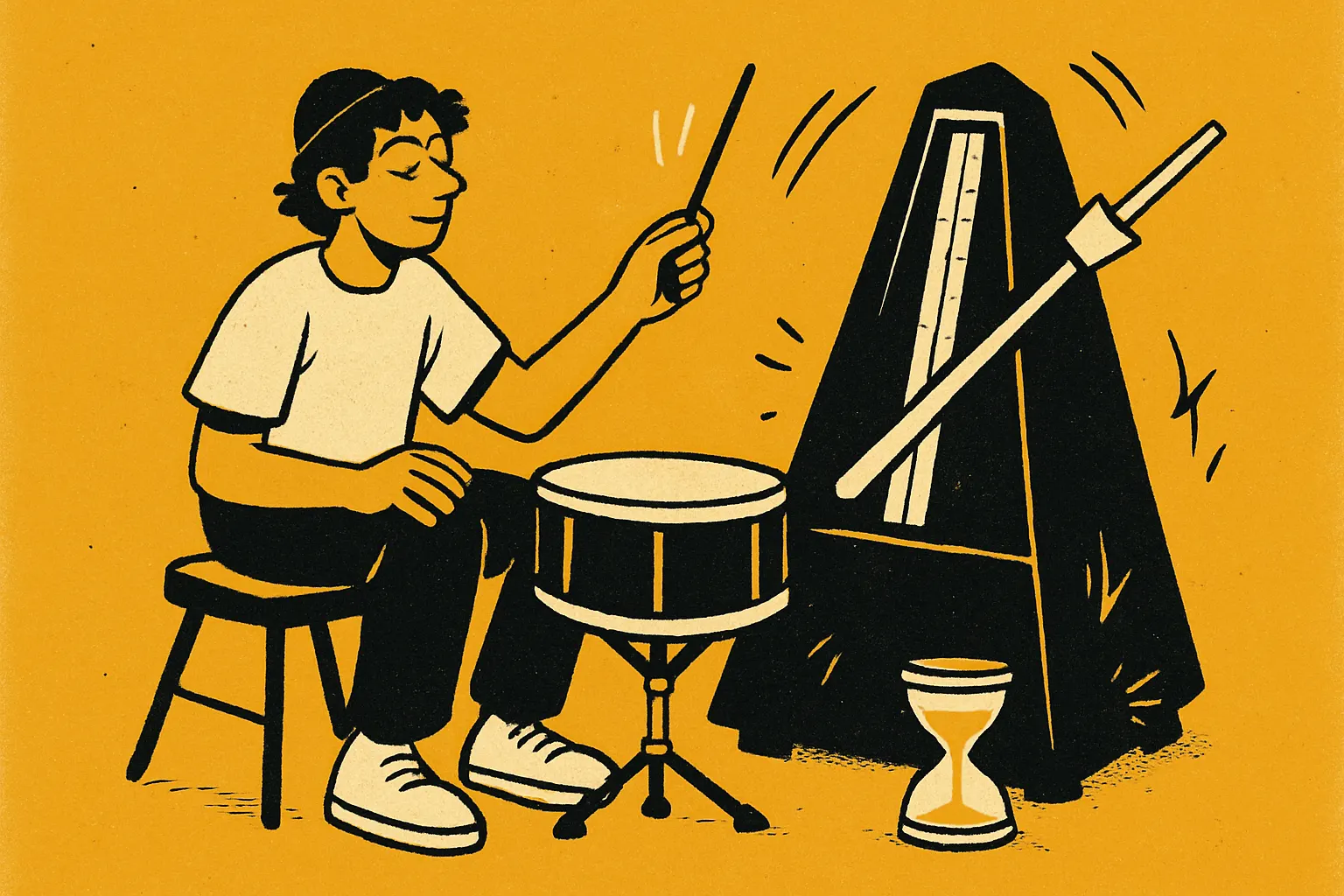
Effective drum practice means working on one specific thing, slowly, with a metronome, for a short focused session — not just playing through songs you already know. If you finish a session and can't say what got better, the session probably wasn't practice. It was playing. Both have a place, but they're not the same thing.
Practice vs. playing — know the difference
Playing is fun. You put on a song, you bash along, you feel good. Nothing wrong with that. But it doesn't fix your weak spots — it can just repeat them.
Practicing is narrower. You pick one thing that's currently hard (a transition, a rhythm, a fill), slow it down until you can do it clean, and repeat it until it's boring. That's the part that actually moves you forward.
A good session often has both: a chunk of real practice, then some playing to enjoy the payoff.
A simple structure for a practice session
You don't need a complicated plan. Something like this can work well for beginners:
- Warm up (5 minutes). Simple hand exercises on a practice pad or a few basic strokes on the kit. Get your hands and feet moving before you ask them to do anything hard.
- Work on one weak spot (10–15 minutes). Pick a single thing — a fill, a coordination pattern, a transition you keep losing. Slow it down with a metronome. Repeat it until it's clean at that speed, then nudge the tempo up slightly.
- Apply it (5–10 minutes). Play the pattern in context — inside a beat, or along to a song section that uses it.
- Play something fun (5–10 minutes). A song you already like. This is the reward lap, and it keeps you coming back tomorrow.
Total time can be short. 20–30 focused minutes on a given day can beat an occasional long session where half the time is spent just noodling.
Use a metronome, and slow down more than feels necessary
A metronome doesn't make you a better drummer by itself — it gives you something steady to compare yourself against, so drift in your timing is easier to notice than when you're setting the pulse yourself.
When you're learning something new, drop the tempo lower than feels needed. If a beat falls apart at 100 bpm, try 70. There's no speed you have to prove — the point is to build the movement correctly first, then add speed once it's automatic.
Practice one thing at a time
Trying to fix your timing, your fills, and a new song all in one session can mean none of them improve much. Pick one focus per session, or one focus per few days. It feels slower. It isn't — you actually retain the work instead of skimming three things at once.
Write down what you're working on
You don't need a formal log. A single line — "kick pattern in verse 2, still messy above 90 bpm" — is enough to pick up where you left off instead of guessing each time you sit down.
How long and how often to practice
Short, regular sessions tend to beat rare marathon ones, since coordination and timing are physical skills — they benefit from repeated exposure, not one long cram. If you can only manage 15–20 minutes some days, that's still useful, especially if it's focused rather than scattered.
There's no fixed number of days you need to hit. Consistency matters more than any specific schedule — a few short sessions a week you actually do beats an ambitious daily plan you abandon after a week.
Common mistakes
- Only playing songs, never isolating the hard part. If a section keeps tripping you up, playing the whole song on repeat won't fix it — you have to slow that section down on its own.
- Skipping the metronome because it feels restrictive. It can feel awkward at first because it's showing you timing issues you couldn't hear before, not because it's making you worse.
- Practicing too fast, too soon. Speed that isn't clean is just a faster version of the mistake.
- No clear focus for the session. Sitting down and "just playing for a while" is fine as a warm-down, but it's not the part of your routine that builds new skill.
- Practicing until you're sloppy from fatigue. A shorter, sharp session beats a long one where the back half is just reinforcing tired, messy playing.
Setting up so practice actually happens
The easier it is to sit down and start, the more often you will. A few things that help:
- A practice pad and a decent pair of drum sticks let you work on hand technique anywhere, without needing the full kit set up.
- If noise or neighbors are a concern, an electronic drum set with headphones lets you practice at almost any hour.
- Playing an acoustic kit in an apartment? Ear plugs protect your hearing during longer sessions, and an anti-vibration mat can cut down on the impact noise that travels through floors.
- A comfortable, correctly adjusted drum throne matters more than it seems — bad seat height makes technique harder to build correctly from the start.
None of this gear makes practice happen on its own. But removing friction — noise worries, an uncomfortable seat, no sticks within reach — makes it a lot more likely you actually sit down and do the work.