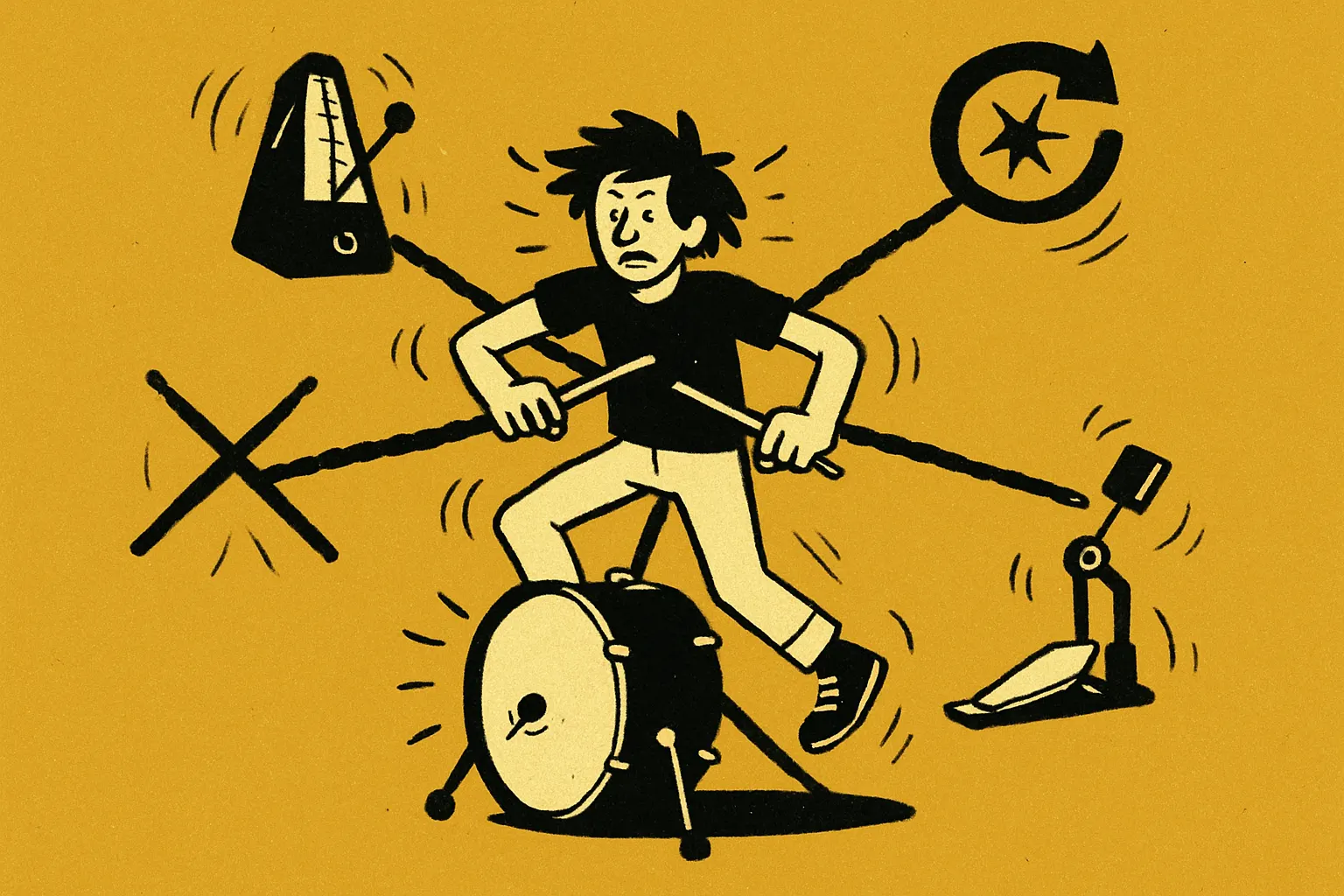
Beginner drumming problems often trace back to one of four things: keeping a steady tempo, coordinating your hands and feet, handling transitions like fills, and listening to the song around you. Figure out which one matches what's actually happening when you play, and you'll know what to practice instead of just running through songs and hoping it clicks.
This page won't hand you one fix for every problem — that's not how it works. Instead, use the symptom list below to figure out where to look first, then go practice that specific thing.
Which Problem Sounds Like You?
Read through these and pick the one that matches your experience. It's fine if more than one applies — a lot of beginner struggles overlap.
You lose the beat during fills. You're locked in during the groove, then the fill comes and you land somewhere off from beat 1. This suggests checking your transitions and counting first — the groove itself is probably fine.
You slowly speed up as you play. The song starts at one tempo and by the chorus you're noticeably faster, without meaning to. Tempo control may be the bottleneck here, not your hands or feet individually.
Everything falls apart when the kick drum pattern changes. You can play a steady hi-hat and snare all day, but the moment the kick does something different, your hands drift with it. Coordination between limbs is worth checking first — this is a common early hurdle, and it's not a sign of "bad rhythm."
You're solid alone but get lost playing along to a real song. Your practice-room groove is fine, but drop a song on and you fall behind or rush. This points toward listening and following the arrangement rather than your technique.
You're fine slow but fall apart above a certain speed. A pattern you can play cleanly at a slow tempo turns sloppy once you push the BPM up. This often means the pattern isn't fully automatic yet at that speed — it needs more reps, not a different approach.
A Starter Drill: If Fills Are Where You Lose It
This drill is for the fill/transition branch specifically — it won't do much for tempo drift or coordination issues.
Play a basic groove for two bars, then replace the second bar's last beat with a simple fill — even just four snare hits — and land back on beat 1 of the next bar. Keep the fill boring on purpose. The goal isn't an impressive fill; it's landing on 1 cleanly every time.
Start at 60 BPM. If that's already messy, drop to 50. There's no speed you have to prove here — you're training the transition, not the flash. A practice pad is useful for this because you can drill the sticking over and over without needing the whole kit set up.
Once landing on 1 feels boring and automatic, add a bar of groove before repeating, then try it at a slightly higher tempo.
For the other branches — tempo drift, coordination, listening — the fix looks different in each case, and it's worth practicing them on their own rather than trying to patch all of it with fill drills.
Common Mistakes That Show Up Early
A few habits show up again and again in the first months of playing:
- Gripping the sticks too tight. A death grip tires your hands out fast and makes rebound harder to control. Loosen up and let the stick bounce. Sticks that are too thick or too heavy for your hands can make this worse — see our beginner drum stick picks if you're not sure your current pair fits you.
- Skipping a metronome or click entirely. Without something steady to play against, it's hard to notice tempo drift while you're the one setting the pulse.
- Jumping straight to full speed. Practicing a beat only at the speed you want to play it, instead of starting slow and building up, tends to bake in the same mistakes at every tempo.
- Ignoring posture and seat height. Slouching or sitting too low makes your kick and hi-hat foot work harder than it needs to. A throne set at the wrong height is an easy, overlooked culprit — check our guide to drum thrones for beginners.
- Not protecting your hearing. Drums are loud up close, and it's easy to brush this off early on. A pair from our ear plugs for drummers guide is cheap insurance.
- Practicing loud and full-volume in an apartment, then quitting out of guilt. If noise is limiting how much you practice, that's a gear and setup problem, not a discipline problem — an anti-vibration mat or a switch to an electronic drum set with headphones can solve it directly.
- Not checking pedal feel. A cheap or poorly adjusted bass drum pedal can make kick coordination feel harder than it actually is, especially for beginners who assume the problem is their foot rather than the hardware.
What To Do Next
Pick the branch above that matches what you're actually experiencing, and give that one thing focused practice for a few sessions before judging whether it's working. Progress on coordination and tempo control comes in small, sometimes frustrating increments — that's normal, not a sign you're doing it wrong.