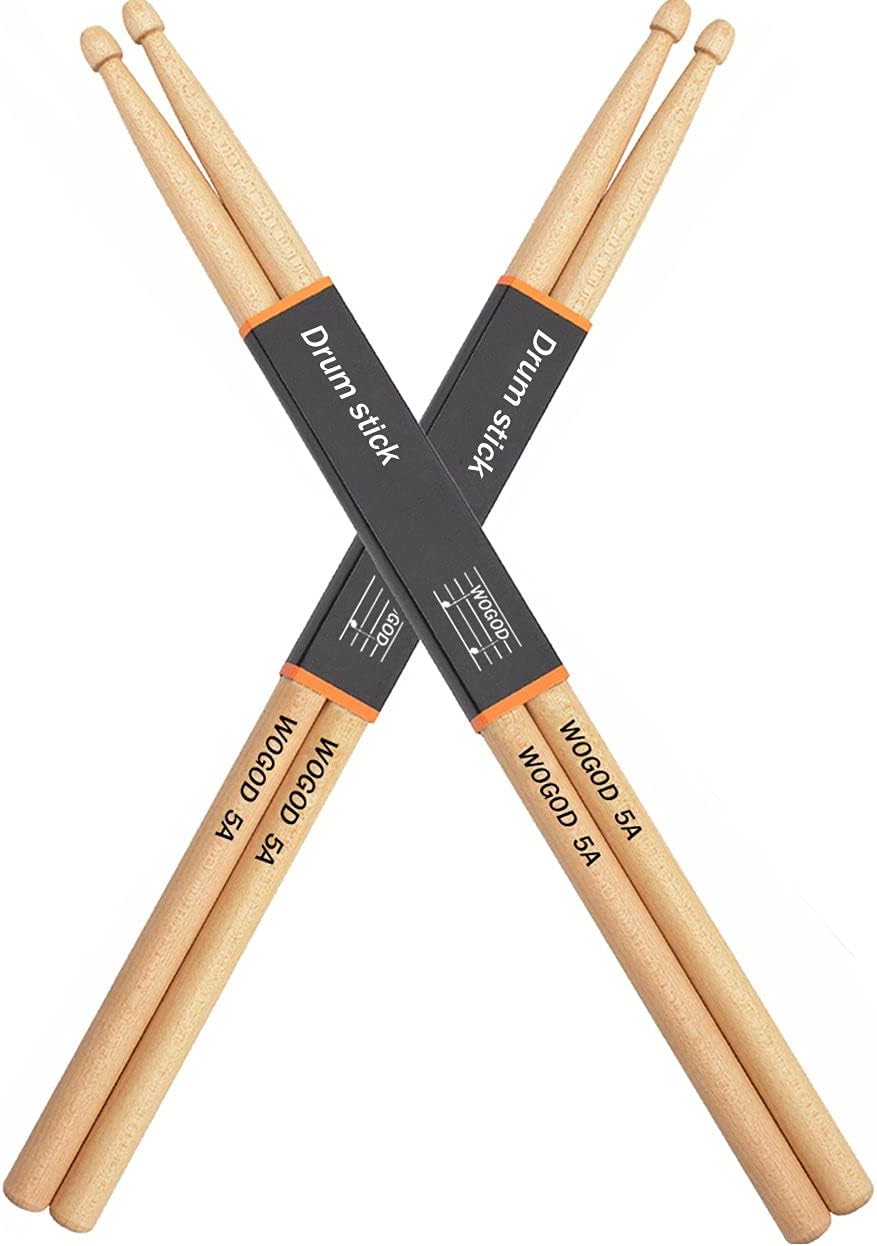
Almost every beginner should start with a 5A stick — the middle-of-the-road size that suits rock, pop, and everyday practice. Below are three pairs worth buying first, from a cheap everyday pair to a grippier stick if yours keep slipping. Buy a couple of pairs; sticks are consumable.
Stick sizes use a number-plus-letter code (5A, 7A, 5B, 2B) where a lower number means a thicker stick. 5A sits in the middle and covers rock, pop, and quiet practice, which is why it's the default first pair. If a 5A feels too heavy in your hand, a 7A is thinner and lighter; if it feels flimsy and you're playing loud, a 5B is a little chunkier.
Wood: hickory for durability, maple for lightness
Hickory is denser, so it takes mis-hits and rim shots better — useful early on, when your aim isn't consistent yet. Maple is lighter and easier on tired hands, but it tends to wear down faster under hard hitting. If you're not sure, hickory is the safer first buy.
Tip shape and material: wood vs nylon
Wood tips give a warmer sound on cymbals and are what you'll find on the standard beginner sticks; they chip and fray over time, especially if you catch the cymbal edge a lot. Nylon tips are brighter and last longer on the tip itself, but they can pop off. Tip shape matters less than you'd think at first: teardrop and acorn shapes both give you a clear ride sound, and the difference is small compared to how you strike.
Grip and finish: this is what fixes flying sticks
A glossy lacquer finish can get slick once your hands sweat, and sticks launching across the room is a common beginner annoyance. You can fix it cheaply with grip tape or a bit of rosin, or pay a bit more for a stick with a tacky coating built in. Choose the coated pair if you'd rather not fiddle with tape — otherwise the cheap fix works fine.
How many pairs to buy
Sticks are consumable, and beginners break and chew them faster than experienced players because hits land on the rim and cymbal edge. Buying two or three pairs at once means a broken stick doesn't end your practice session. Multi-pair budget packs make sense here, as long as you accept slightly less consistency between sticks.
Weight matching between the two sticks
Ideally the two sticks in a pair feel close to identical, so your left and right hands learn the same feel. Name-brand pairs tend to be sorted for consistent weight and balance; cheaper bulk packs can vary a little. It's a real difference, but it's not a reason to skip cheap sticks if money is tight — playing regularly matters more.
We started from the size that fits the widest range of beginner playing — 5A — and then looked at the three problems beginners run into first: durability, cost, and sticks slipping out of sweaty hands. One pick is the standard hickory 5A that gives you consistent weight and takes mis-hits; one is a cheaper maple multi-pair for tight budgets, with the honest tradeoff that it wears faster and can vary between sticks; one costs more but solves the grip problem without tape. All three are the same nominal size, so you can switch between them without relearning the feel.
Frequently asked questions
How much should I spend on my first pair of drum sticks?
A single pair of standard beginner sticks is one of the cheapest things you'll buy for drumming, and there's no need to go past the entry-level range. Put the money toward two or three pairs instead of one fancy pair — you'll break some.
Do I need 5A, or should I get 7A or 5B?
5A is the middle-of-the-road size and a sensible default. Go 7A if a 5A feels too heavy or thick for your hands, and 5B if you want a slightly thicker stick for louder playing; both are still fine for a beginner.
Can I just use the sticks that came with my drum kit?
Yes, to get started. Kit-included sticks are often unbranded and can be mismatched in weight, so if the two sticks feel different in your hands, a proper 5A pair is a cheap upgrade.
Why do my sticks keep flying out of my hands?
Slippery lacquer plus sweaty palms is one common cause, and a grip-coated stick or a wrap of grip tape helps. Gripping too tightly and then losing the stick on the rebound is another — if it happens more as you get tense or tired, loosen your hold before you go shopping.
Do I need different sticks for an electronic kit or a practice pad?
No, the same 5A works on mesh pads, rubber pads, and acoustic drums. Some players use lighter sticks on pads because of the harder rebound, but it's a preference, not a requirement.
Are nylon tips better than wood?
They're different, not better. Nylon sounds brighter on cymbals and the tip resists chipping; wood sounds warmer and is what you'll find on the standard beginner sticks. Either is fine for learning.
How long should a pair of sticks last?
This varies a lot — it depends on how hard you hit, how often you catch the rim, and how much cymbal work you do. Expect to replace sticks more often at the start than later, when your aim is more consistent.