What "Limb Independence" Actually Means
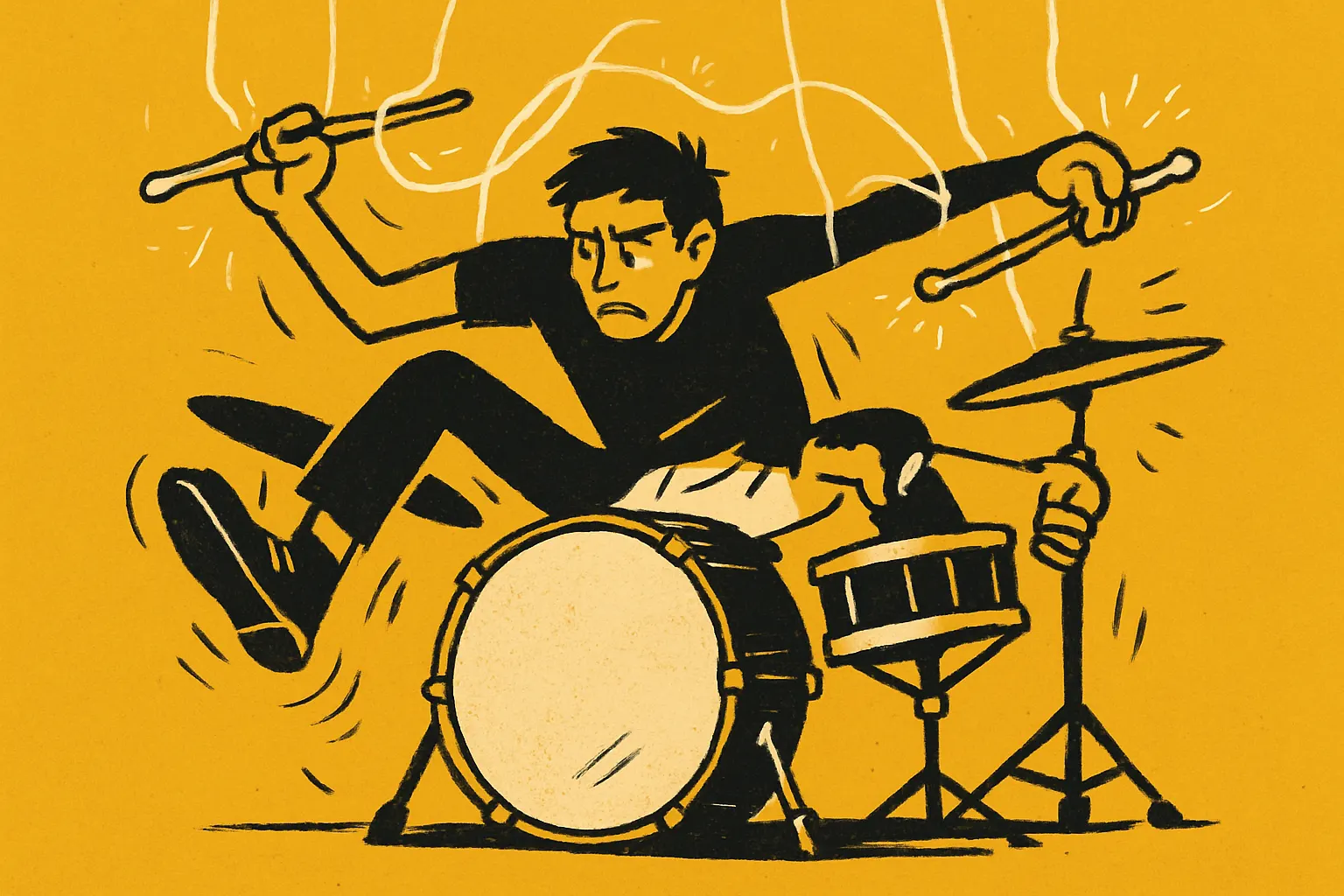
Drummers use the term limb independence for the ability to keep two or more limbs doing genuinely different things at once — say, a steady hi-hat pattern in one hand while the other hand and your kick foot play something else entirely. When people talk about "two-limb" or "four-limb" independence, they just mean how many limbs are involved in that separation.
Why It Feels Impossible at First
When you first try to play one pattern with your hands and a different one with your feet, your brain wants to merge them into one movement. That's the whole challenge of limb independence — training your hands and feet to stay on separate tracks instead of defaulting to the same one. It gets easier with repetition, not with talent you either have or don't.
You Don't Need a Full Kit to Practice This
Limb independence can be built away from a full drum kit. You can tap the pattern on your legs, a table, or a practice pad — the coordination challenge is the same whether or not there's a drum under your hands. That makes it one of the easier things to practice in short bursts, even in an apartment where noise is a concern.
The Standard Starting Exercise
A common way to start is with single-stroke eighth notes as the steady foundation, usually on the snare, then adding the foot underneath. If you're right-handed, lead with your right hand. Keep one limb doing something steady and simple — eighth notes are the classic choice — while the other limb plays something different. That contrast is the whole exercise.
Play the snare pattern alone first until it's boring-easy. Then add the kick pattern shown above. If the kick keeps pulling your snare hand off its steady eighths, slow down until it doesn't — there's no speed you have to prove here.
Two-Limb Before Four-Limb
Independence is usually built in stages: get two limbs separating cleanly before you try to add a third and fourth.
| Stage | What's moving | What to check |
|---|---|---|
| Two-limb | One hand + one foot | Can the foot pattern change without your hand pattern drifting? |
| Three-limb | Both hands + one foot | Does adding the second hand pull the foot back into copying? |
| Four-limb | Both hands + both feet | Can each limb hold its own part while the others move? |
Don't rush to four-limb patterns before two-limb feels steady. Going back a stage when something falls apart isn't a setback — it's how the skill actually gets built.
Common Mistakes
- Jumping straight to full-kit grooves. If a basic beat falls apart, the fix is often to strip it back to just two limbs, not to keep grinding on all four.
- Speeding up before it's clean. A fast, sloppy version teaches your limbs the wrong habit. A slow, clean version is worth more.
- Practicing only on the kit. Since this can be drilled without acoustic drums, short reps on a pad, a table, or your knees during the day add up.
Should You Practice This Instead of Rudiments?
Beginners often debate whether to spend practice time on limb independence drills or on rudiments like paradiddles from a method book. There's no single right order — rudiments build hand control and vocabulary, while independence drills build the coordination to use that vocabulary across your whole body. Many drummers work on both in the same practice session rather than picking one over the other. Dedicated method books are frequently recommended for structured independence practice if you want a set path to follow instead of guessing what to try next.