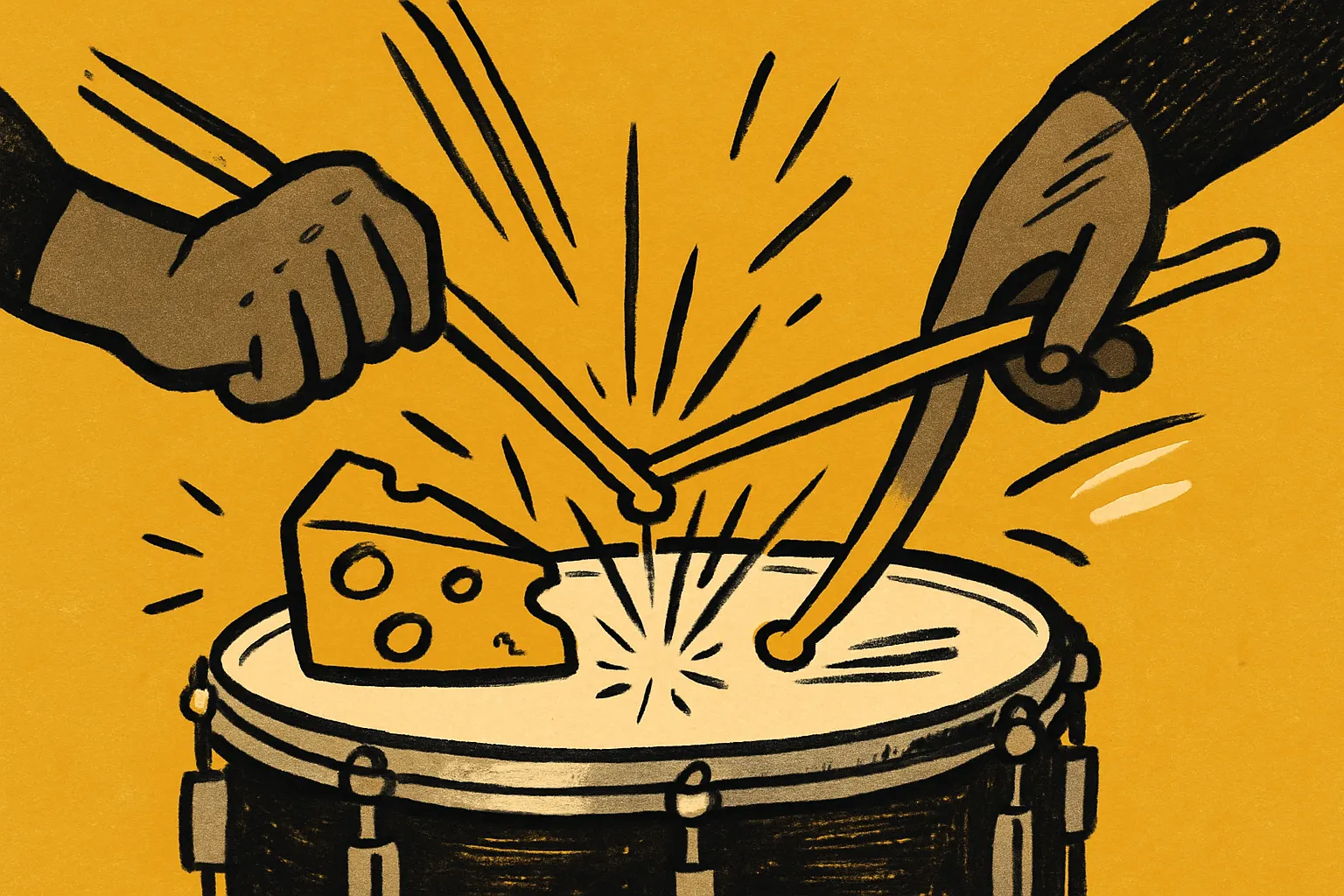
What the Cheese Rudiment Actually Is
A cheese is what's called a hybrid rudiment — a rudiment built by combining two other rudiments into one new pattern. In this case, it's a flam combined with a diddle (a double stroke), and some sources describe it as a flam plus a drag instead. Both descriptions point at the same thing: you're taking the accented note of a flam and turning it into two quick hits instead of one.
Beginners often ask how this is different from a flam tap, since the shape looks almost identical on paper. The difference is speed. In a flam tap, the notes are evenly spaced. In a cheese, the diddle is played at roughly double the speed of the surrounding notes — which is why the cheese behaves more like a drag rudiment than a flam tap, even though it looks similar.
How It's Built: Flam + Fast Diddle
Here's the breakdown, one hand at a time:
- One hand plays a soft grace note (the "flam" part).
- The other hand plays a diddle — two strokes, played fast — right after it (the "cheese" part).
- You alternate which hand leads the grace note and which hand plays the diddle.
If you isolate just one hand and watch it over several repetitions, you'll see it play a diddle, then later come back in softly as the grace note for the next gesture — which is where the "triple stroke" description some sources use comes from. It's the same motion, just viewed hand-by-hand instead of gesture-by-gesture.
Sticking Pattern
Here's a simplified, alternating version of the pattern — left hand leads first, then right hand leads:
Read it as: soft left grace note, fast right-hand diddle, rest — then soft right grace note, fast left-hand diddle, rest. Keep the grace notes noticeably quieter than the diddle strokes; that contrast is what makes it sound like a cheese instead of just four even notes.
How to Practice It
A sensible first step is learning the flam accent on its own — it's built from an eighth-note triplet feel and gives your hands the flam-then-tap motion before you add speed to the second note. Once that feels stable, layer the diddle in.
Practice steps:
- Play the flam accent slowly, hands relaxed, until the grace note stays quiet and consistent.
- Slow the whole pattern down further, then speed up only the diddle part while keeping everything else at the same tempo.
- Alternate leading hands so both sides get equally comfortable.
- Build up speed gradually rather than jumping straight to a fast tempo — this rudiment rewards patience more than most.
A practice pad is a good place to drill this — you can hear stick control clearly without worrying about cymbal or drum tone masking a sloppy diddle. Any pair of beginner-friendly drum sticks will work fine; you don't need anything specialized for rudiment practice.
Common Mistakes
- Grace note too loud. The flam should sound like one thick note, not two separate hits of equal volume.
- Diddle at the same speed as everything else. If the double stroke isn't noticeably faster than the surrounding notes, it's closer to a flam tap than a cheese.
- Tensing up to get speed. Speed comes from relaxed double-stroke technique, not from gripping harder.
- Skipping the flam accent step. Trying to learn the cheese before the flam and diddle are solid on their own usually just means practicing the mistakes instead of the rudiment.
Where You'll See It
The cheese is one of the more common ways hybrid and corps-style drummers dress up standard rudiments, and it also shows up as a building block inside bigger hybrid patterns — the Cheese Chutichuh, for example, uses the cheese as one of its components. You don't need to chase those bigger patterns right away; get the basic cheese solid first.
This is a technical rudiment, and it's fine if it takes a while to feel natural. Start slow, keep the grace note quiet and the diddle clean, and let speed show up on its own.
