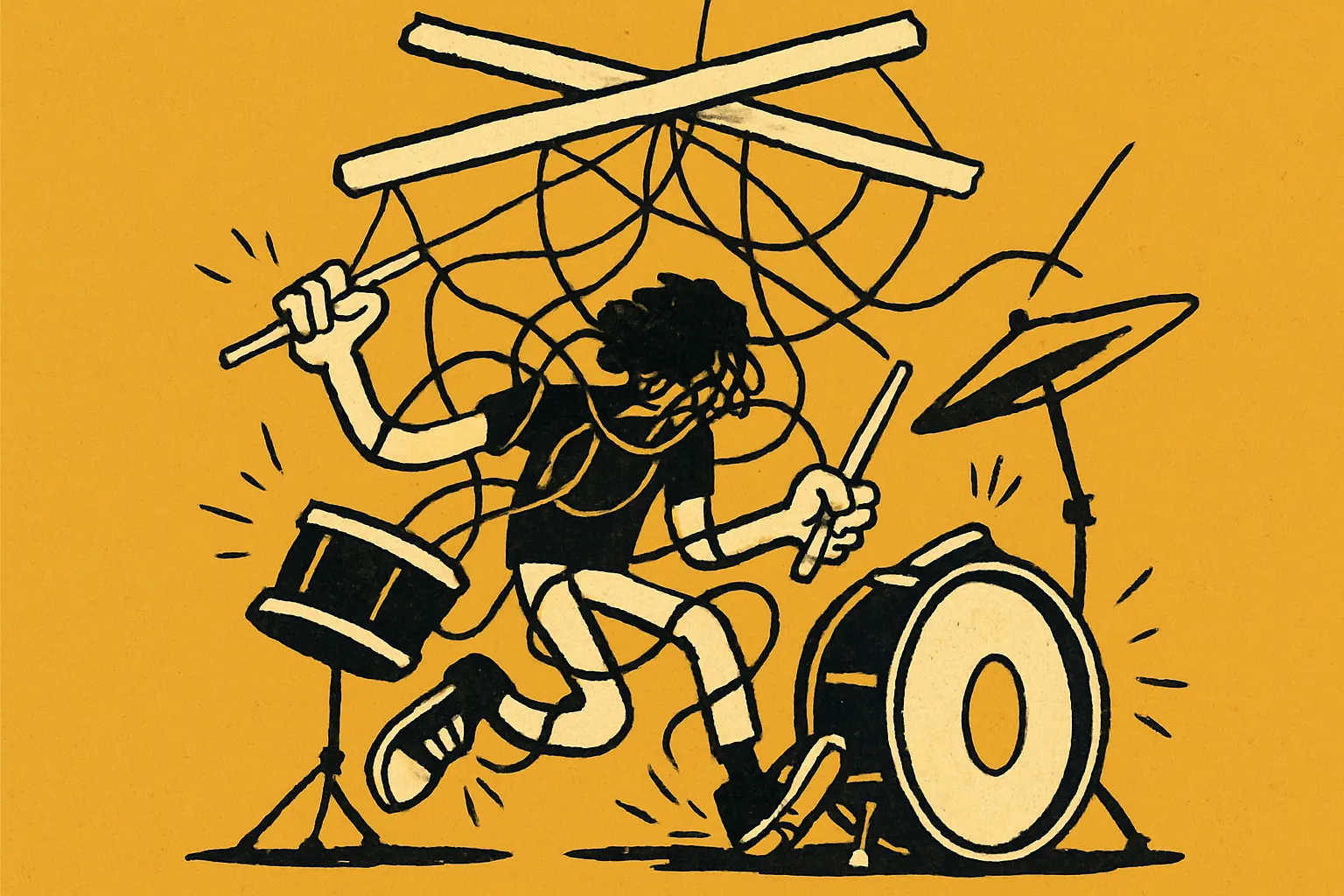
Which of these sounds like you?
Independence problems don't all come from the same place. Find the version that matches what happens when you sit down.
One limb copies another — often your left foot mimicking your right hand.
This is called sympathetic movement. If your hi-hat foot stomps every time your right hand hits, that pairing is the thing to check first, not your groove as a whole. Cross-lateral tapping (below) targets it.
The kick vanishes as soon as your hands get busy — or your hands stall when the kick moves off the beat.
This suggests the limbs are still fused into one gesture. Layering may be the bottleneck: isolate each part, lock the hands as your foundation, then add one limb at a time.
It works slowly, then falls apart above a certain speed.
This suggests the pattern isn't automatic yet at that tempo. If you can't play it cleanly and calmly, you're practising too fast. Speed is a reward for control, not a substitute for it — drop the tempo until the mistakes disappear, then creep back up.
Your snare hand and kick are supposed to land together, but you hear two sounds.
A flam, a ghost note, or a slight lag points you to which pairing to check. That's a unison-accuracy issue rather than a whole-groove issue.
Your left foot does nothing at all.
If the hi-hat pedal hasn't had a job, that foot hasn't had a chance to build any independence. It needs its own patterns — quarter notes, 8th notes, off-beats, hi-hat splashing, double strokes — before it can sit under a beat you already know.
Your shoulders are up by your ears and your arms feel tight.
Physical tension in the shoulders, arms and wrists slows movement and creates unwanted extra motions, and it can be part of what throws hand/foot coordination off. Breathe deeply while you warm up, stay loose, and sit upright but comfortable. Sometimes the coordination is fine and the tension is what's breaking it.
More than one of these can be true at once. Pick the one that matches what you hear often and start there.
Targeted fixes
For sympathetic movement (limbs copying each other): get away from the kit and do cross-lateral tapping. Tap your right hand on your left knee and your left hand on your right knee. Then uncross and tap your own knees. Alternate crossed and uncrossed. Once that's steady, add your right foot while the hands are crossed and your left foot while they're uncrossed. You can also just rehearse patterns mentally or tap them on a table — away from the kit there's nothing to focus on but the rhythm.
For fused limbs: use the layering method. Play each limb's part on its own until it's boring and easy. Lock the hands as the foundation and loop them until they run without thought. Then add one limb at a time, very slowly, with a metronome. Loop the same two-bar phrase until it stops feeling like thinking, then nudge the tempo up.
For a lazy left foot: work the five fundamental hi-hat foot patterns — quarter notes, 8th notes, off-beats, 8th-note splashing, double strokes — then bolt them onto beats you already play.
For weak feet in general: it's easy to drill rudiments with your hands and skip the feet entirely. Take single strokes and double strokes to the bass drum pedal and build the same dexterity down there.
For unison accuracy: start at 60 BPM and focus on your left hand and right foot landing as one single sound. A ghost note or a lag can point to the pairing that needs work.
One drill: if the kick disappears when your hands get busy
This is the layering starter, and it serves that one branch — the crossed-limb and hi-hat-foot problems need their own drills above.
- Set a metronome to a quarter-note pulse. Start at 60 BPM. If that's messy, drop to 50. There's no speed you have to prove here.
- Layer one: right hand plays quarter notes on the hi-hat. Nothing else. Loop it until it's dull.
- Layer two: keep that hand going and add bass drum on beats 1 and 3. Loop two bars. Don't move on while you're still thinking about it.
- Layer three: now alternate your hands — right, left, right, left — on the hi-hat or snare, while the bass drum holds steady quarter notes.
- When any layer gets sloppy, go back one step or take the tempo down. Only raise the click once the current speed feels calm.
Keep it this plain on purpose. The goal is two limbs that stop arguing, not an impressive groove.
Common mistakes
- Practising at the speed you want to play, not the speed you can control. If it isn't clean and calm, it's too fast.
- Running the full groove over and over instead of breaking it down. This can give your brain little chance to separate the parts.
- Only drilling your hands. Feet need rudiments too.
- Adding accents and dynamics too early. Get the limbs placed correctly first, then shape the sound.
- Practising with your shoulders clenched. Tension can undo work you've already done. Reset your posture and breathe.
- Moving on the moment it works once. Loop it until it stops feeling like thinking — that's where it tends to start holding up in a song.
Related
- Timing and counting basics — the foundation under all of this
- Why do I speed up when playing drums? — if tempo control is the part that slips
- Why can't I count while playing? — when the counting drops out before the limbs do
- Building a practice routine — how to fit layering work into a short session