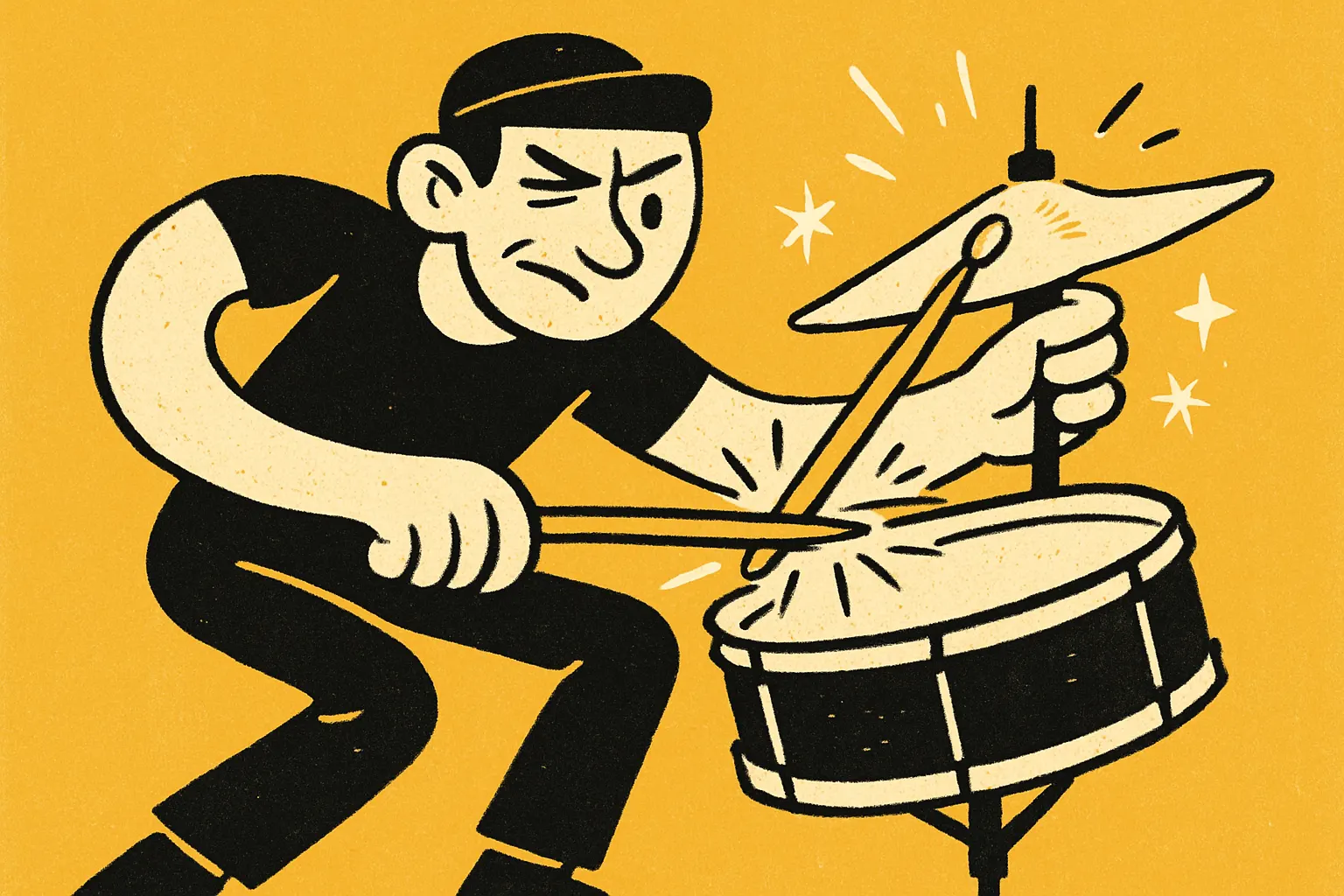
What This Sound Is Actually Called
If you've ever wanted to look this up and didn't know the word for it, here it is: it's called a sting. Stings are short musical or drum phrases used to punctuate a moment — in comedy and cabaret settings, that moment is often the punchline of an obviously bad joke. You'll also hear it called a comedy punchline rimshot or a joke stinger. All three names point at the same three-part sound.
In writing, many people spell it "ba dum tss." That's a common version, but plenty of people write "badum-pshh," "ba-dum-CHING," or "ba-dum chsh" instead. None of these is more "correct" than another — they're just attempts to spell a drum sound using letters, and the differences often come down to which cymbal gets hit for the last part.
How to Play It on a Drum Kit
Here's the basic version, broken into three hits:
- "Ba" — one hit on the snare drum.
- "Dum" — a second snare hit, played as a rimshot (stick hits the drumhead and the rim of the drum at the same time). This is what gives the sound its sharp, cracking punch instead of a plain snare hit.
- "Tss" — immediately after, hit a crash cymbal and grab it with your hand (or the other stick) right after striking it, so it cuts off short instead of ringing out. That choked, clipped cymbal sound is the "tss."
The timing is quick — all three hits happen close together, right on the punchline, not spread out like a drum fill. If you're working this out on a kit for the first time, start slow and separate the three hits in your head before you try to rush them together. A regular pair of drum sticks is all you need — no special stick required, since the rimshot is about hand technique, not equipment.
Different Ways to Play the Same Joke Sting
There isn't just one "correct" way to play this. Drummers demonstrate a handful of variations, and the difference often comes down to the last hit:
- Crash cymbal, choked — the classic "tss," short and clipped.
- Hi-hat, opened briefly then closed — gives more of a "chick" or "ching" ending, closer to "ba-dum-CHING."
- Splash cymbal — a smaller, quicker cymbal sound if you have one, giving a lighter ending.
- China cymbal, choked — a trashier, more clattery ending some drummers use for extra comic effect.
None of these is wrong. The three-part rhythm (two snare hits, then a cymbal) is the constant part; the exact cymbal choice is where drummers put their own spin on it.
Practicing the Timing Without a Full Kit
You don't need to be near a full kit to work out the hand pattern. A practice pad is enough to drill the two snare hits and the rimshot technique — you just won't have the cymbal cutoff to practice on that surface. If you're working this out at home and don't want to wake up the house, an electronic drum set lets you play the full three-hit sting, cymbal choke included, through headphones instead of out loud.
If you're practicing on an acoustic kit and plan to hit the crash more than once while you dial in the choke technique, a pair of ear plugs is worth having nearby — a crash cymbal at close range is loud even for a single hit, and you'll likely be repeating this one a few times to get the timing right.
Common Mistakes
- Spreading the hits too far apart. The sting is supposed to land tight, right on the joke's punchline — not as a slow three-beat fill.
- Hitting the cymbal too softly. The "tss" needs to cut through, so the cymbal hit should be at least as confident as the snare hits before it.
- Forgetting to choke the cymbal. If you let the crash ring out, it stops sounding like a punchline and starts sounding like you're mid-song.
- Skipping the rimshot on "dum." A plain snare hit there sounds flat compared to the crack of an actual rimshot — that crack is a big part of what makes the sound recognizable.
If You Just Need the Sound, Not the Skill
If you don't actually need to play this on a kit — say, you're editing a video or building a slideshow — there are free downloadable joke drum sound effects and soundboard buttons online that play the sting with one click or tap, plus apps built specifically to play "ba dum tss" from your phone. That's a fine shortcut for a one-off project. But if you're a drummer and want the sting in your back pocket for live moments, it's worth just learning the three hits above — it takes very little practice once you've got the rimshot down.