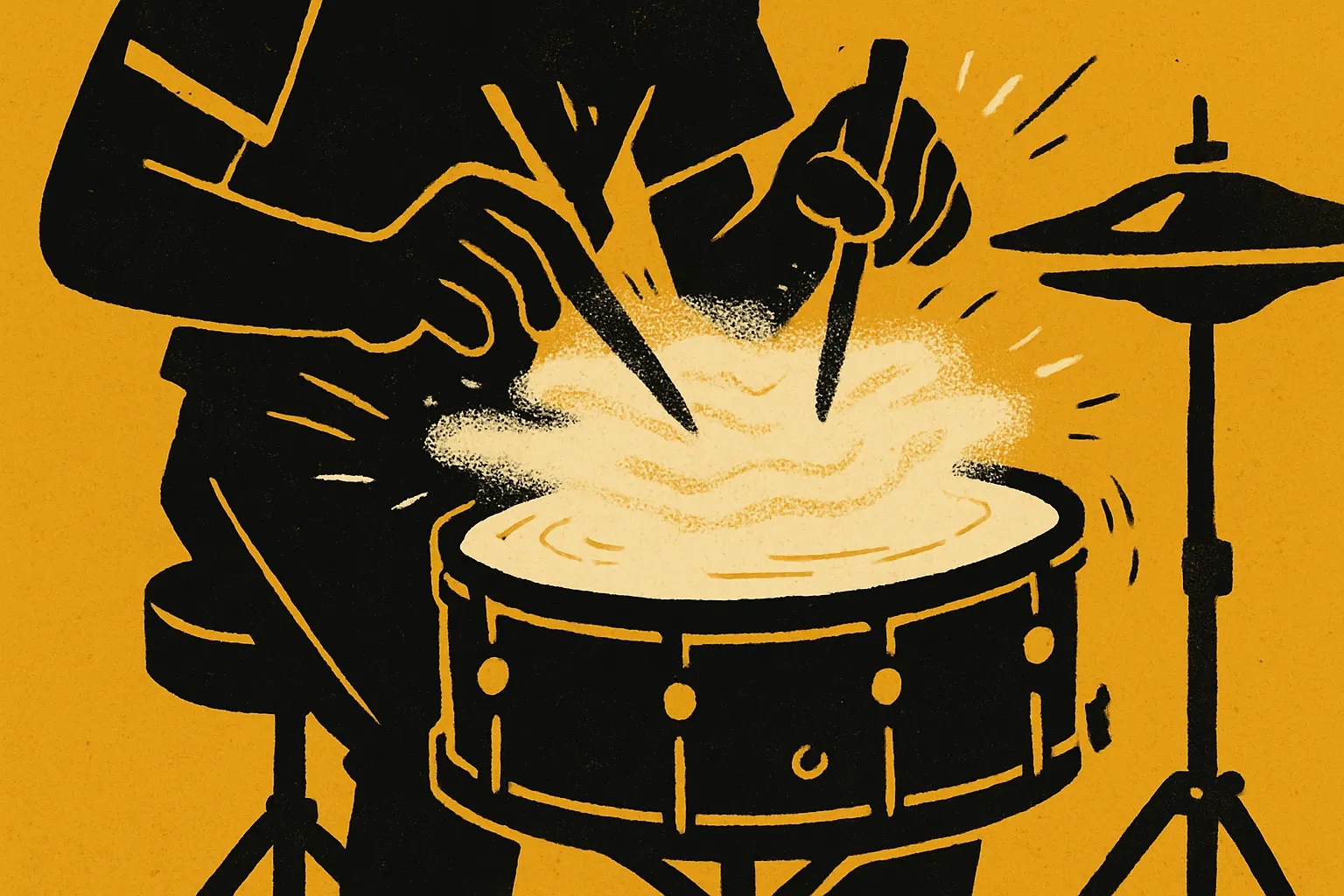
Why it sounds like a blur instead of separate hits
When strokes land close enough together in time, your ear stops hearing them as individual events and starts hearing them as one continuous sound — similar to how a fan's blades blur into a circle once they spin fast enough. A drum roll uses that same idea. The faster and more even the strokes, the smoother the blur.
The three basic types of rolls
Drummers often mean one of three things when they say "roll," and they sound a little different from each other:
- Single stroke roll — alternating hands, one stroke per hand movement (R-L-R-L). Played slow, it sounds like a simple pattern. Played fast, it becomes the classic even, driving roll sound.
- Double stroke roll — two strokes per hand before switching (R-R-L-L). This lets each hand rest slightly between pairs, so it's often easier to sustain at higher speeds once you've built the bounce technique.
- Buzz roll (press roll) — you press the stick into the head slightly so it bounces multiple times on its own per stroke. This is the smoothest, most "blurred" sounding roll of the three — it's what you often hear under a drumline cadence or a suspense build before a cymbal crash.
All three can end up sounding similar at speed, but the buzz roll is the one built specifically to sound continuous rather than pulsed.
How to play a basic single stroke roll
Start slow — there's no speed you need to prove here.
- Hold your sticks with a relaxed grip, not a death grip. Tension is a big part of what makes a roll sound choppy.
- On a practice pad or snare, alternate R-L-R-L at a slow, even tempo — count "1-2-1-2" if it helps.
- Once that's steady, gradually speed up. Keep listening for evenness, not speed. A slower, even roll sounds better than a fast, wobbly one.
- As you speed up further, the individual hits should start to blur together into that continuous buzz sound.
If it falls apart above a certain speed, that's a sign the pattern isn't automatic yet at that tempo — slow back down and build up again rather than forcing it.
How to play a buzz roll
A buzz roll uses a different motion: instead of a clean single stroke, you let the stick bounce (buzz) several times after it hits.
- Drop the stick onto the head with a little extra downward pressure, rather than a normal clean stroke.
- Let the tip bounce on its own a few times before lifting off — you're not controlling every bounce individually.
- Alternate hands, overlapping each hand's buzz slightly with the next so there's no gap between them.
- The goal is one continuous texture, not a series of distinct buzzes.
This one takes some feel to get right, and it's fine if it sounds more like a scrape than a buzz at first — that's part of learning the stick control.
Common mistakes that break the "roll" sound
- Uneven spacing — if one hand is slightly late or early, the blur breaks and you hear individual hits again.
- Gripping too tight — tension kills bounce and makes every stroke sound flat and separate.
- Rushing to full speed — a roll that starts fast and messy rarely smooths out on its own; build it up gradually instead.
- Losing volume control — many rolls are meant to swell (get louder) or fade, not stay one flat volume the whole time.
Want to hear a reference before you try?
If you want to hear what a drum roll sounds like before attempting one yourself, free sound-effect libraries online have large collections of drum roll audio clips you can listen to. They vary quite a bit in tone and intensity from clip to clip, since some are recorded on real drums and others are electronic or produced for a specific effect — so treat them as a general reference for the sound, not a technique guide.
If you're practicing on an electronic drum set, a pair of headphones makes it much easier to actually hear whether your roll is blurring smoothly or still sounding choppy.

