Which of these sounds like you?
Read these and pick the one closest to your experience. More than one can be true at the same time.
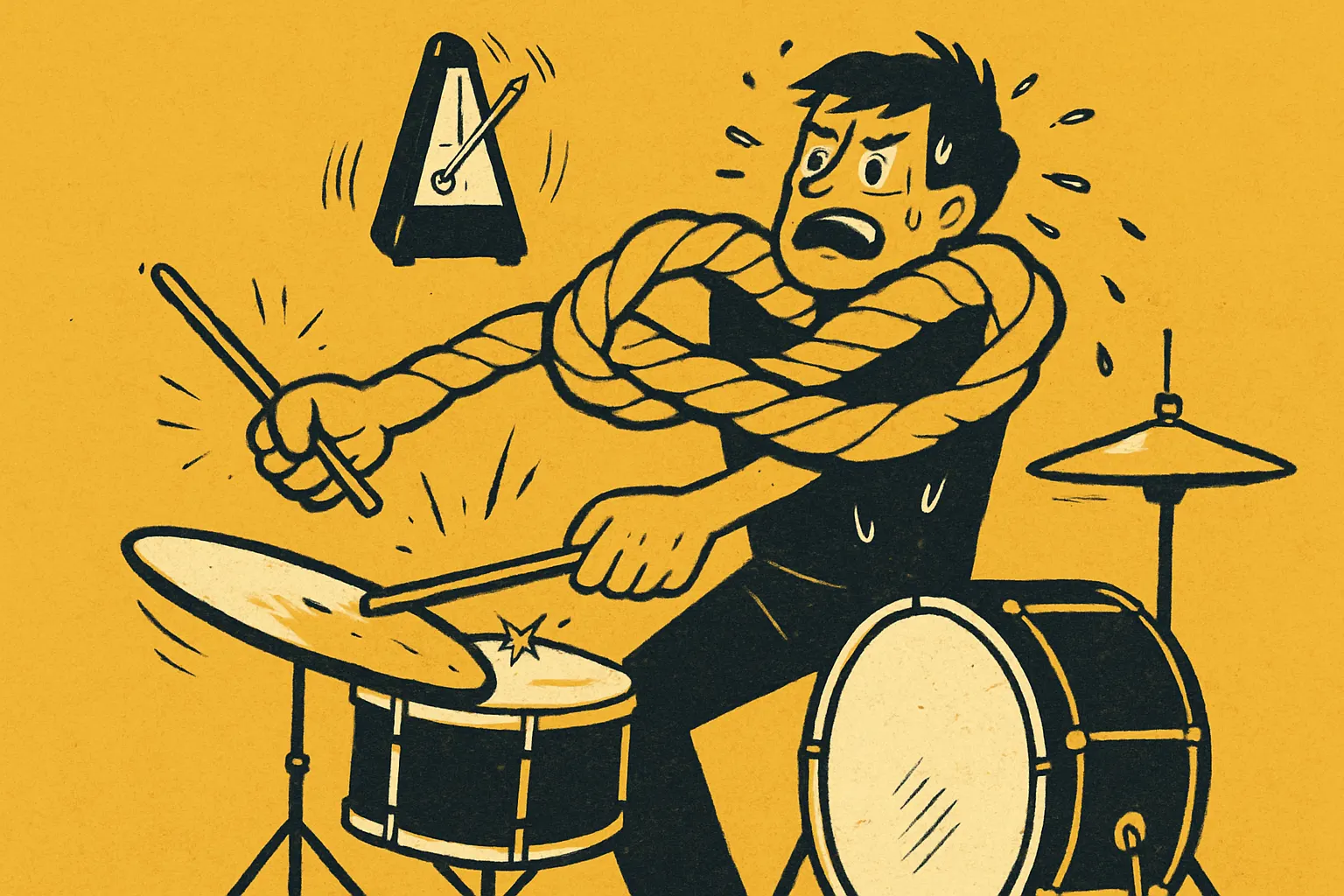
Your hands cramp, your forearms get sore, or your knuckles go white.
Start by checking grip and tension. A grip that's too tight, or one that uses awkward angles, restricts the stick's natural rebound and forces your muscles into strenuous positions — tension travels from fingers through wrists, arms, shoulders and back. If you see white knuckles or feel a death grip, that's the signal to drop the tempo and refocus on relaxing rather than pushing through.
You feel like you're lifting the stick for every single hit.
Rebound may be the bottleneck. Speed comes from controlling how the stick bounces back off the head, not from picking it up and throwing it down again with force. If every stroke is a separate act of lifting, you're doing far more work than the tempo needs.
Single strokes are okay but fast rolls or doubles stall out.
This suggests looking at finger control first. It's common to lean on the wrists and arms and leave the fingers out of it. Fingers can push and pull the stick in a bouncing motion, and that's especially useful for fast rolls.
Your arms are swinging in big motions.
Check economy of motion. Big movements take longer than small ones. Use only the movement needed to make the sound you want.
Your hands are fine, but the pattern breaks above a certain BPM.
This points more at familiarity than physical speed. If a groove is smooth at 80 and chaos at 95, the pattern may not be automatic yet at 95 — you're still thinking each note through. The fix is reps at a tempo where it stays clean, not more effort at the tempo where it doesn't.
You lose the beat only when you add a fill.
That's a different problem from speed. See freezing during fills.
You drift faster without meaning to.
That's tempo control, not speed capacity. See why do I speed up?
The fix for tension and grip
Loosen the grip and loosen the shoulders. Keep a small gap at the fulcrum — the point where your thumb and index finger contact the stick — so the stick can rebound freely. Don't squeeze.
Then practice slowly with one single goal: don't tense up at all. Not "play this cleanly," not "get a bit faster" — just stay loose. Once you can play a pattern without tension or cramping, speed tends to follow.
Whenever your movement turns tense, lower the BPM. That's not a step backwards; it's the whole method. Recording yourself can also help — playback can make things easier to notice than they are while you're playing, including timing, dynamics, and whether you're holding your breath.
The fix for rebound
Change what you're paying attention to. Instead of thinking "lift, hit, lift, hit," watch how the stick bounces off the surface and let that bounce do part of the next stroke. Focusing on rebound is one of the more effective ways to build relaxation into your playing.
Hold the sticks loosely enough that they rebound freely off heads and cymbals. If a stick feels dead in your hand, you're probably gripping it too hard for it to move.
The fix for finger control
Do it in isolation before you try to use it in a groove. On a practice pad, hold the stick with your thumb and index finger, keep your other fingers loose, and use those fingers to push and pull the stick in a bouncing motion. Small taps. Increase the speed gradually.
This is fiddly at first, which is normal. It's a new movement, not a stronger version of one you already have.
One drill: the relaxed-hands check
If tension is where you lose it, try this. It's boring on purpose.
- Set a metronome to 60 BPM. If that feels rushed or your hands stiffen, drop to 50. There's no speed you have to prove here.
- On a practice pad or snare, play steady quarter notes — one hit per click — alternating hands: right, left, right, left.
- Your only job: stay loose. Small gap at the fulcrum. Shoulders down. Let each stick bounce back on its own.
- Every 8 bars, do a check: knuckles white? Forearms burning? Holding your breath? If yes, stop, shake your hands out, and restart slower.
- When you can hold it with no tension for a couple of minutes, move to steady eighth notes — two hits per click — at the same tempo.
- Only raise the tempo when the current one stays relaxed. When tension shows up, come back down.
You're not training speed directly. You're training the loose, rebound-driven stroke that speed needs.
Common mistakes
- Pushing through the burn. Sore forearms and a death grip are the cue to slow down, not to try harder.
- Only ever practicing at your top speed. If every rep is at the tempo where you fall apart, you're rehearsing falling apart.
- Squeezing harder as the tempo climbs. It feels like more control. It restricts the rebound you need.
- Skipping the pad. Finger taps and relaxed strokes are easier to isolate on a practice pad than in the middle of a groove.
- Treating "can't play fast" as one problem. Tension, rebound, finger control and pattern familiarity are separate things, and pushing the tempo up doesn't address any of them.
- Raising the tempo by big jumps. Small increases keep you in the zone where you can still stay relaxed.
Related
- Timing and rhythm basics — counting and pulse, if the pattern itself is the problem
- Why do I speed up when playing drums? — for drifting faster without meaning to
- Freezing during fills — if fills are where things break down
- Building a practice routine — how to fit slow, relaxed reps into regular practice