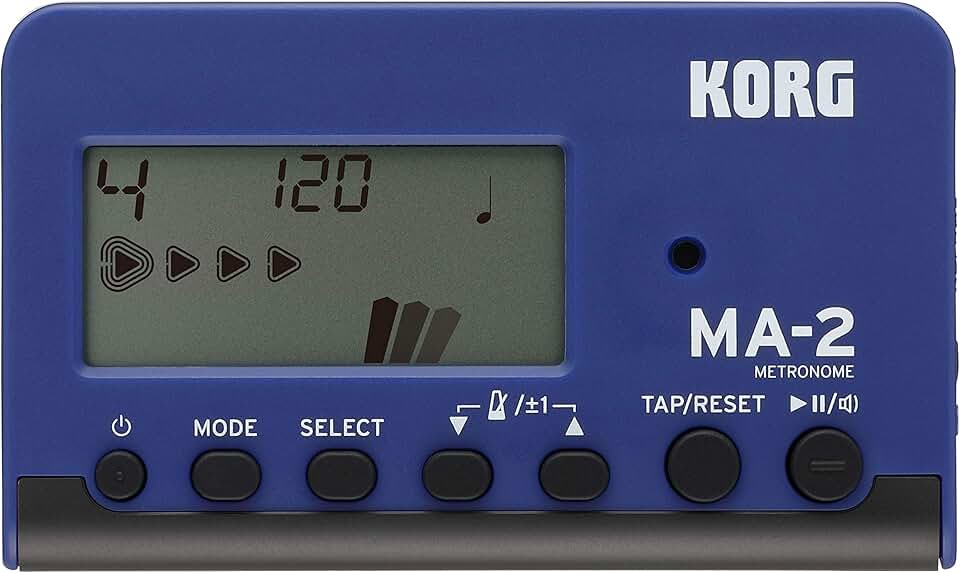
You improve your timing by practicing with a metronome, counting out loud while you play, and recording yourself so you can hear what actually happened instead of what it felt like. Start simple — single notes on the click, then add complexity. Then take the click away and see if the pulse holds on its own.
That last part matters. Timing isn't just "can you follow a click." It's building an internal sense of pulse you carry with you. The metronome is how you check it and train it, not a crutch you play with forever.
Why your timing feels fine but sounds off
Here's the frustrating part nobody warns you about: you can feel locked in the groove while you're playing and then hear the recording and find your timing wandered. That gap between how it feels and how it sounds is normal, and it's the whole reason recording yourself is so useful.
When you're playing, your attention is busy with limbs, sticks, and what comes next. It's easy to smooth over drift in the moment. Playback doesn't do you that favor. It just plays back what you did.
If you're stuck on full songs, timing is one of the things worth checking — it can be what's holding a whole tune together more than any single fancy technique.
Step 1: Learn the pattern first, then add the click
Don't try to learn a new beat and lock it to a metronome at the same time. That's two hard jobs at once.
Get the notes familiar without the click. Play the pattern slowly until your hands and feet know where they're going. Then turn the metronome on and see whether it lines up. This order makes the click a test of something you already know rather than an extra thing to fight.
Step 2: Start with single notes, not grooves
Before a full beat, do this:
- Set the metronome to 60 BPM. If that feels rushed, go to 50 — there's no speed you have to prove.
- Play one quarter note on the snare (or a practice pad) with each click. Just right hand.
- Listen for the click disappearing underneath your hit. When your stick lands right with the beep, you stop hearing the beep as a separate sound.
- Now alternate hands — right, left, right, left — still one note per click.
- Only then add the kick, then the hi-hat, then a full groove.
Adding complexity in that order helps you see which layer broke it when something falls apart.
Step 3: Count out loud while you play
Counting out loud is one of the simplest timing tools you have, and it's easy to skip because it feels silly. Do it anyway.
For a basic rock beat, count "1 and 2 and 3 and 4 and" as you play eighth notes on the hi-hat. Say it at a normal speaking volume — not muttered.
Why this helps: your voice is out in the open. If your counting starts speeding up or getting uneven, you hear it right away. And if you can't say the count while playing the pattern, the pattern isn't automatic yet.
When you're working on 16th notes, count "1-e-and-a 2-e-and-a" so you can hear where each note sits.
Step 4: Break hard rhythms into small pieces
When a rhythm won't sit in time, it can be too big to swallow whole. Break it down.
- Take one bar, not eight.
- Take one hand, not both.
- Play just the kick pattern against the click, then just the hands, then combine.
- Slow it right down. Slower than feels necessary.
A fill that keeps landing early? Play only the last note of the fill and beat 1 that follows it, over and over, until that landing is solid. Then add the notes before it back in.
Step 5: Record yourself
Your phone is enough. Record a 60-second loop of one groove with the metronome running, then listen back.
What to listen for:
- Are your hits sitting on the click, or slightly before or after it?
- Does the groove drift when you change something — a fill, a crash, a kick variation?
- Are your hi-hat notes evenly spaced, or is one hand slightly late?
This is uncomfortable at first. Do it anyway. Playback can make drift easier to notice than it is while you're playing.
If you use recording software, you can go further: record one part, then record a second part over the top. Overdubbing can expose timing inconsistencies between takes — small differences that are hard to catch in a single pass.
Step 6: Alternate click on, click off
This is the test that shows whether the pulse holds on its own or is being borrowed from the metronome.
- Play a groove with the click for four bars.
- Mute the metronome (or turn the volume down) and keep playing the same groove for four bars.
- Bring the click back in.
- Did you still line up?
If you come back in and the click has moved relative to you, that's useful information — not failure. It shows where the pulse drifts when you're holding it yourself. Many metronome apps have a "mute bars" or "gap click" feature that does this automatically.
This is one way to build that internal pulse: by having to hold it yourself, then checking the answer.
Step 7: Vary the subdivision against the click
Once single notes on the click are comfortable, keep the metronome at the same tempo and change what you play against it:
- One note per click (quarter notes)
- Two notes per click (eighths)
- Four notes per click (16ths)
- Three notes per click (triplets — count "1-trip-let 2-trip-let")
Go back and forth between them without changing the tempo. Switching subdivisions cleanly suggests you're feeling the pulse underneath rather than just reacting to each beep.
A harder version for later
Once that's easy, you can set the click to sound on fewer beats — for example, only on beats 1 and 3 instead of all four. You have to supply the missing beats yourself. Save this one until basic grooves feel solid; it's a strengthener, not a starting point.
Step 8: Play along to real music, in different styles
A metronome gives you a grid. Songs give you feel.
Play along to actual tracks, and deliberately pick different styles — a straight rock song, a shuffle, a funk tune, something with a slow tempo you have to hold. Playing across styles can build feel that sticking to one style doesn't.
For practicing along to music, decent headphones for electronic drums let you hear the track clearly over the kit. On an acoustic kit, you need the music loud enough to hear over the drums, which is where proper ear plugs for drummers or isolating headphones earn their money.
You can practice timing without a kit
Some of this doesn't need drums at all. You can clap or count along to a click while you're sitting on the couch. You can tap quarter notes on your leg and count "1 and 2 and 3 and 4 and" out loud.
A practice pad and a pair of beginner drum sticks cover a lot of the hand-timing work at almost no volume — handy if you live with people or in an apartment. Timing lives in your head more than your hands, and your head is portable.
A 15-minute timing practice block
Use this as-is or adjust it:
- 3 min — Single notes on the click at a slow tempo. Right hand, left hand, alternating.
- 4 min — One groove with the click, counting out loud.
- 3 min — Click on for four bars, click muted for four bars. Repeat.
- 3 min — Subdivision switching at one tempo: quarters, eighths, 16ths, back down.
- 2 min — Record one take of your groove and listen back.
Do this a few times a week rather than one long session. Reps over time are what move timing, and there's no shortcut around that.
Common mistakes
Setting the tempo too fast. If you can only just play the pattern, it's hard to also monitor whether you're in time. Drop the tempo until you have attention left over.
Only ever playing with the click. The metronome shows you the grid, but it can also hide the fact that you're reacting to each beep instead of feeling the pulse. Turn it off sometimes.
Never recording. Feel and reality can disagree. Without playback you're guessing.
Counting in your head instead of out loud. In your head, the counting can quietly bend to match what your hands are doing. Out loud, it doesn't.
Skipping straight to full grooves and fills. Single notes on a click sound boring, and they're where a lot of the accuracy comes from.
Treating drift as proof you have no rhythm. Drifting can be information about where the pattern isn't automatic yet. That's a practice target, not a verdict.
Fighting an uncomfortable setup. If you're stretching to reach a pedal or perched too low, your body spends attention on balance instead of the beat. A stable drum throne at the right height removes a variable.
What to do next
Pick one thing from this page and do it today. If you haven't recorded yourself, do that — it can tell you a lot in a short time. If you haven't played with the click muted for a few bars, try that next.
Timing builds slowly and unevenly. Some weeks nothing seems to change, then a groove you struggled with suddenly sits still. Keep the reps going.