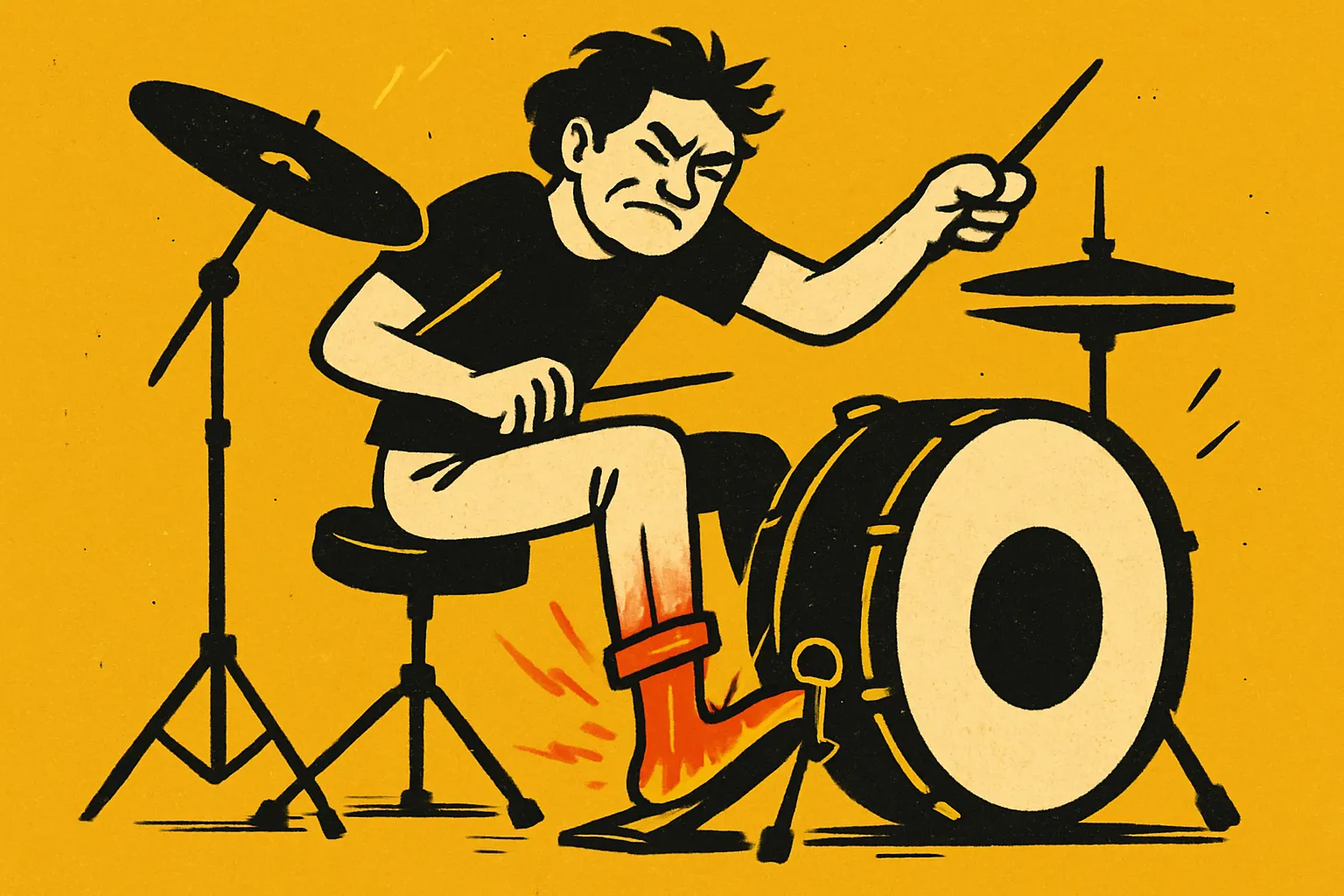
The two main foot techniques: heel-down and heel-up
Basic bass drum foot technique falls into two main camps.
Heel-down. Your heel stays dropped onto the footboard the whole time. The motion comes mostly from your ankle, like tapping your foot to music. It's quiet, controlled, and easy on a light touch — good for soft playing and for feeling the pedal.
Heel-up. Your heel lifts off the board and you play on the ball of your foot, with the leg driving down into the pedal. Heel-up is a common technique on the kick pedal, and it tends to give more power and speed.
Drummers also use variations on those two: flat foot, swivel, and heel-toe. You don't need any of them yet. Pick heel-up or heel-down, get comfortable, and add the fancier stuff later if a specific song demands it.
Many beginners end up on heel-up because it's louder and feels more natural once the leg relaxes. But if heel-down feels better on your kit, use it. There's no rule that you have to switch.
Where to put your foot on the pedal
Foot placement varies a lot between drummers. Some play high up on the footboard with the whole foot on it, some sit toward the middle, some play near the bottom of the board.
One approach that works well: put your toes on the part of the footboard closest to the drum — the top — and let your leg generate most of the movement. High on the board gives you more leverage from the pedal, which means less work per note.
Try all three positions for a minute each at a slow tempo. Whichever one lets you play twenty quarter notes without your leg tightening up is the one to keep.
Where the stroke actually comes from
Think of the stroke as push down, then retract. You push down with the whole leg to drive the beater into the head, then pull the leg back to reset. That's the basic leg-to-ankle motion, and it's what gives a kick note its weight.
The catch: using the whole leg for every stroke can become a limitation at faster tempos. There's only so quickly a whole leg can go down and come back up. That's why drummers often blend leg drive with ankle motion — the leg sets the position and the power, the ankle handles the quick, small strokes.
For now, at beginner tempos, whole-leg strokes are fine. Just know that if you hit a wall where the notes won't come fast enough, the fix may not be "push harder" — it may be letting the ankle take over some of the work.
Tension: the real reason the leg quits
On heel-up, some beginners hold the leg hovering in a braced, half-flexed position the entire song. That means the leg is working even between notes. It's a tiring way to play, and it's easy to do without noticing.
A few things to try:
- Let the weight of your leg rest into the pedal between strokes instead of holding it up in the air.
- Don't crush the beater into the head. You can hold the beater against the drum (buried) or let it come back off, and both are valid choices for different sounds. But if you're squeezing your leg into the pedal to keep it buried, that's constant effort with no extra volume.
- Check your volume expectations. A kick doesn't need to be stomped. Play a groove at a comfortable medium volume and notice how much less it costs.
Also check your seat. If your throne is too low, your thigh angles up and your leg has to lift more to reach the pedal; too high and you lose stability. Aim for a height where your thigh runs roughly level or angles slightly downward toward the knee, with your heel able to reach the footboard without stretching. A wobbly or sagging seat makes this harder than it needs to be — if yours is a folding stool that came free with the kit, a proper drum throne is one of the better early upgrades.
A slow routine to build the motion
This one is simple on purpose. Set a metronome to 60 BPM. If that feels messy, drop to 50 — there's no speed you have to prove.
- Both feet together. Kick and hi-hat pedal striking at the same time, one hit per click, for a minute. This gets both legs used to the same push-and-retract motion.
- One foot at a time. Play four strokes with your right foot, then four with your left, alternating. Then try groups of eight per side.
- Add the hands. Quarter notes on the hi-hat with your right hand, kick on beats 1 and 3. Nothing else.
- Two kicks in a row. Kick on 1, and again right after 1 (count "1 and"). This is where whole-leg strokes can start feeling slow, so keep the volume down and let the motion get small.
Do this for five minutes at the start of a practice session rather than thirty minutes once. Watch your leg while you play — if it's tensing between notes, stop, shake it out, and restart slower.
If you're on an electronic kit or a quiet setup, you can run the same routine with your hands on a practice pad so the focus stays on the foot.
Common mistakes
- Stomping for volume. Volume on the kick comes more from beater speed and a clean stroke than from body weight.
- Never resetting the beater. If your foot doesn't retract, the next note has nowhere to come from and the pattern stiffens up.
- Practising only at the tempo you want. Slow reps build the motion; fast reps mostly expose it.
- Blaming the pedal too early. Plenty of stock pedals work fine for beginner grooves. That said, spring tension is adjustable on many pedals, and a spring cranked very tight makes each stroke harder work — try loosening it a little and see how it feels. If your pedal is genuinely loose, rattly, or sticking, a beginner-friendly bass drum pedal will make practice less annoying.
- Switching techniques every session. Heel-up one day, heel-down the next, flat foot on Friday. Pick one for a few weeks so your foot can actually learn something.
What to focus on this week
One technique, one foot position, one slow routine. Play a basic groove — hi-hat quarter notes, kick on 1 and 3, snare on 2 and 4 — at 60 BPM for two minutes without your leg tightening. When that's boring, speed it up by 5 BPM. The kick is one of the core parts of the kit, and a lot of the beats you'll want to play run through that foot, so time spent here pays off across everything else.