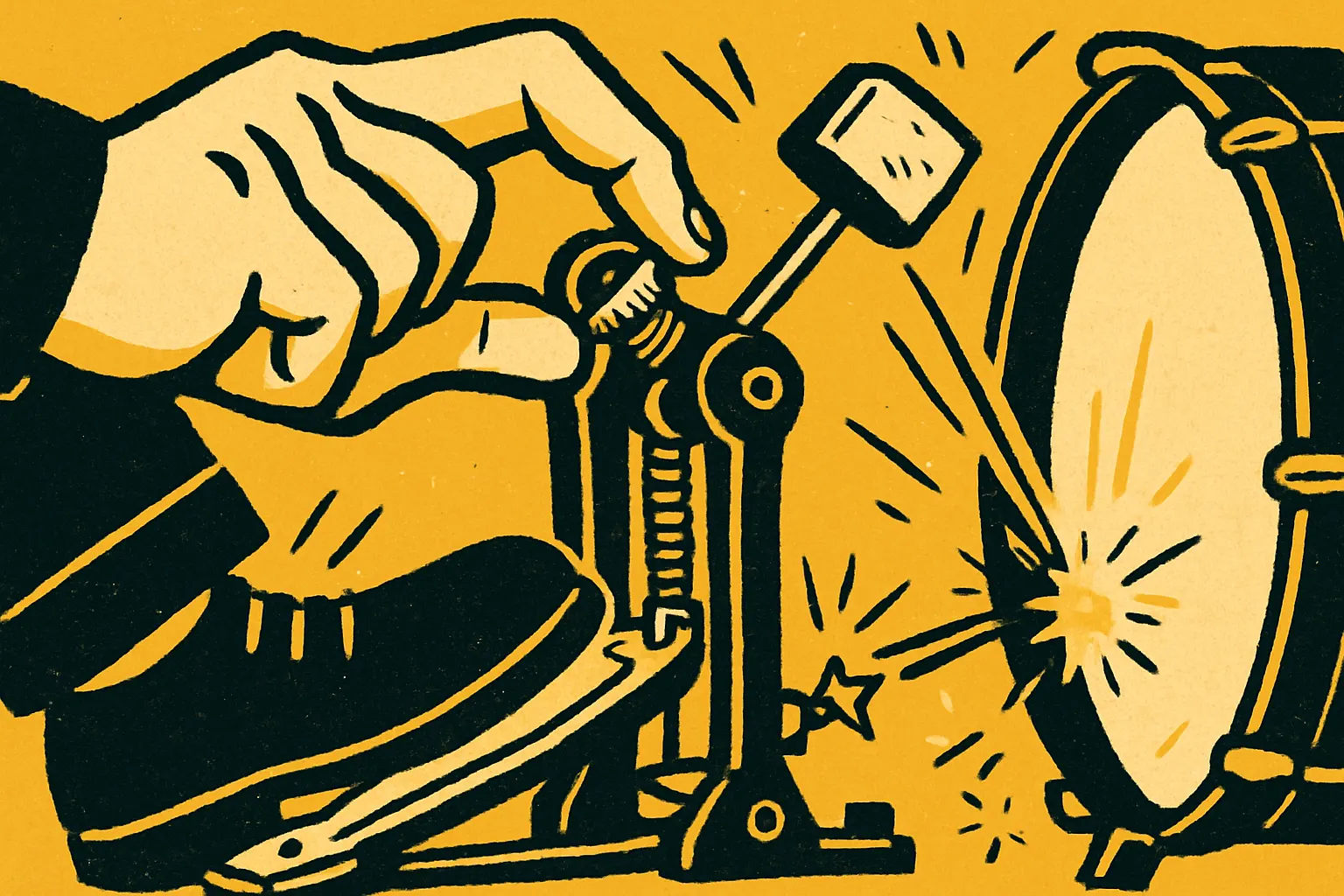
Before you touch anything
Check your pedal's manual first. Pedals differ more than they look — some use a coil spring, others use cable or strap systems, and thread sizes vary. The manual tells you which parts on your pedal do what, and which key fits.
Depending on the screws on your model, you'll need a drum key (the square one) or a small Allen wrench.
One habit that saves frustration: before you loosen anything, note where it currently sits. That way you can put it back if the change feels worse.
Which of these sounds like you?
Different complaints point at different parts of the pedal. Find the one that matches what you notice.
"The beater feels stiff and heavy under my foot" — or the opposite, floppy and slack. This suggests checking spring tension first.
"The beater sits too far from the head" or looks like it's already touching it before I play. This suggests checking beater angle and distance first.
"The beater hits low on the drum, or up near the hoop" — not in the middle of the head where you want it. Start with beater height.
"The whole pedal creeps or wobbles while I play" — check the hoop clamp before you change anything else, and check the pedal is seated properly under the drum.
"My foot feels like it's reaching too far to get a hit" — beater distance from the head may be the bottleneck. Some pedals have a slotted stroke adjustment that changes that distance too.
"The pedal feels fine, but my kick still lands in the wrong place" — that points at playing rather than hardware, and it needs a different fix. Nothing on the pedal will place the note for you. See why you speed up or counting while you play.
A symptom can have more than one cause at once, so treat these as places to look, not verdicts.
Beater height
This sets where the beater strikes the head.
- Loosen the square key or Allen screw on the beater stopper.
- Slide the beater up or down in its holder to the position you want.
- Tighten the beater holder first, then tighten the beater stopper.
Aim for the beater striking somewhere around the middle of the head rather than low on the shell or up against the hoop.
Beater angle and distance from the head
On many pedals, a small screw on the right side of the pedal moves between several holes — that screw sets the beater's angle and how far it starts from the head. Newer pedals often use a rocker hub instead, which gives infinitely variable positions rather than fixed holes.
On pedals with a cam:
- Loosen the square or Allen bolt on the beater angle adjustment cam.
- Move it a small amount.
- Re-tighten.
Keep the changes small. If you move the angle too far in either direction, the beater stops reaching the head at all — so tiny adjustments, then test.
Direct-drive pedals have no central cam, but you can still set beater angle using the square key bolt on the beater angle adjustment cam.
Spring tension
Tighter spring means more resistance under your foot; looser means less. Which one you prefer is personal, so change it in small steps and play a bar or two after each one.
On a typical two-nut pedal:
- To increase tension: loosen the upper tension nut, then tighten the lower nut.
- To decrease tension: loosen the lower nut, then tighten the upper nut to lock the setting in place.
On other spring designs:
- Loosen the knurled nut at the base of the spring.
- Pull down on the spring tension nut underneath the ear of the base casting.
- Tighten or loosen it to taste.
- Lock the setting by tightening the knurled nut above the ear.
If your pedal uses a cable or strap system instead of a coil spring, go by the manual — the parts aren't the same.
Hoop clamp
If the pedal shifts while you play, the clamp gap may not match your bass drum hoop.
- With an Allen wrench, loosen the set screw on the knurled nut above the clamp.
- Turn the nut to widen or narrow the clamp gap so it fits your hoop.
- Re-tighten the set screw.
If the pedal feels wrong, try this before you change anything else
This one is for the "stiff or floppy under my foot" branch — a slow, honest feel check.
Set a metronome to 60 BPM. Drop to 50 if that's messy. There's no speed you have to prove here.
- Play steady quarter notes on the kick only — one hit per click, nothing else.
- Do that for eight bars, then stop and notice one thing: does your foot feel like it's fighting the spring, or like the beater is falling through with no support?
- Make one small tension change in the direction you want.
- Play the same eight bars again and compare.
Repeat until it stops bugging you. One change per test, or you won't know which change did what. If your quarter notes are landing unevenly, that's likely a separate thing from how the spring feels — don't try to solve it with a wrench.
Common mistakes
- Changing spring tension and beater angle at the same time. Then you can't tell which one helped. One variable per test.
- Big angle moves. Too much movement either way stops the beater reaching the head. Fine adjustments only.
- Forgetting to lock the setting. On two-nut and knurled-nut designs, the second nut is what holds your setting. Skip it and the setting can drift while you play.
- Guessing at the parts. Pedals use different spring types and thread sizes. The manual is faster than trial and error.
- Trying to fix a playing problem with hardware. If your kick pattern falls apart when it gets busier, coordination may be the bottleneck, and a pedal tweak won't cover it.
- Never touching the pedal at all. A beater sitting way off the head or a clamp that doesn't grip your hoop are both easy fixes that you can do in a minute.
Related
- Timing and counting basics — the groundwork under every kick pattern
- Why do I speed up when I play?
- Why I can't count while playing
- Building a practice routine — where to put slow kick work