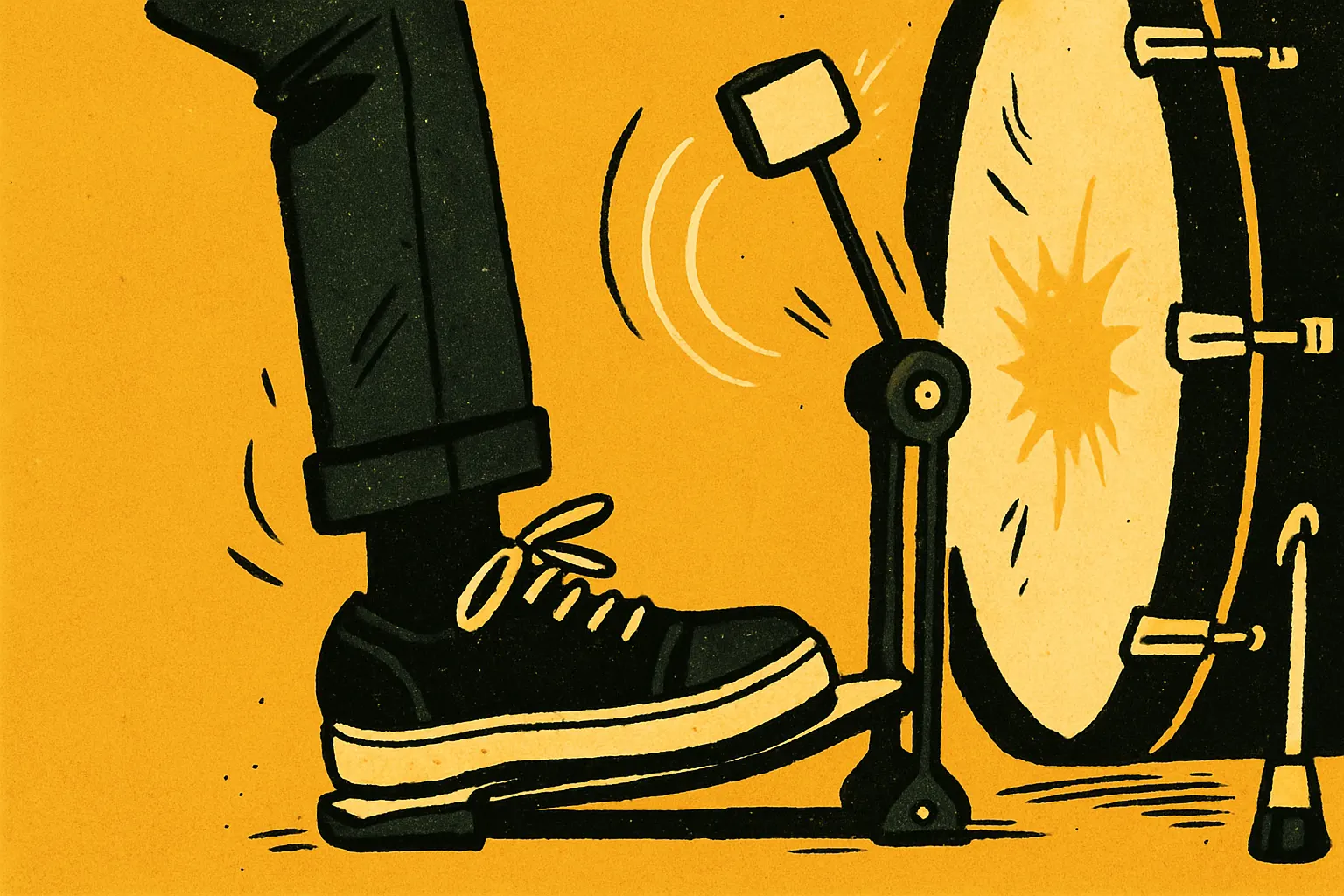
Check the setup before you blame your foot
- Angle the bass drum slightly rather than parking it dead straight in front of you. A slight angle lets your right leg sit in a more natural line instead of twisting at the hip.
- Check it from the throne, sitting down. Standing over the kit tells you nothing. Sit as you'd sit to play, put your foot on the pedal, and see whether your leg is comfortable, whether your heel reaches the back of the footboard, and whether your knee is doing something odd.
If your throne is wobbly or too low to let your legs settle, that can show up in how your kick feels. A stable seat at a height you can repeat matters more than the pedal you own — see our beginner drum throne picks if yours came free with the kit.
How it feels at first (this part is normal)
Your kick foot will feel dumb compared to your hands. Notes come out uneven, some are loud and some barely speak, and the moment your hands play something new your foot forgets the pattern. That's coordination, not a verdict on your ability. Early on, aim for consistent kick notes at a slow tempo rather than fast or loud ones.
The three techniques you'll meet first
Three kick techniques are commonly taught to beginners. They're not levels — they're tools, and plenty of drummers switch between them depending on what they're playing.
| Technique | How it works | Why use it |
|---|---|---|
| Heel-down | Whole foot stays flat on footboard, heel stays down, push with toes | Good starting point — you feel every bit of what the pedal is doing |
| Heel-up | Heel lifts off footboard, strike with ball of foot, more ankle/leg motion | Often described as giving the most power and speed, but can hide sloppiness |
| Flat foot | Foot stays flat-ish, motion comes mostly from the ankle, no committed heel-down anchor or full heel lift | A real technique if it feels good and notes come out even |
Heel-down
Your whole playing foot stays flat on the footboard. Your heel stays down, your knee stays fairly still, and you push your toes down to move the pedal. Because the foot never leaves the board, you feel every bit of what the pedal is doing, which is why it's a good starting point.
How to do it:
- Sit at the throne with the ball of your foot roughly over the middle of the footboard and your heel resting on the back of it.
- Press down with your toes and let the beater move to the head.
- Release and let the board come back up under your foot. Don't stomp — press.
- Play slow quarter notes and listen for four notes that sound the same.
Heel-up
Your heel lifts off the footboard and you strike with the ball of your foot, using more of your ankle and leg. This is a very common approach and is often described as giving you the most power and speed, which is why many drummers move to it once the basics feel steady. The trade-off is that it can be easier to hide sloppiness — big leg motion can mask uneven notes.
Flat foot
A middle option: the foot stays flat-ish and the motion comes mostly from the ankle, without a committed heel-down anchor or a full heel lift. Some drummers land here naturally and never think about it. If it feels good and your notes are even, it's a real technique, not a mistake.
Where on the footboard should your foot sit?
This varies, and it changes how the pedal feels. Drummers play high up on the board (near the top, closer to the beater), toward the middle, or lower down. Higher up generally feels lighter and quicker; lower down feels heavier and more powerful. There's no correct spot to prove — try all three positions for a minute each at a slow tempo and keep the one where your notes come out most even.
What about swivel and heel-toe?
You'll see these mentioned online. Swivel rocks the foot side to side, and heel-toe gets two notes from one motion (heel then toe). Both are real techniques and both exist mainly to play fast doubles. They're not something to chase in your first months — they're often easier to build once single kick notes are reliable. Bookmark them and move on.
Should you try more than one?
Yes, eventually. Beginners are encouraged to try all the different kick techniques rather than locking into one, because each can feel better for different jobs — quiet steady eighths versus a loud single hit on beat 1, for example. Start heel-down for a few weeks so you learn to feel the pedal, then experiment.
Pay attention to the feedback from the pedal
One thing that's easy to ignore is what the pedal tells your foot. Feedback from the pedal and beater is a key element in developing kick technique — the spring pushing back, the beater bouncing off the head, the board returning under your foot. Instead of only listening for the boom, notice:
- Does the board come back up on its own, or are you fighting it down?
- Does the beater bounce back, or do you press it into the head and hold it there?
- Are you tensing your whole leg to play one note?
Both leaving the beater against the head and letting it rebound are things drummers do on purpose for different sounds. Just make it a choice you can feel, not an accident. If your pedal feels sticky, noisy, or dead no matter what your foot does, the hardware may be the limit — our beginner bass drum pedal guide covers what's worth spending on and what isn't.
A first drill: 3, 6, 9, 12
This borrows a pattern you may already use for your hands — groups of 3, 6, 9, and 12 strokes on each foot.
Start with three "down-tap-ups" on your kick foot: three deliberate strokes, then stop and reset. Then:
- Set a metronome at 60 BPM. If that's messy, drop to 50 — there's no speed you have to prove.
- Play 3 kick notes, rest a bar, repeat. Ten times.
- Move to 6, then 9, then 12, resting a bar between each group.
- Do the whole thing heel-down. Then, if you like, run it once heel-up and notice the difference in feel.
- Repeat it with your hi-hat foot too. That foot needs the same work and rarely gets it.
You're listening for one thing: do all the notes in a group sound the same? If note 7 disappears or gets loud, you've found the tempo to stay at.
When you can't make noise, you can still keep the hands moving on a practice pad — but foot technique needs an actual pedal to give you feedback, so a pedal-plus-pad setup or an electronic kit is what lets you work on this quietly.
Common mistakes
- Stomping. Driving the whole leg down for every note. It's tiring and the notes can come out uneven. Press, don't stamp.
- Skipping the setup check. Fixing your foot while the bass drum sits straight in front of you and your throne is at a random height.
- Practicing kick only inside grooves. Your foot gets a handful of reps per bar. Isolated groups (see the drill) give it far more.
- Playing too loud to hear the unevenness. Volume can hide timing problems. Play softly and the gaps show up.
- Chasing heel-toe early. Speed techniques built on shaky single strokes just make faster mess.
- Assuming one technique is the correct one. Different drummers use different techniques and different footboard positions on purpose.
What to do this week
Sit at the throne, angle the bass drum slightly, and check your leg is comfortable. Run the 3-6-9-12 drill heel-down at 60 BPM (or slower) for five minutes a day, listening for even notes. Then play a simple groove — kick on 1 and 3, snare on 2 and 4, eighths on the hi-hat — and keep the same foot feel you just practiced. Once that's boring, try heel-up on the same drill and compare.
