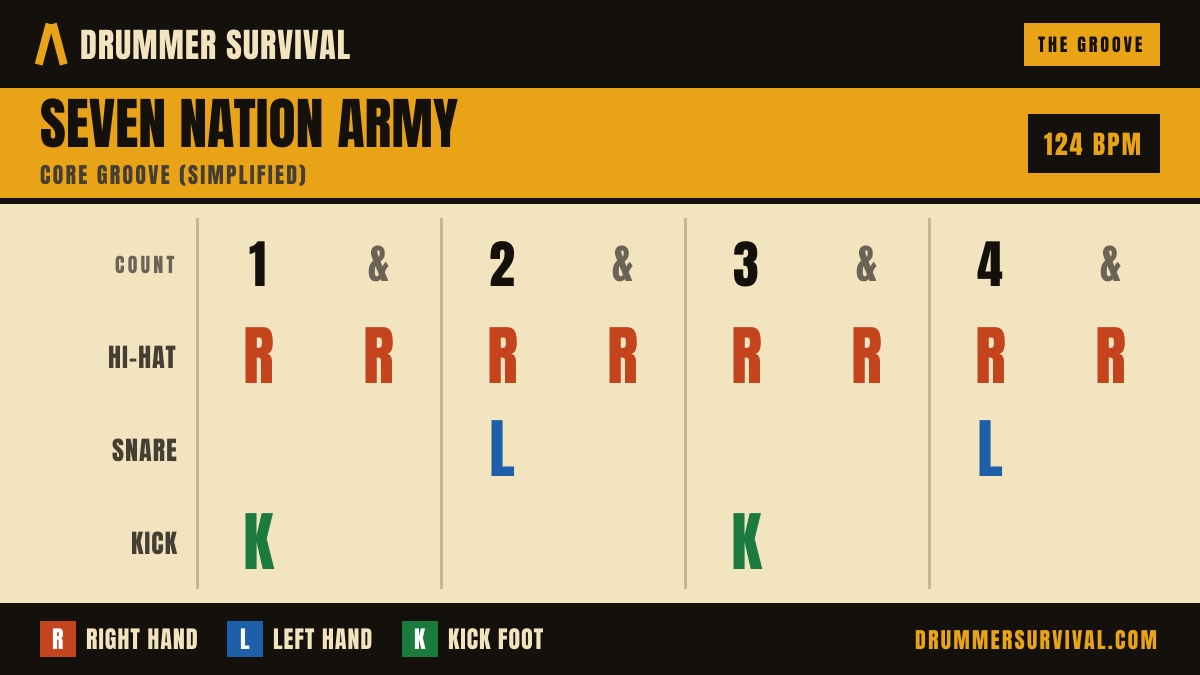
The drum part behind The White Stripes' "Seven Nation Army" is a straight, steady beat: kick on every quarter note, snare on beats 2 and 4, hi-hat ticking eighth notes the whole way through. At 124 BPM it sits at a comfortable walking-to-jogging pace, which is why it's a common first "real song" for new drummers.
The Core Groove
This is a simplified beginner version of the feel — not a note-for-note transcription, just enough to get the stomp going.
Count it as "1-and-2-and-3-and-4-and." Your hi-hat hand plays on every number and every "and." Your kick foot lands on 1, 2, 3, and 4 — a steady four-on-the-floor pulse. Your snare hand cracks on 2 and 4 only. Once your kick and hi-hat feel automatic together, drop the snare in last — it's the easiest part to rush.
Mapping the Song's Sections
- Intro — the famous bass riff plays alone for several bars before drums enter. This is the hardest moment for a beginner: you have to come in on time after just listening, with no groove to lock onto yet.
- Verse — the basic groove above, played a bit quieter to leave room for the riff and vocal.
- Chorus — the same groove, just louder and more driven. There's no need to add extra notes here — dynamics do the work.
- Outro — the groove rides out and fades or stops with the band.
There's no complicated fill work in this song. What separates a shaky take from a solid one is timing and dynamics, not flashy drumming.
The Tricky Part
For many beginners, the beat itself isn't the hard part — it's coming in after the intro riff. You have to count silently through several bars of just bass line and enter exactly on the beat. Practice this separately: play the riff (hum it, or loop it) and practice dropping your groove in on the right beat, over and over, before you worry about anything else.
The second common trouble spot is dynamics: playing the verse noticeably softer than the chorus. It's tempting to play everything at one volume when you're still focused on just hitting the right notes — that's normal early on, but it's worth adding back in once the groove feels automatic.
Common Mistakes
- Speeding up in the chorus — the song feels like it should push, but the tempo doesn't actually change. Keep your hi-hat hand honest.
- Playing everything at one volume — flattens the difference between verse and chorus.
- Adding fills that aren't there — the song's power comes from repetition, not variation. Resist the urge to decorate it.
- Losing the kick pattern once the snare comes in — practice kick and hi-hat alone first, snare last.
A Practice Plan
- Isolate the groove. Play kick and hi-hat only at 80–90 BPM until it feels boring-easy. Add the snare last.
- Bring it up to 124 BPM in small jumps, only moving up once the slower tempo feels solid.
- Practice the entrance. Loop the intro riff and drop your groove in on beat 1, several times in a row, until it's not a guessing game.
- Play along to the actual song with headphones so you can hear where you drift. A practice pad works for the hand pattern away from the kit, and a decent pair of sticks makes the snare crack land cleanly at this tempo.
If you're practicing on an electronic drum set, a good pair of headphones makes it much easier to hear your own timing against the track. Playing along on an acoustic kit at home, a set of ear plugs protects your hearing during longer practice sessions at this volume.
