Why This Feels So Hard Right Now
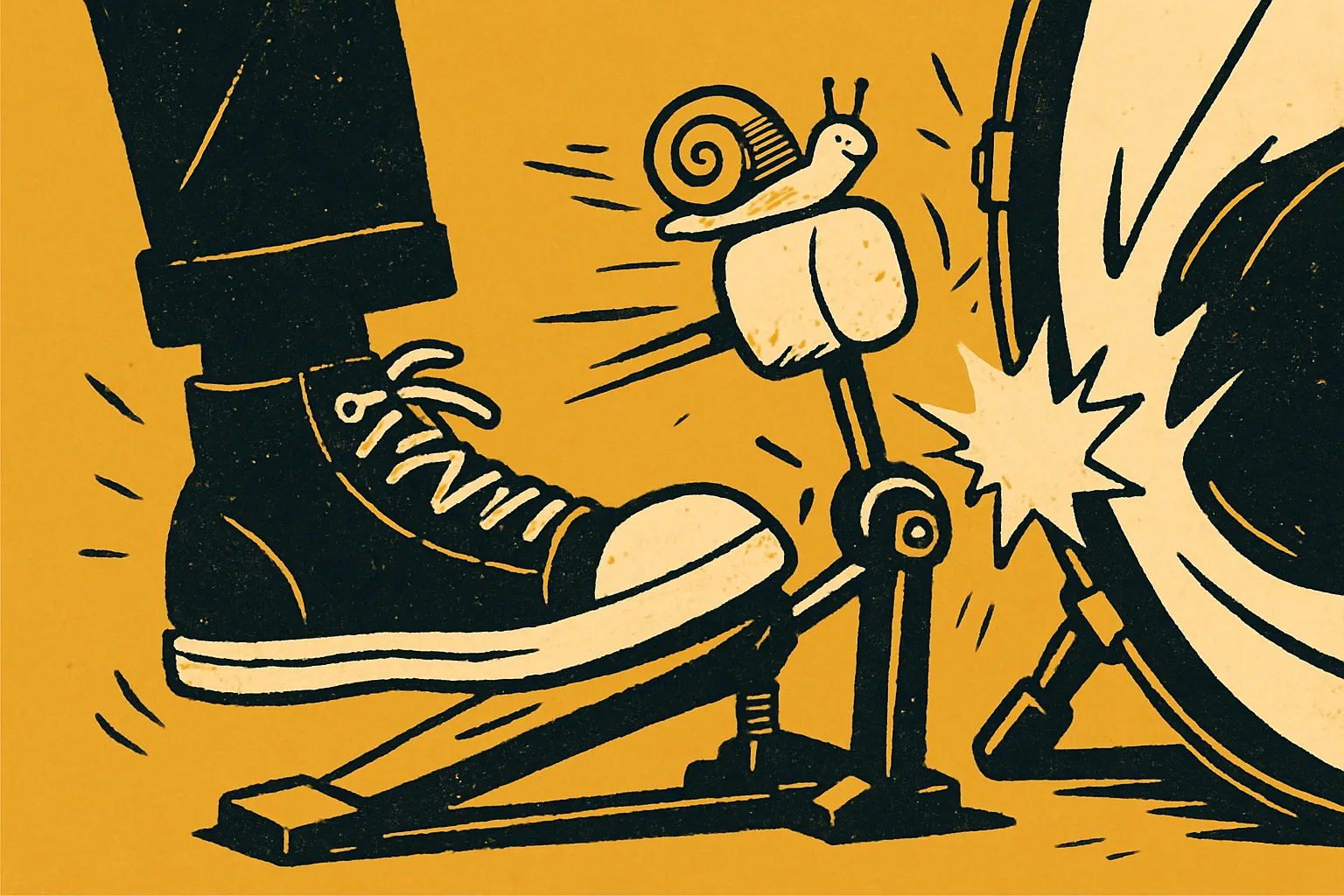
Your foot doesn't have the small-muscle control your hands have. Hands get years of fine motor practice before you ever sit at a kit — feet mostly don't. So when you try to play fast single strokes on the kick, the motion feels stiff, uneven, or like it's fighting you. That's not a sign you lack some natural talent for double bass. It's a sign your foot hasn't built the pattern yet, and that only comes from reps at a tempo you can actually control.
Start Slower Than Feels Necessary
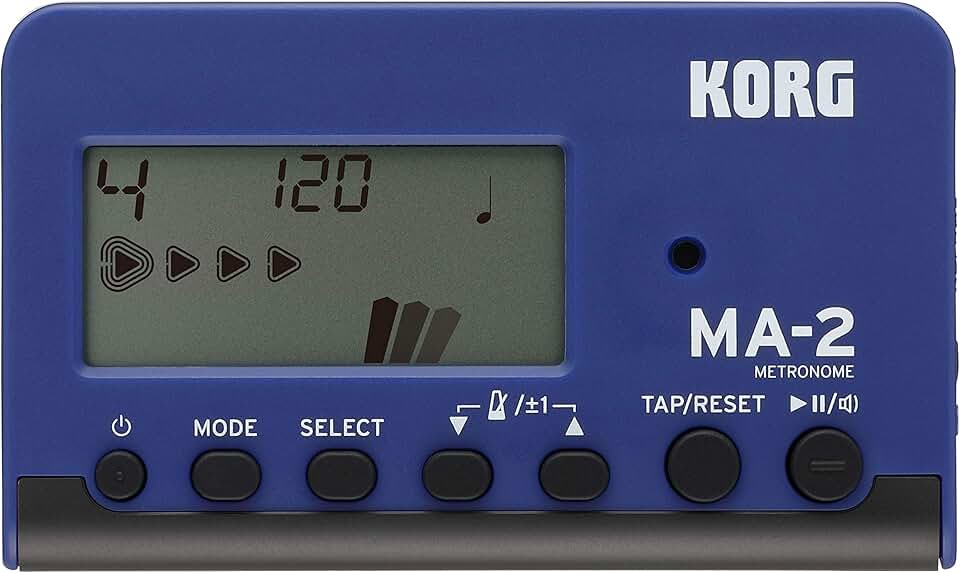
The instinct is to practice near your top speed, because that's the speed you actually want. Do the opposite. Beginners building foot speed should stay around 70 BPM or slower while they focus on precision — even a tempo as low as 68 BPM is a reasonable starting point for control work. At that speed you can hear if one stroke is louder than the other, if your ankle is tensing up, or if your beat is drifting off the click. Fix those things slow. Speeding up a sloppy motion just makes a faster, sloppier motion.
The One Exercise Worth Repeating
You don't need a stack of different foot drills. Real single-pedal speed gains tend to come from picking one simple exercise — like straight eighth or sixteenth notes on the kick alone, to a click — and repeating it consistently, rather than jumping between five different patterns. Pick one pattern. Play it slow. Play it a lot. Increase the tempo only when it's clean, not when you get bored.
Practice Both Feet, Not Just Your Strong One
It's tempting to only drill your dominant foot, since that's the foot doing more of the work in a normal beat. But bass drum workouts are meant to be practiced with both feet, not just the one you favor. Even if you never plan to play double bass patterns, training your weaker foot improves your overall foot control and balance on the pedal.
Your Pedal and Setup Matter Too
Speed isn't only about your foot muscles — it's also about the machine under your foot. Improving bass drum speed involves understanding pedal anatomy and setup (spring tension, beater angle, footboard position) alongside the technique work itself. If your current pedal fights you — too stiff, too loose, or just worn out — that's worth ruling out before you blame your technique. A beginner bass drum pedal that's set up properly for your foot size and playing style removes one variable you don't need to be fighting.
Your seat matters here too. If you're perched too high or too low, your leg angle changes and your foot has to work harder for the same motion. A drum throne at the right height keeps your knee roughly level with your hip, which gives your foot a more natural, repeatable stroke.
Heel-Toe: Getting Two Strokes From One Foot
Once your basic single-stroke speed feels steady, heel-toe technique is the next tool. It lets one foot produce two strokes per motion — a heel stroke followed by a toe stroke — instead of one stroke per foot-lift. This is how a lot of fast single-pedal players get speed without needing a double pedal.
Learn it the same way you learned everything else here: slow, and one foot at a time. Heel-toe exercises should be practiced with each foot separately before you try combining them into a full pattern. Trying to coordinate both feet doing heel-toe together before either foot has it solo can just double the confusion.
Speed vs. Endurance: Two Different Problems
Being able to play a fast burst on the kick and being able to hold that speed through a whole song are not the same skill. Endurance is its own problem, separate from raw speed — it's common for kick technique to get sloppy after roughly an hour of playing songs in the 140–160 BPM range, even for a foot that can hit that tempo cleanly in short bursts. If your foot gives out partway through a song rather than failing on the first hit, endurance may be the issue rather than top speed — and reps at song length are more likely to help than a faster metronome setting.
Practice With Real Songs, Not Just a Click
Once your single-pedal speed feels solid on its own, try this: pick a song you already know that's on the slower side, and play along doubling the bass drum rate against the beat — turning quarter notes into eighths, or eighths into sixteenths. Holding that faster subdivision steady against a real song is a different challenge than holding it against a bare click, and it's a good test of whether your speed actually transfers to playing music.
Keep It Short and Daily
You don't need long sessions to see progress. A short daily routine — around 5 minutes of focused bass drum work — can produce noticeable improvement in speed and control over time. Five focused minutes every day beats one long, tired session once a week, especially for a motion this repetition-dependent.
Common Mistakes
- Chasing tempo before control. If your strokes aren't even at a slow tempo, they won't magically even out at a fast one.
- Only training your strong foot. This limits your overall balance and control on the pedal, even for single-pedal playing.
- Skipping the pedal check. A pedal that's poorly set up for your foot can cap your speed no matter how good your technique gets.
- Confusing endurance with speed. If you fall apart late in a song rather than early, more speed drills probably won't fix it — stamina practice likely will.
- Jumping into heel-toe with both feet at once. Get each foot solid alone first.
If you want a more structured path than trial and error, there are full video lesson series built specifically around improving bass drum speed step by step — worth looking into once you've got the basics above under your foot.