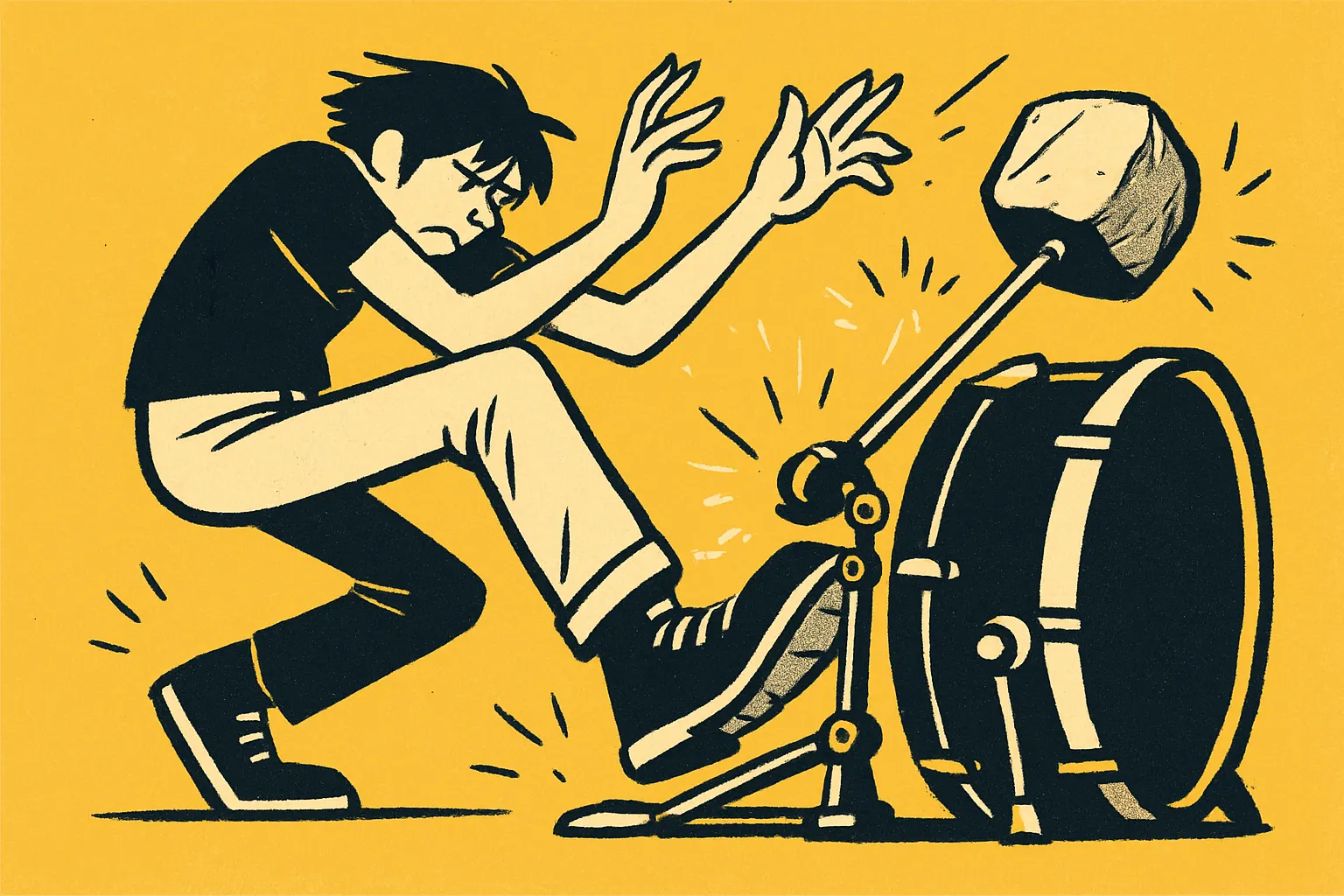
Which of these sounds like you?
Pick the one that matches what happens when you play. A symptom can have more than one cause behind it, so treat these as "check this first", not a verdict.
The beater stays pressed into the head after every note.
This is called burying the beater. It limits you to one note per two movements — one to push the beater forward, one to pull it back. Digging into the head also creates a harsh sound that doesn't let the drum resonate, and it puts more weight than necessary on the pedal, which can compromise your balance. Check your release first: after you strike, lift your foot slightly so the beater can clear the head.
Your leg tires quickly, or your kick volume is inconsistent from note to note.
Combined with a buried beater, that's a reason to check tension before you go hunting for a heel-up-versus-heel-down answer. Staying tense and pressing into the pedal often buries the beater. Check whether you're holding your leg rigid the whole bar instead of making a stroke and letting it release.
You hear your shoe slapping the footboard, or your foot bounces up off the pedal.
Stay in light contact with the pedal instead. If you're coming up off the footboard, slow down and work through the mechanics at a tempo where your foot stays connected.
The pedal itself feels either sluggish or uncontrollable.
Spring tension may be the bottleneck. Higher tension makes the pedal rebound faster but harder to control, and it takes more effort. Lower tension suits playing that needs precision, control, or feathering. Setup is worth checking before you assume the problem is your leg.
Your foot is fine on its own, but falls apart when your hands change pattern.
That suggests checking coordination first. The foot may be capable of the note — it just can't hold it while something else changes. Slowing the whole groove down until all the limbs line up is the place to start.
It only breaks down above a certain tempo.
If the pattern is clean at 70 and mush at 100, the pattern may not be automatic yet at that speed. That's a reps problem, not a talent problem. Practise at the fastest tempo where it's still clean, not the tempo you wish it worked at.
Heel up or heel down?
Both work. One common approach is to start heel-down to develop ankle coordination and control, then move to heel-up once your timing is solid. Heel-down rests the heel on the footboard and moves the pedal by bending at the ankle; because it uses only foot and calf muscles, less power reaches the beater, so it tends to be used for jazz and lower-volume playing. Heel-up is more powerful and is widely used across styles, and for many beginners it feels more natural and gives better access to strength and control.
The mistake to avoid with heel-up is thinking it means holding constant leg tension. Use the leg and the ball of the foot to make the stroke, then let things release. With heel-up, it's also worth hunting for the sweet spot on the pedalboard — the spot where the least effort produces the most continual motion.
Setting up the pedal so it isn't fighting you
Two fine-tuning adjustments matter here: spring tension and beater angle. Beater angle is set by loosening the beater angle cam adjustment. For tension, loosen the upper tension adjustment nut and then tighten the lower nut to increase it; loosen the lower nut and tighten the upper one to decrease it.
To find your setting, try both maximum and minimum tension so you can feel the difference, then set it to medium and adjust from there. A longer beater suits higher tension and a shorter beater suits lower tension, and heel-up works better with high tension than heel-down does.
One drill: relaxed quarter notes, both techniques
If tension and a buried beater are where you're stuck, start here.
- Set a metronome to 60. If that feels messy, drop it lower — there's no speed you have to prove.
- Play plain quarter notes on the kick. Nothing with the hands.
- Keep the leg relaxed and let the beater rebound off the head instead of pressing it in.
- Every two minutes, switch technique — heel-down, then heel-up, then back.
- Work up toward 70 bpm only while the notes stay even and your shoe stays in light contact with the footboard.
The point isn't speed. It's building comfort and control with both techniques while your leg stays loose.
When plain quarter notes feel easy and the beater is rebounding cleanly, a next step is foot-rocking: set the metronome to 8th notes at 65–70 bpm and play groups of two, accenting only the downbeats. Then reverse it and accent only the upbeats, rolling the foot up first and then bringing it down. Done regularly, this can make multiple quick notes easier with less effort.
Common mistakes
- Cranking the spring to maximum hoping for speed. More tension rebounds faster, but it's harder to control and takes more effort — you can end up slower and more tired.
- Pushing the beater in and holding it there. Two movements for one note is a hard way to get fast.
- Treating tiredness as a technique choice. If your leg tires fast and your volume wobbles, look at tension before you switch between heel-up and heel-down.
- Practising at the tempo you want instead of the tempo you have. If your foot bounces off the board, that's the signal to slow down.
- Measuring early practice against fast, syncopated playing. Those take much longer to build.

