Why the name is misleading
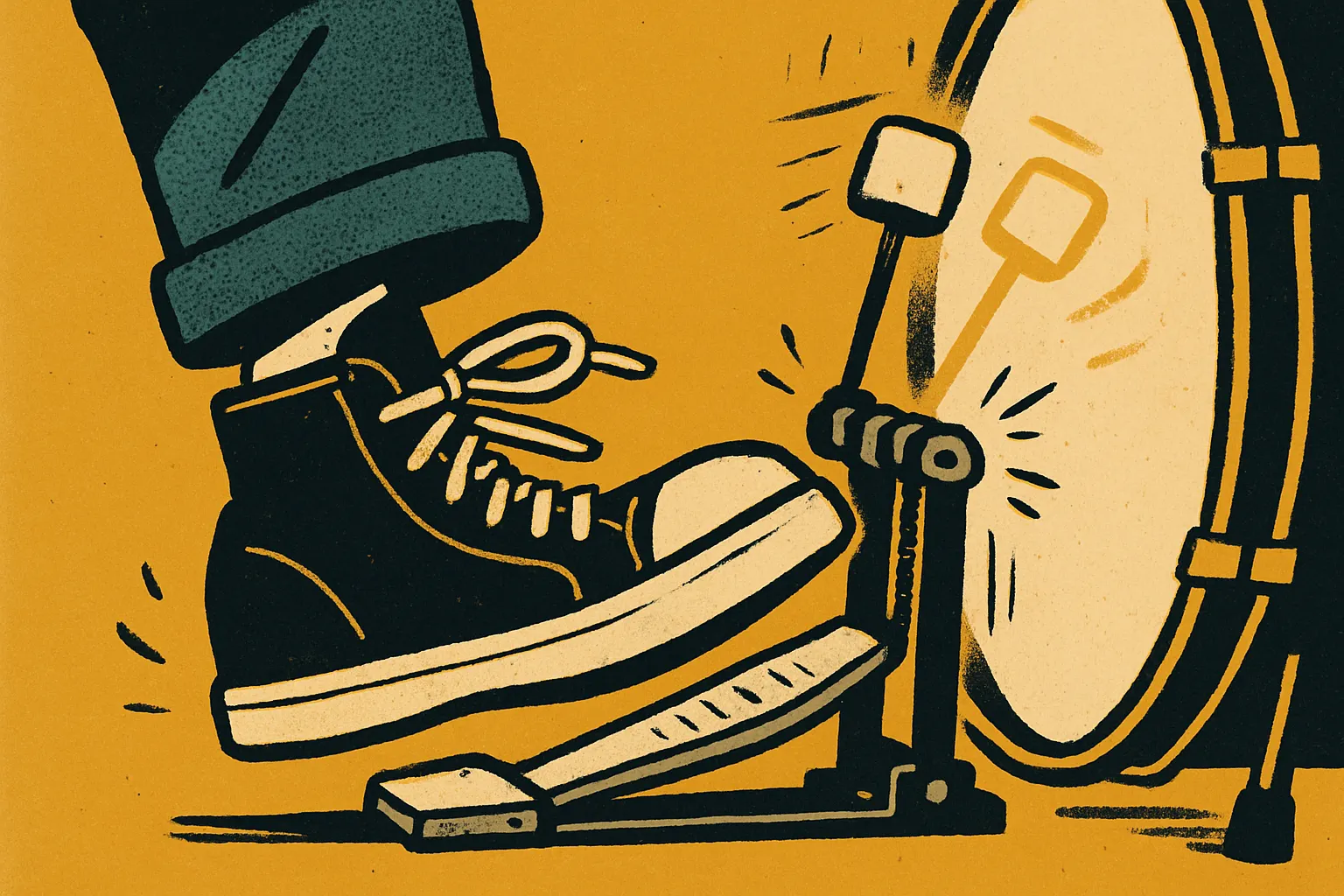
The name describes where your foot is, not what's doing the hitting.
- "Heel" = your foot is flat, heel down on the footboard, as you push the pedal for the first stroke.
- "Toe" = your heel lifts, your weight shifts forward onto the ball of your foot, and your toes deliver the second stroke.
So the first note comes from a flat-footed push of the whole foot. The second comes from the toes/ball of the foot right after. If you try to smack the pedal with your heel bone, you'll get a weak, thuddy note and a sore heel.
Drummers often describe heel-toe as the foot version of the Moeller technique used by the hands — a rocking back-and-forth motion between flat foot and ball of the foot, where one gesture produces two strokes instead of two separate efforts.
What it feels like when you're learning it
Awkward. Then slightly less awkward. Then suddenly the second note appears and you don't quite know how you did it.
Expect these things at first:
- The two notes come out uneven — a loud one and a quiet one.
- Your ankle feels tense and tires quickly.
- It works once, then you can't repeat it.
- It works slowly but falls apart when you speed up.
That's normal for a coordination pattern your foot has never made before. It's a rocking motion, not a stomping one, and rocking motions take reps before they feel like one movement instead of two.
How to do it: a three-step progression
Break the motion into pieces before you try to join them. Work on each step until it's boring, then add the next.
Step 1 — the flat push. Sit with your foot flat on the footboard, heel down. Push the whole foot down so the beater strikes the drum. Don't lift your heel. Just get a clean single note from a flat foot. Play it slowly, over and over.
Step 2 — the toe tap. Now start with your heel raised and your weight on the ball of your foot. Tap the footboard with your toes to get a note. Again, just singles, slow. This is the second half of the pair, on its own.
Step 3 — join them into one rocking motion. Push flat (stroke one), let your heel come up as your weight rolls forward, and tap with your toes (stroke two). Heel down, heel up — one rock, two notes. Say it out loud while you do it: "flat, toe."
Go slow enough that both notes sound the same volume. If the second note is a whisper, one thing to check first is whether you're rolling your weight forward onto the ball of the foot, or flicking your toes with a stiff ankle.
Heel-toe is also one of those techniques that's much easier to understand by watching than by reading. Free video demonstrations of the foot motion are easy to find, and watching someone's ankle rock in slow motion fills in what words can't.
A small exercise
Once you can get two even notes, put them somewhere musical.
- Play a slow, plain beat: hi-hat on every count, snare on 2 and 4, bass drum on 1 and 3.
- Keep it simple and steady. Start at 60 BPM. If that's messy, drop to 50 — there's no speed you have to prove.
- Now turn the bass drum note on beat 3 into a double: heel-toe it, so you get "1 ... 2 ... 3-and ... 4".
- When that's clean, do it on beat 1 as well.
- Only raise the tempo when both notes of the double sound equally loud and land where you meant them to.
One double per bar is plenty of work at first. A row of doubles all the way through a bar is a much harder ask, so don't start there.
Heel-toe on the hi-hat pedal
The same technique applies to the hi-hat pedal, not just the bass drum. That means your left foot can play doubles on the hi-hat — useful for foot-driven hi-hat patterns and for keeping time with your foot while your hands are busy elsewhere. Learn it on the bass drum first if that's where you want to use it, but know the motion transfers.
Common mistakes
- Trying to strike with the heel. The heel goes down, it doesn't attack. The strokes come from the flat push and then the toes.
- Locking the ankle. Heel-toe is a rocking motion. A stiff ankle turns it into two separate stomps, which defeats the point.
- Speeding up before the notes are even. If note two is much quieter, more speed just hides it. Fix the balance slow.
- Practicing it for long stretches while your ankle is burning. Short bursts spread through a session are kinder to your foot than one long grind, and tense practice can lock in tension.
- Sitting in a position that fights you. Where you sit and how high you sit changes how your leg reaches the pedal. If the motion feels cramped, try adjusting your seat height before you blame your ankle — a stable, adjustable drum throne makes that easier to dial in.
- Assuming your pedal is the problem. It might be a factor, but it's often worth putting in reps first. That said, spring tension and beater distance do change how the pedal rebounds, so experiment with your own settings — and if your pedal is badly worn or sloppy, a decent bass drum pedal gives you a more predictable feel to learn on.
Do you need heel-toe as a beginner?
Not to play songs. Plenty of music never asks for fast bass drum doubles, and you can get a long way with plain single strokes. Heel-toe is commonly taught as a beginner topic and it's widely used for double bass drumming speed, so if fast kick work is what pulls you to the kit, there's no reason to wait until you're "advanced" to start poking at it.
Just treat it as a side project rather than your main practice. Your steady time, your basic beats, and your ability to play along with a song will do more for how you sound right now.
If noise is what limits how much you can practice foot technique, an electronic kit with a quiet kick pedal and a set of headphones for electronic drums lets you drill the motion without filling the house with bass drum thumps.

