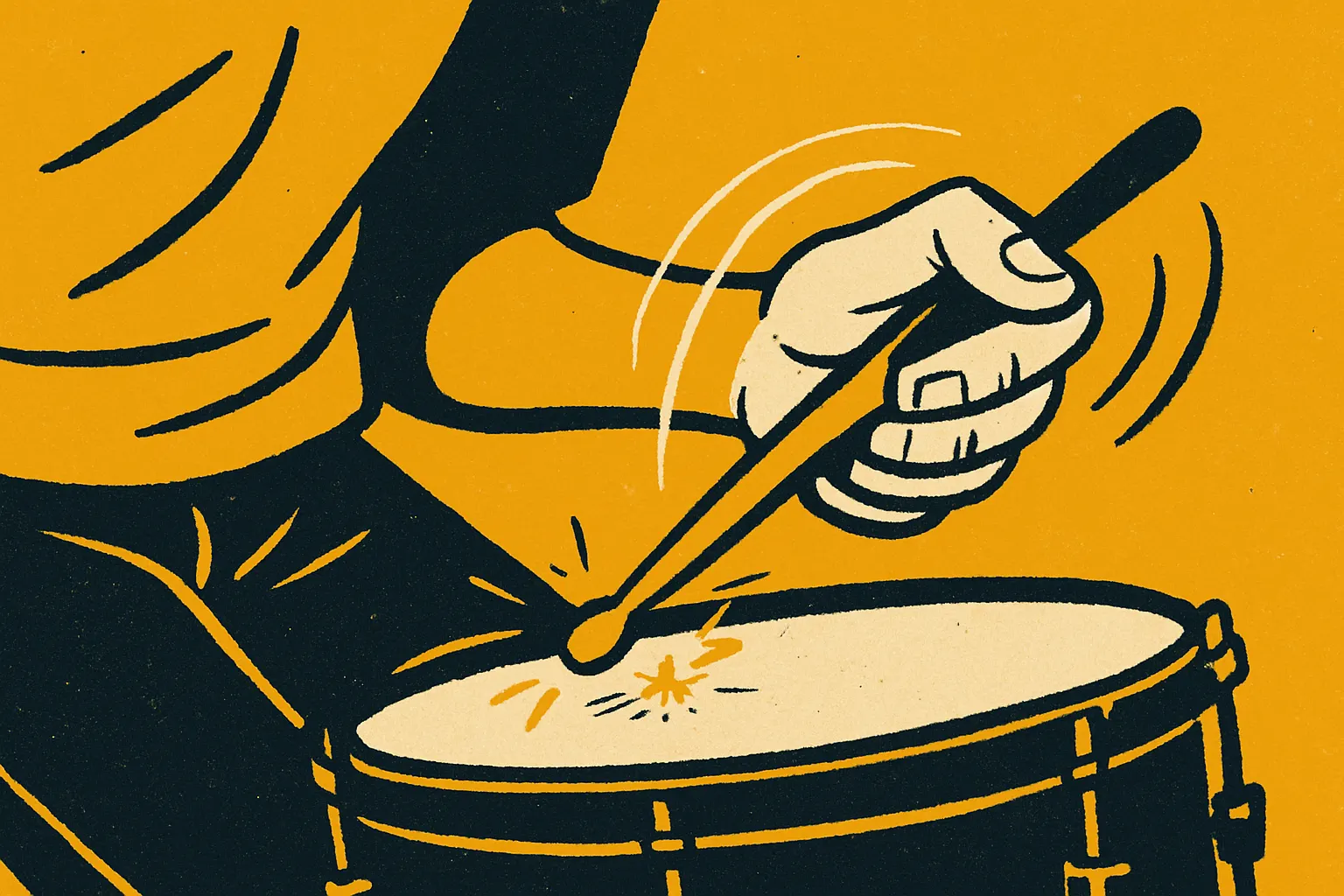
Technique is just the way you move. Dictionaries define it as the manner in which basic physical movements are used — a way of doing an activity that needs skill, and the skill itself, built through training and practice. On drums that means how you hold the sticks, how the stick travels down and back up, how you sit, and how your foot works the pedal. It is not talent, and it is not speed. It is the physical how behind every sound you make.
That matters early because a beat is not only what you play — it is also how you play it. Two people can play the same eight notes and one sounds loose and musical while the other sounds stiff. Often the difference is in the movement, not the pattern.
The word itself (and how to say it)
Say it tek-NEEK, with the stress on the second syllable. It came into English from French, and traces back to Ancient Greek tekhnikos — "relating to art, skilful" — from tekhne, meaning "art, handicraft." So the word points at craft: a practical method applied to a task, the way you'd talk about the technique of watercolour painting.
You may also see technic, a North American variant noun that means the same thing. It's rare in drum talk; stick with "technique."
One more thing worth separating: technique is not technology. Technique is a way of doing a specific activity. Technology is the use of scientific knowledge and methods — often described as the whole sum of techniques, skills, methods and processes behind making something. Your electronic kit is technology. How you strike its pads is technique.
What technique is not
Beginners often hear "technique" and picture blazing fast hands or a drummer doing something complicated. Technique is broader and much more boring than that.
- It's not speed. Speed is one possible result of efficient movement, not the definition of it.
- It's not one correct grip that everyone must use. There are established grips and approaches, and drummers disagree about details.
- It's not advanced. You already have technique right now. It might just be inefficient technique.
- It's not separate from music. How hard you hit, where on the cymbal you hit, whether the stick bounces back — that's all technique, and it's all sound.
The parts of technique a beginner actually deals with
You don't need a full syllabus. In the first months, technique comes down to about five things.
1. Grip. Where your fingers sit on the stick and how tightly you hold. A common beginner habit is squeezing the stick in a fist, which stops it from bouncing. Try holding it firmly enough that it can't fly out, loose enough that it can move. The stick should feel like it's doing some of the work.
2. The stroke and the rebound. A drum and a cymbal both push the stick back at you. Efficient playing tends to use that bounce instead of fighting it. Drop the stick, let it come back, catch it. That's a stroke.
3. Where you sit. Seat height and distance from the kit change everything about how your arms and legs can move. If you're reaching or cramped, movement gets harder. A stable, height-adjustable seat is one of the few pieces of gear that directly affects technique — see our drum throne buyer's guide if you're still sitting on a dining chair or a stool.
4. Your feet. Heel down, heel up, how much of the beater's swing you use — the pedal is a technique problem, not just a leg-strength problem. The pedal's own feel matters too, so a beginner-friendly bass drum pedal can make the motion easier to learn.
5. Moving between drums. Getting from the hi-hat to the snare to a tom without the beat sagging is technique as well. It's often less about the hands and more about planning the move before you get there.
How good technique feels
It mostly feels like less. Less effort for the same volume. Less tension in your shoulders after ten minutes. The stick bouncing back on its own instead of you lifting it. A hit that sounds fuller even though you swung less.
What it does not feel like is instantly comfortable. New movements can feel awkward at first, even when they're more efficient, because your body has already learned the old way. That awkward stretch is normal and it doesn't mean you're doing it wrong.
One honest note: aching, burning forearms or hands are a signal to stop and look at your setup and your grip, not something to push through. Technique work should feel easier over time, not more painful.
A small technique drill you can do today
All you need is a pad or a snare. A practice pad is genuinely useful here because you can hear the stick better when the room isn't ringing, and you can do this on the couch.
- Set a metronome to 60 BPM. If that's messy, drop to 50. There's no speed you have to prove.
- Play one stroke per click with your right hand only. Eight strokes. Watch the stick come back up.
- Do the same with your left hand. Eight strokes.
- Now alternate: right, left, right, left — one per click, sixteen strokes.
- Repeat the whole thing, but count out loud: "1, 2, 3, 4."
Five minutes is plenty. While you do it, pick one thing to watch — grip pressure, or rebound height, or whether both hands sound the same volume. Watching everything at once often means watching nothing.
The hands sounding different is common early on. Your non-dominant hand has fewer reps, that's all.
Common beginner technique mistakes
- Squeezing the sticks. A death grip works against rebound and tires your hands out fast.
- Playing everything loud. Volume is a choice. Practising only at maximum volume makes soft playing an unpractised skill.
- Chasing speed before the movement is comfortable. Speeding up a tense motion often just gets you a faster tense motion.
- Sticks that fight you. A stick that's too heavy or too thin for your hands makes the movement harder to feel. Many beginners do fine with a common all-round size — our beginner drum stick guide covers what actually matters.
- Ignoring the seat. Height, angle and distance from the kit shape every motion above them.
- Skipping the left foot and the hi-hat pedal. It's technique too, and it's easy to leave it out for a long stretch without noticing.
- Practising loud with unprotected ears. An acoustic kit in a small room is genuinely loud; ear plugs made for drummers let you practise longer without the volume wearing you down. On an electronic kit, the same goes for decent headphones instead of cranking cheap earbuds.
Where to put your attention first
If you want an order, this one is reasonable for a first-months beginner:
- Sit properly. Seat height and position, so nothing else has to fight your setup.
- Fix the grip and find the rebound. Slow single strokes on a pad, both hands.
- Learn to control volume. Play the same pattern quiet, then medium, then loud, on purpose.
- Then add the feet, one at a time, at a tempo where you can still hear what you're doing.
Technique is skill you develop through training and practice, which is another way of saying it comes from reps and it takes time. Nothing on this page gets solved in one session. But five focused minutes on one movement, most days, adds up more than an hour of playing the same beat on autopilot.