Why Timing Feels So Hard at First
When you're new, your brain is busy just finding the right limb at the right moment. Adding "stay in time" on top of that feels like doing two jobs at once. That's normal — timing exercises exist specifically to separate the two jobs so you can work on pulse without also fighting coordination.
The Core Exercises
1. Play along to a metronome
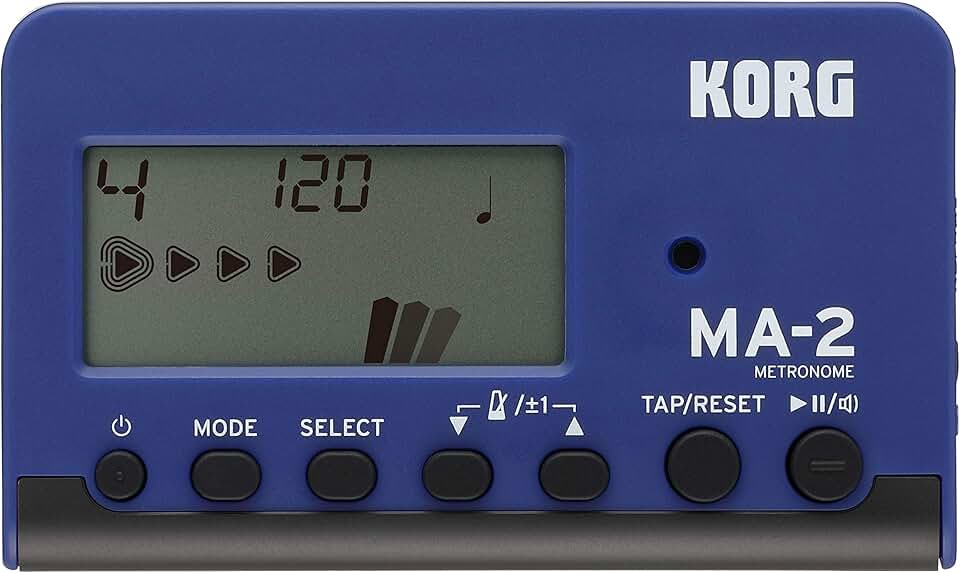
A metronome gives you a steady click to measure yourself against. Playing along to it can help reveal when you're speeding up or dragging — something that's hard to notice when you're the one setting the pace. Start with something simple, like quarter notes on the hi-hat, and just try to land with the click.
2. Count out loud while you play
Saying "1-2-3-4" (or "1-e-and-a" for subdivided beats) out loud while you play ties your hands to a spoken pulse. It feels awkward at first — you're doing three things at once — but it gives your brain an anchor besides "just feel it."
3. Subdivide the beat
Subdividing means counting the smaller pieces inside each beat instead of just the beat itself — "1-e-and-a" instead of just "1." This is one of the more useful timing exercises because it forces you to notice where the gaps between notes actually sit, not just where the downbeats land.
4. Clap or tap rhythms away from the kit
You don't need a kit for this one. Clapping or tapping a rhythm with your hands — no sticks, no drums — is a good way to internalize a pulse before you add coordination and limb independence into the mix. If you want something more structured, a practice pad with a good pair of sticks lets you do this at the kitchen table.
5. Rhythmic reading
Reading a written rhythm (even a simple one) and clapping or playing it back is a core rhythm exercise. It trains your eyes and hands to translate a pattern into time, which is exactly what you're doing when you read a fill or a groove off a lesson sheet.
6. Silent beat training
Once a groove feels solid with the click on, try turning it off for a few bars and see if you land back on the beat when it comes back. This is called silent beat training, and it's a way to check whether you're actually holding time internally or just following the click.
7. Play along to drum loops
A metronome click is useful, but it's not music. Practicing along to simple drum loops or backing tracks adds the feel of playing with other instruments, which is closer to what you'll actually do in a band or along to a song.
8. Ahead, centered, behind — placement practice
Once your basic pulse feels steady, try deliberately placing your notes slightly ahead of the click, then dead center, then slightly behind. This builds control over where in the beat you sit, not just whether you're in time — useful once "in time" alone starts to feel too basic.
A Simple Routine to Start With
One structured way to build speed and consistency: play two bars of a simple pattern (even just 16th notes on one drum or the hi-hat) along with the click, repeat that for about two minutes, then bump the metronome up by 5 or 10 BPM and repeat. Keep the tempo low enough that the pattern stays clean — there's no speed you have to prove. If it falls apart, drop back down 5–10 BPM and rebuild from there.
Common Mistakes
- Skipping the click because it feels boring. The click isn't the exercise — noticing when you drift away from it is.
- Jumping tempo too fast. Increasing by 5–10 BPM once a level feels stable works better than doubling the speed and hoping.
- Only practicing with a click and never without one. Silent beat training checks whether you can actually hold time yourself, which is the real goal.
- Ignoring rhythm work away from the kit. Clapping and counting rhythms without sticks or drums is a legitimate part of practice, not a shortcut around it.
Gear That Helps
You don't need much to start these exercises — a metronome (many phones have a free one) and something to hit. A practice pad and a decent pair of sticks are enough for clapping, counting, and subdivision drills away from a full kit. If you're practicing on an electronic drum set, many come with a built-in click and loop function, and a pair of headphones makes it easy to hear the click clearly while you play.