Why This Feels Harder Than It Sounds
A common moment in early metronome practice: you're playing along, it feels fine, but you genuinely can't tell if you're on the beat or slightly off it. That confusion is normal when you're starting out — your ear hasn't learned yet what "locked in" actually feels like, so you're relying on a sense you haven't built. The fix isn't trying harder in the moment. It's slowing down enough that hearing the difference becomes possible.
Setting Up Your Practice
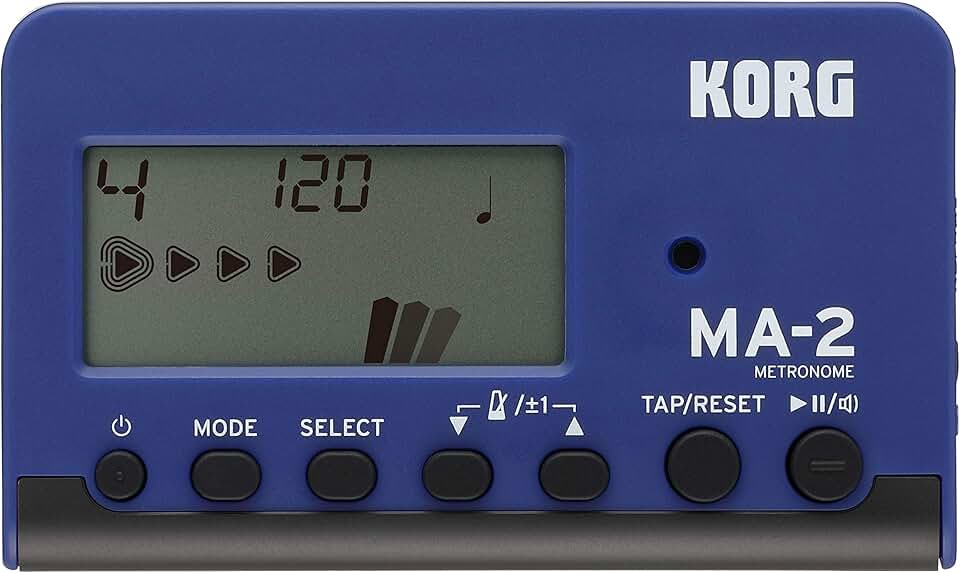
You don't need special equipment to start — a free online metronome works fine, and many let you set an exact BPM and pick a time signature so you get a clean, consistent click. These tools often cover a huge range, from very slow tempos up past 200 BPM, but as a beginner you'll likely spend most of your time well under that.
A reasonable starting point is somewhere around 50–70 BPM. That's slow enough to actually hear each click clearly and react to it, instead of chasing a fast pulse you can't process yet.
If you're playing an electronic drum set, many have a built-in metronome you can run through headphones, which makes the click easier to hear over the drums than a phone speaker across the room.
Start With the Simplest Possible Pattern
Before worrying about fills, grooves, or fast subdivisions, practice something small enough that all your attention goes to the click:
- Play quarter notes on the snare, one hit per click.
- Once that's steady, try a basic kick-snare pattern — kick on 1 and 3, snare on 2 and 4 — at the same slow tempo.
The goal isn't to sound impressive. It's to notice, honestly, whether each hit lines up with the click or drifts slightly ahead or behind. If you're not sure, that's a sign to drop the tempo further, not to push through.
A practice pad is useful here too — it lets you isolate your hands against the click without needing a full kit set up, and a pair of sticks you're comfortable with makes it easier to focus on timing instead of grip.
Leveling Up Once the Basics Feel Solid
Once quarter notes and a simple beat feel genuinely locked in — not just okay, but boring-easy — a few techniques can push your timing further:
Change the subdivision. Instead of only playing on the click, try playing eighth notes or triplets against it, so the click becomes a checkpoint rather than every note you play.
Outline the subdivision. Play notes that fill in the space between clicks, so you're building the beat around the click instead of just landing on top of it.
Try a static click. Some metronome tools let you set the click to only sound on certain beats — for example, just beat 1 of every bar — instead of every beat. This removes the constant reference and forces your internal sense of tempo to carry more of the weight.
Displace the click. Shift where the click falls relative to the beat, so it lands on the "and" of 2, for example, instead of on the downbeat. This is a way of testing whether your timing holds up when the obvious reference point moves.
Reinterpret the click. Treat the same click as a different subdivision — hear it as the "and" of a beat instead of beat 1, and play your pattern around that reinterpretation. It's a mental exercise as much as a physical one, and it's worth trying only after the earlier steps feel comfortable.
There are drum lessons built entirely around walking through a few specific ways to play beats and fills against a click, which can be worth watching if you want to see these ideas demonstrated rather than just described.
A Simple Routine to Try
You don't need a long session to make this useful. A short, focused block — working through a few patterns at a slow, fixed tempo — beats an hour of unfocused playing. Some metronome tools are even built to organize short sessions like this around specific patterns or rudiments, which can help if you tend to lose structure once you sit down.
A basic version:
- 5 minutes of quarter notes on the snare at a slow tempo.
- 5 minutes of a simple kick-snare groove at the same tempo.
- 5 minutes trying one leveling-up technique above, only if the first two felt solid.
Raise the tempo only once a step feels easy, not effortful.
Common Mistakes
Assuming you're in time because it feels close. This is a common early trap — your ear needs practice recognizing drift before it can catch it in real time. Recording yourself and listening back, or watching for the click visually if your tool shows one, can make gaps between you and the click easier to notice than they are while you're playing.
Jumping tempo too fast. Moving up before a pattern is genuinely steady just moves the same timing problem to a faster speed.
Dropping the click during fills. It's tempting to let go of the metronome the moment a fill starts. Practicing fills at the same slow tempo as the groove around them is what actually builds the connection.
Treating the click as decoration. The click is a reference to check against, not background noise to play along near. Every technique above works by making that check-in more demanding, not by removing it.
If your kit setup involves an acoustic kit and a proper seat or a bass drum pedal you're still getting comfortable with, keep those variables simple while you're doing metronome work — this is timing practice, not gear practice.