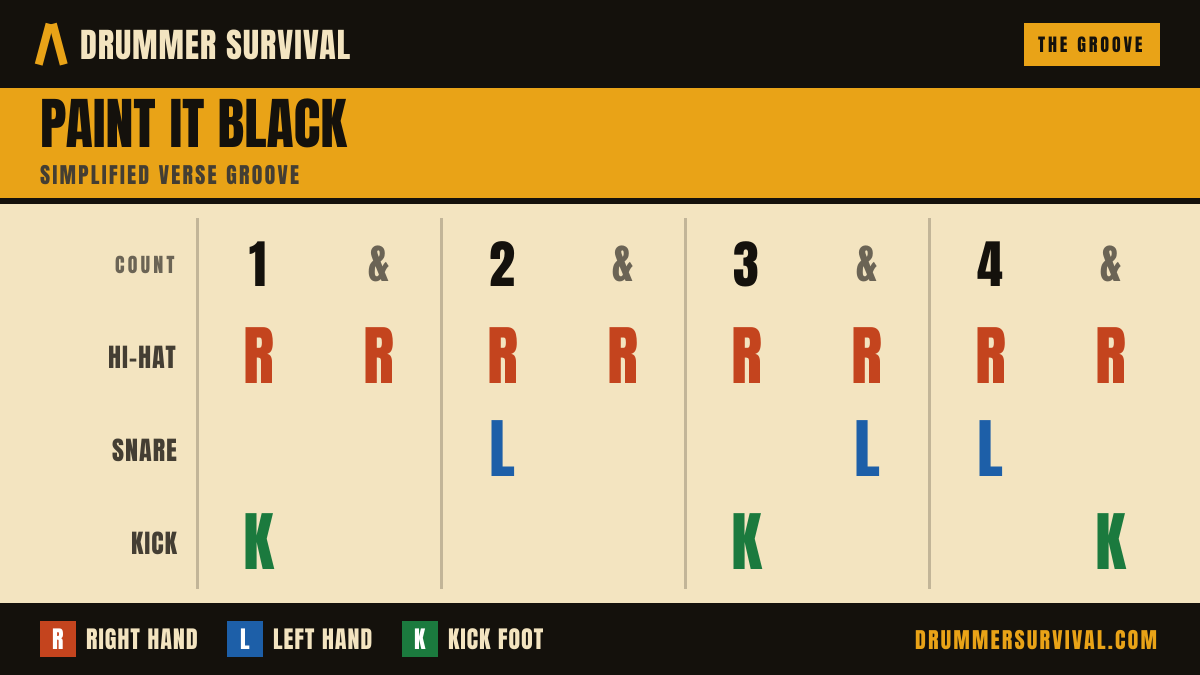
The drums in "Paint It Black" are built on a steady rock beat — hi-hat on straight eighth notes, kick on beat 1, snare cracking on 2 and 4. What makes the song tricky isn't the notes themselves; it's holding that beat rock-solid while the song keeps adding intensity around you. If you can play a basic rock beat cleanly and keep your hands relaxed under pressure, you can play this song at a beginner level.
The Core Beat, Simplified
Strip away the record and what's left is a beat almost every beginner already knows or is close to learning:
- Hi-hat: steady eighth notes, evenly spaced, no accents
- Kick: on beat 1 (add a light second kick around the "and" of 2 if you want it closer to the recording, but skip this at first)
- Snare: on beats 2 and 4
That's the whole engine. Play it slow on a practice pad or your kit until your hi-hat hand stays even without speeding up or dragging — that evenness is what sells this song, not complexity. If your kick foot feels sloppy or disconnected from your hands, spend a session just on kick-and-hat before adding the snare; a comfortable bass drum pedal makes this a lot less frustrating while you're building that control.
Don't chase the exact tempo of the original recording on day one. Loop a slow, comfortable speed on a metronome and only move up once the beat feels boring at that speed — boring means automatic, and automatic means you're ready to add the next layer.
Mapping the Song
You don't need to memorize a chart to follow along — just know what's coming:
- Intro: the drums are mostly absent at first, then come in and set the groove that carries the whole song. Use this section to lock your tempo before the vocal starts.
- Verses: the core beat described above, steady and understated. This section repeats often, so it's worth putting a good chunk of your practice time here.
- Choruses: the same beat, but the song feels bigger — resist the urge to actually rush or hit harder just because the energy lifts. Let the song build around your steady beat, not the other way around.
- Instrumental section: a chance to breathe. Keep the beat simple here rather than trying to fill space with extra hits.
- Outro: the song pushes its energy higher toward the end. This is a section that can trip up beginners, because it's tempting to speed up along with the excitement. Your job is to keep the pulse where it's been the whole song.
The Trouble Spots
Staying at one tempo through the build. One common challenge in this song for a beginner isn't a hard fill — it's discipline. As the song feels more intense, your hands may naturally want to speed up. Practice the transition from verse into chorus with a metronome running so you can hear if you've drifted.
Keeping the hi-hat even. Because the beat is so exposed and repetitive, any unevenness in your eighth notes is obvious. Slow, deliberate practice on a pad or kit — not just playing along with the record — is what fixes this.
Fills into the chorus. Keep any fill you add short and simple: a few snare hits that land you back on beat 1 is plenty. A complicated fill you can't play cleanly will hurt the song more than a simple one played confidently.
A Simple Practice Plan
- Play the core beat alone with a metronome, slow, until it's boring.
- Add a simple two-hit fill before the chorus, practiced on its own in a short loop.
- Play along with just the verse section of the song on repeat, focusing only on staying steady.
- Play through the full song once you can hold the verse beat without drifting, paying special attention to the outro build.
- Record yourself and listen back — playback can make tempo drift easier to notice than it is while you're playing.
Gear That Helps You Learn This Song
You don't need much to work on this one. A solid pair of drum sticks and a practice pad are enough to drill the core beat without needing a full kit every session. If you're practicing at home on an electronic drum set, a decent pair of headphones makes it much easier to hear your own timing against the track. And if long practice sessions on an acoustic kit are part of your routine, ear plugs and a comfortable drum throne are worth having before your ears or your back start complaining.