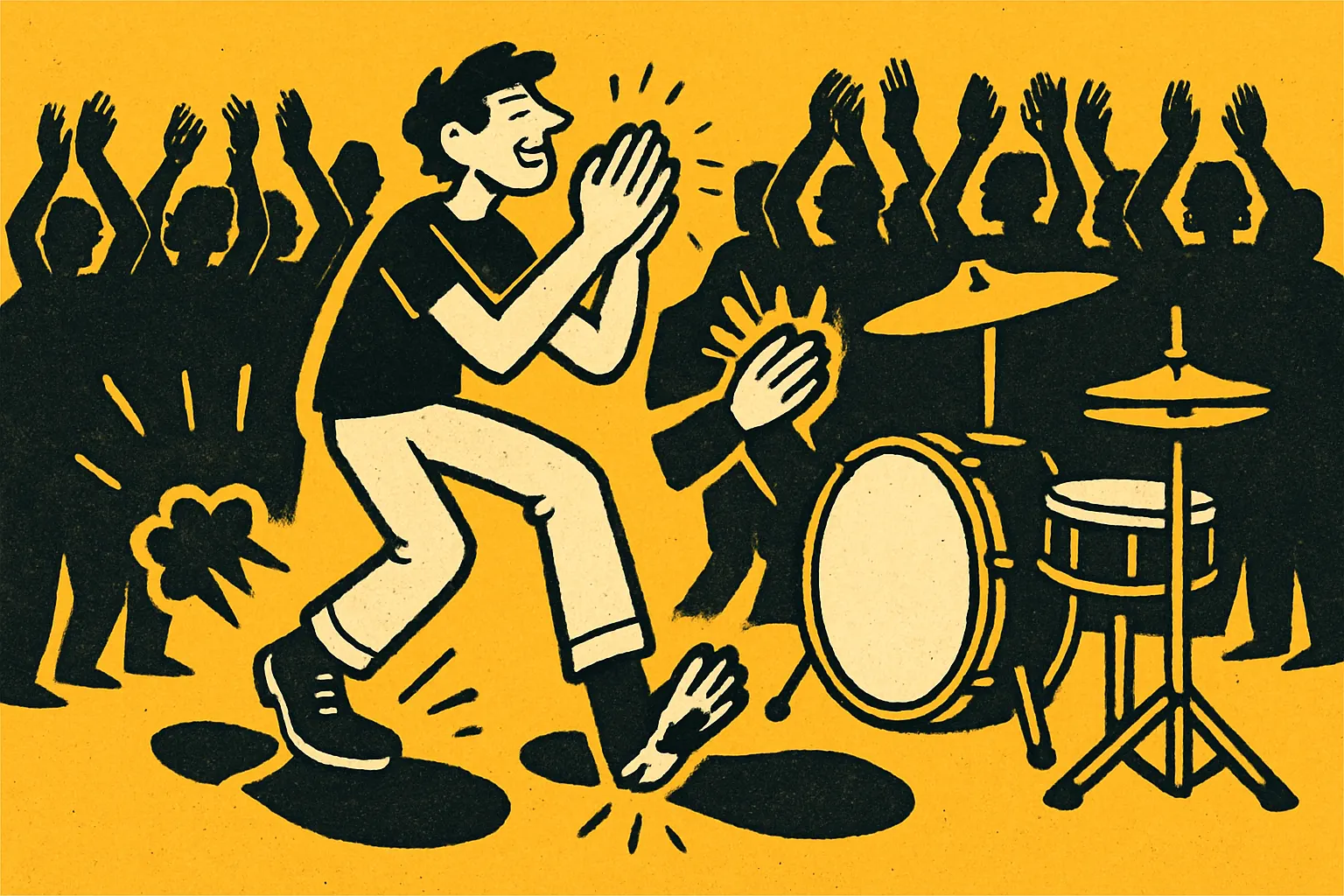
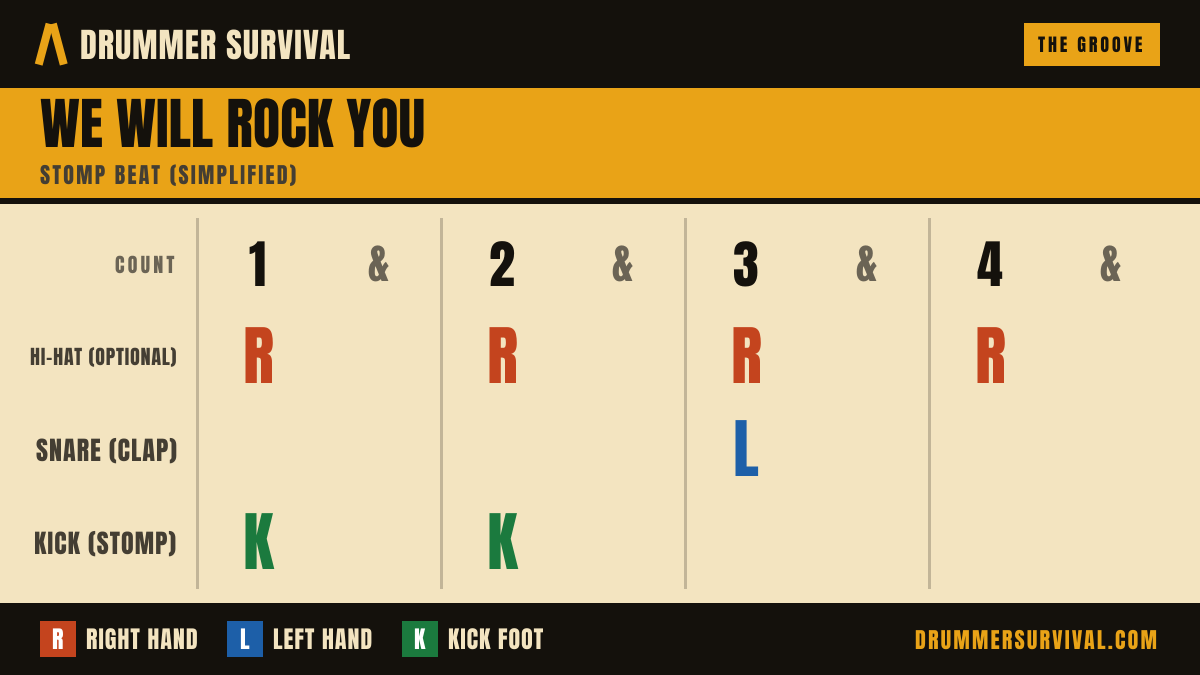
The drum part is just two kick hits followed by one snare hit, played on a loop. That's the whole "stomp-stomp-clap" pattern the whole world already knows how to clap along to. No hi-hat, no fills required to get started — which is exactly why this is a great first song to learn on a kit.
The beat, broken down
Strip away the guitar and vocals and the drum part is:
- Kick
- Kick
- Snare (or a cross-stick / rim click if you want it to sound a little more like a hand clap)
Then repeat. That's it. If you've ever stomped your feet and clapped along to this song at a game or a concert, you already know the rhythm in your body — you're just moving it onto a kit.
Count it as "1, 2, clap" or "boom, boom, clap" out loud before you sit down at the kit. Say it a few times until it feels automatic, then move your feet and hand to match: left-right stomp with your feet (or just your kick foot hitting twice), then a hit on the snare.
A simplified beginner version
You don't need two feet on kick drums to play this — one kick pedal handles both "stomp" hits. Here's the beginner-friendly way to build it:
- Sit at the kit and just play the kick drum alone: kick, kick, rest, kick, kick, rest. Get that feeling locked in with a metronome before adding anything else.
- Add the snare on the third beat: kick, kick, snare — kick, kick, snare.
- Once that's steady, that's the entire main pattern. You can play the whole song with just this loop.
If you want it to sound a bit fuller once the pattern feels easy, you can add a light hi-hat or ride cymbal hit on top of each note, but it's completely optional — the song works with just kick and snare.
Mapping the song's sections
You don't need to memorize a complicated arrangement here — the drum pattern barely changes:
- Intro/first verse — the stomp-stomp-clap pattern, often sparse, just that loop.
- Building sections — as the song grows louder, you can hit the snare and kick a little harder and add cymbal accents, but the underlying kick-kick-snare pattern stays the same.
- Later section with the guitar solo — this is where a full band arrangement sometimes adds a beat with hi-hat, but if you're playing along to the original track, you can keep the same stomp pattern straight through.
Because the part repeats so much, the challenge isn't memorizing an arrangement — it's staying locked in for the whole song without drifting.
Where beginners lose it
- Speeding up when it gets loud. As the song builds in energy, it's easy to unconsciously push the tempo. Practice with a metronome and check yourself against it, especially through the louder sections.
- Rushing the space between the two kicks. The gap between "kick, kick" and the snare needs to stay even. If you're not sure it's even, clap the pattern by itself first, away from the kit.
- Playing it too soft or too tentative. This is a stomping, anthemic pattern — it's meant to be played with weight. Once the pattern feels steady, focus on hitting with confidence rather than rushing to add more parts.
Practice plan
- Clap or say the pattern ("boom, boom, clap") without any instrument until it's automatic.
- Play just the kick foot pattern alone with a metronome.
- Add the snare hit on top.
- Play along with the actual song at a comfortable volume, focusing on staying with the recording rather than rushing ahead of it.
- Once it's solid, try adding a light hi-hat or ride hit on the offbeats for extra texture — but only after the core pattern feels boring-easy.
If you're practicing at home, the kick drum is often one of the louder, more vibration-heavy parts of a beginner's setup, so an anti-vibration mat under the kit is worth it if you live in an apartment. If you're on an electronic drum set, a decent pair of headphones for electronic drums makes it much easier to hear the kick-snare relationship clearly while you practice. And since this song rewards playing with some real force, a comfortable pair of drum sticks and a stable drum throne help you commit to the hits without straining.
Common mistakes
- Overcomplicating the pattern early by adding fills or extra cymbal hits before the basic kick-kick-snare loop is steady.
- Losing the pattern's feel by playing it too evenly and flat — the pattern is simple, but it should still feel like a stomp, not a metronome click.
- Ignoring the foot pattern and rushing straight to snare — a lot of the groove's identity comes from those two kick hits landing evenly.
This is a genuinely beginner-friendly song specifically because the pattern is short, repetitive, and doesn't require hi-hat coordination. Get the two-kick-then-snare loop steady, and you can play along to the entire track.