Back in Black is a steady rock beat played at 94 BPM, with hi-hats on every eighth note, snare on 2 and 4, and a simple kick pattern underneath. There's no double bass, no odd time signature, and no fast fills — the challenge is staying locked to that tempo for the whole song without rushing, and coming in confidently after the guitar-only intro.
The Core Groove
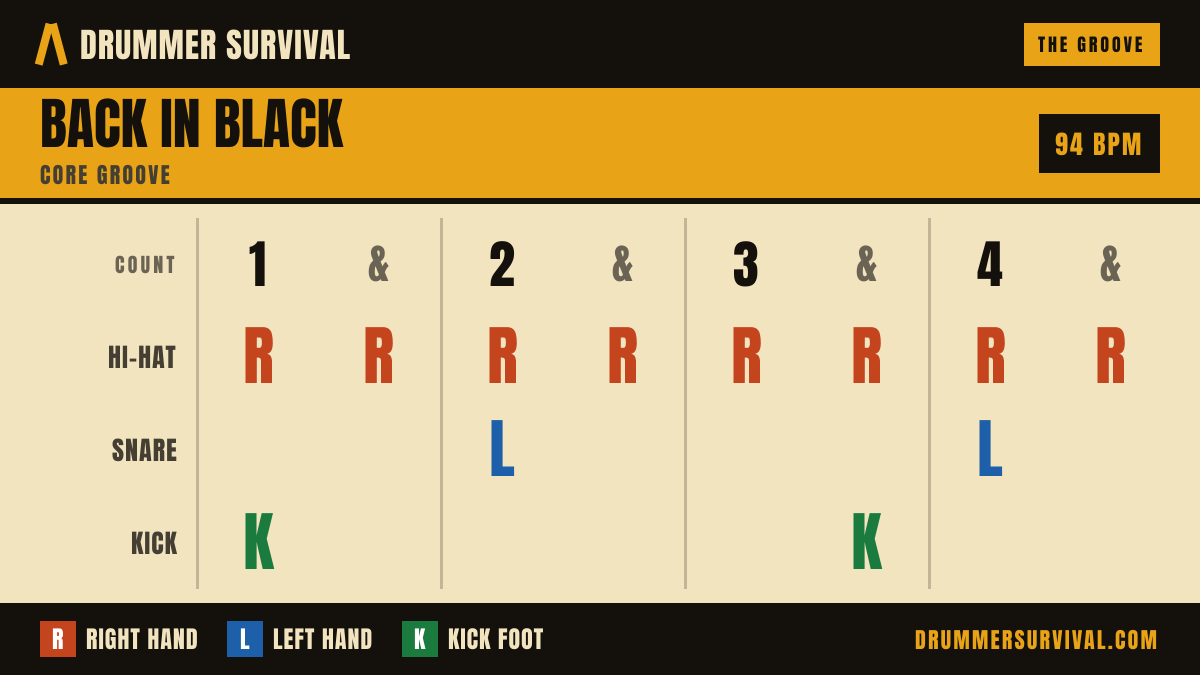
Here's a simplified beginner version of the beat that carries almost the entire song:
Your right hand rides the hi-hat on every eighth note, steady and even. Your left hand hits the snare on beats 2 and 4 — that backbeat is what makes it feel like rock. Your kick foot lands on beat 1 and then again on the "and" of beat 2. That's it. Loop that pattern with a metronome before you try to play along with the song.
If your kick foot feels sloppy on that second hit, it's often a pedal control issue more than a rhythm issue — a pedal with smoother action can make quiet, precise kicks easier to control (see our bass drum pedal picks).
The Sections: Intro, Verse, Chorus, Fills
| Section | What's happening | Drum part |
|---|---|---|
| Intro | Guitar riff alone, no drums | Count the bars silently, don't play yet |
| Verse | Full band comes in | Core groove, hi-hat closed |
| Chorus | Same groove, bigger feel | Often switch hi-hat for a crash on beat 1 |
| Fills | Short transitions into chorus | Simple 2-4 hit snare fill, land back on beat 1 |
The song opens with a guitar riff and no drums at all. That's the part beginners often get wrong — not the playing, but the waiting. You have to count through those bars accurately so you come in on the right beat, at the right tempo, the first time the band kicks in.
Once the drums enter, the pattern barely changes for the rest of the song. The chorus often opens up a bit, often by switching from a closed hi-hat to a crash cymbal on beat 1, but the underlying groove stays the same. Fills going into the chorus are short — a handful of snare hits is enough. Don't reach for anything fancy; a simple fill played in time and landing cleanly on beat 1 sounds better than a busy one that rushes.
Why 94 BPM Feels Harder Than It Sounds
94 BPM isn't fast, and the pattern isn't complicated — which is exactly why it's easy to speed up without noticing. Simple, repetitive grooves can feel like there's nothing to concentrate on, so your internal tempo can drift up over four minutes. Practicing this song is as much about tempo discipline as it is about the notes themselves.
The Trouble Spot: Coming In After the Intro
The intro riff plays alone for several bars before the drums enter. Beginners often either come in too early (guessing) or hesitate and come in late. The fix is counting: know exactly how many bars of intro there are, count them in your head at the song's tempo, and practice entering on the correct beat before you try playing the rest of the song.
Practice Plan
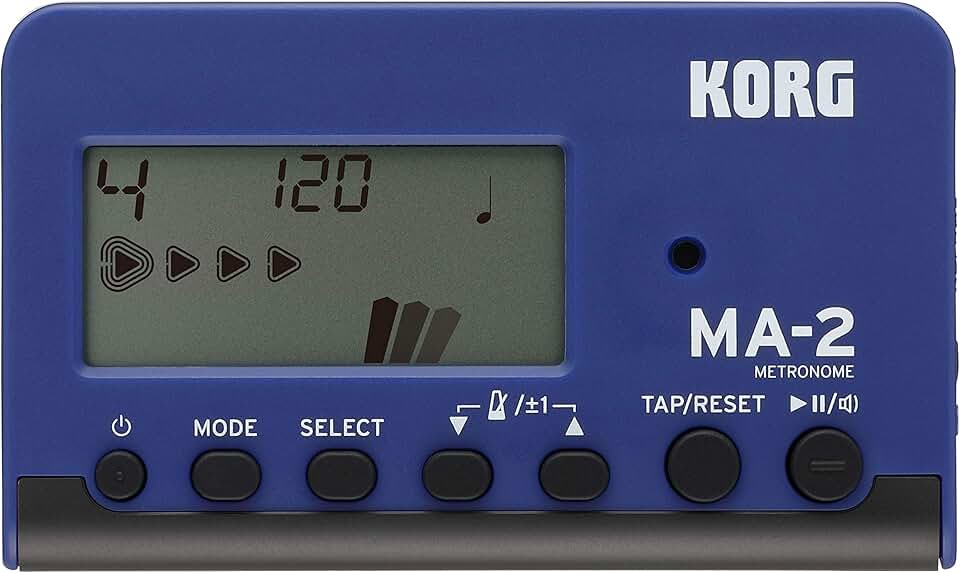
- Loop the core groove alone with a metronome at a slower tempo, around 70-75 BPM, until it feels automatic.
- Bring the tempo up gradually to 94 BPM, checking that your hi-hat stays even and doesn't rush.
- Practice the simple snare fill on its own, always ending it by landing on beat 1.
- Count through the intro bars out loud (or in your head) and practice entering the groove exactly on time.
- Play along with the actual song once the groove, entrance, and fill each feel solid on their own.
A practice pad is useful for steps 1-3 if you want to drill hand patterns without needing the full kit set up. Playing along with the real track will be loud — ear plugs protect your hearing during longer practice sessions, and if you're practicing in an apartment, an electronic drum set with headphones lets you play along at full tempo without disturbing anyone.
Common Mistakes
- Rushing the tempo. The groove feels simple, so it's easy to speed up without noticing. Check yourself against a metronome regularly.
- Hesitating at the entrance. Not counting the intro bars leads to a shaky, late start when the band comes in.
- Overplaying the fills. A busy fill that doesn't land cleanly on beat 1 sounds worse than a simple one played in time.
- Losing the backbeat. If your snare on 2 and 4 gets buried under the hi-hat, the groove loses its drive. Make sure the snare cuts through.