Bad Moon Rising is a great first CCR song to learn because the drum part barely changes for the whole track. It's built on one steady rock beat — hi-hat on every eighth note, snare on the backbeat, kick keeping the pulse — repeated with small variations into the chorus. If you can hold a basic rock groove steady, you can play this song.
The Core Groove (Simplified)
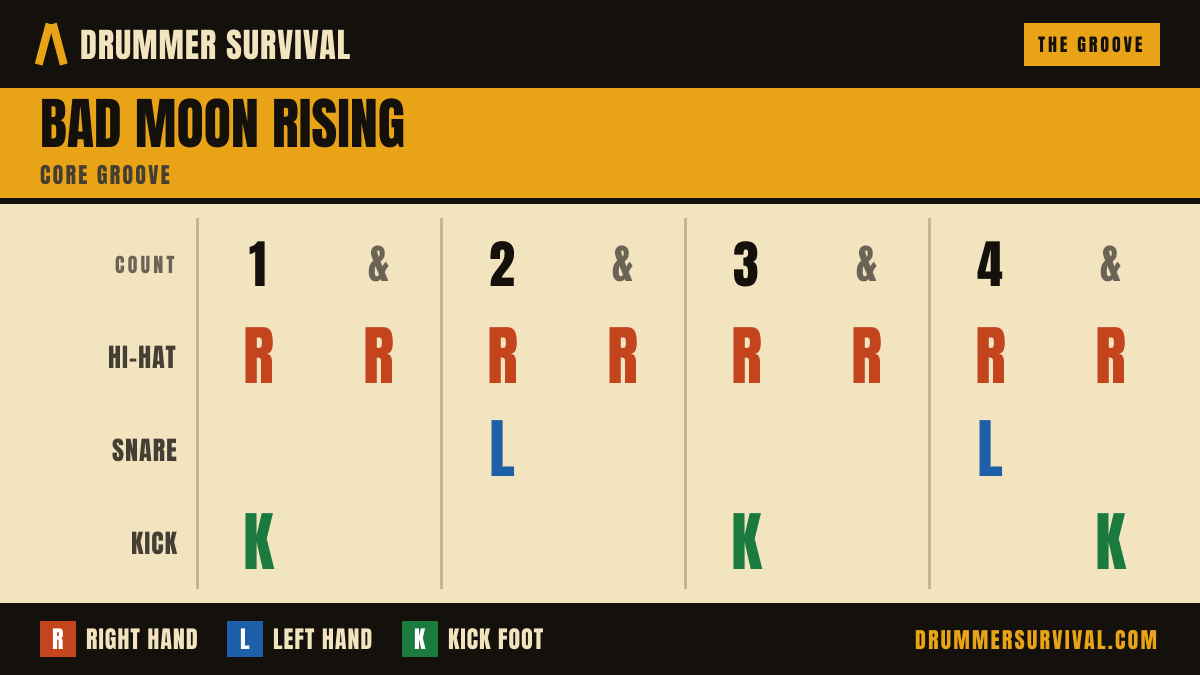
Here's a beginner-friendly version of the beat that drives the whole song:
Read it left to right, one hit per eighth note. Your hi-hat hand plays every box. Your snare hand lands on beats 2 and 4 (the "backbeat" — that's what gives rock music its bounce). Your kick foot lands on beats 1 and 3. That's the whole engine of the song.
Learning It Hand by Hand
Don't try to play all three limbs at once right away. Build it in layers:
- Hi-hat alone. Sit at the kit (or a practice pad with a hi-hat stand) and play steady eighth notes with your right hand until it feels automatic, not counted.
- Add the kick. Keep the hi-hat going and drop your foot in on beats 1 and 3. If this makes your hi-hat hand wobble, that's normal — slow down until it doesn't.
- Add the snare. Now add beats 2 and 4 with your other hand. Say "1-2-3-4" out loud and hit the snare on "2" and "4" to lock it in.
Work at a tempo where you can play the whole loop cleanly for 30 seconds before you try to speed up. There's no reason to rush this — a slow, solid groove is worth more than a fast, shaky one.
Mapping the Song
Bad Moon Rising doesn't have a drum intro — the beat comes in with the band from the start and barely lets up. The rough shape is:
- Verse — the core groove above, steady and unchanging.
- Chorus — often felt with a bit more push or volume rather than a different pattern.
- Turnarounds / song end — short fills lead back into the groove or wrap up the song. Keep any fill simple: four snare hits landing back on beat 1 does the job. You don't need a flashy fill to play this song well.
Because the tempo isn't fixed across every recording or cover, don't try to memorize a BPM number. Instead, play along with the actual track you're learning from and find the speed by ear, starting slower than the record if you need to.
The Trouble Spot
The hardest part of this song isn't a tricky fill — it's staying locked at one tempo for the whole song without speeding up. Because the beat is so repetitive, it's tempting to rush, especially once you're comfortable with the pattern. Practice with a metronome or the original track running underneath you so you have something outside your own head keeping you honest.
A Simple Practice Plan
- Play the core groove alone for 2–3 minutes at a slow, comfortable tempo.
- Add a click or metronome at that same slow tempo and repeat.
- Play along with the actual song at a reduced speed if your app or player allows it.
- Once that's solid, bring it up to the real song tempo.
- Add one simple fill (four snare hits) at the end of a phrase, landing back on beat 1.
A basic drum throne and a comfortable pair of drum sticks make longer practice sessions like this much easier on your body. If you're practicing on an electronic drum set, a decent pair of headphones lets you hear the click and the song clearly while you play.
Common Mistakes on This Song
- Rushing the verse into the chorus because the energy feels like it should pick up — it doesn't need to for this song.
- Overplaying the fills. This song doesn't need busy fills; simple ones fit the style better.
- Losing the hi-hat hand when the kick and snare come in — go back to step 1 of the practice plan if this happens.
- Skipping the metronome step because the groove feels easy — repetitive beats are a common place for tempo drift to sneak in.