The drum part in this song isn't a normal rock beat built around the hi-hat — it's a marching-style pattern built around the toms and snare. That's what makes it sound different from most songs you'll learn early on, and also why it's manageable once you isolate the pattern: it repeats a lot, so you're mostly learning one figure and reusing it.
The core pattern (simplified)
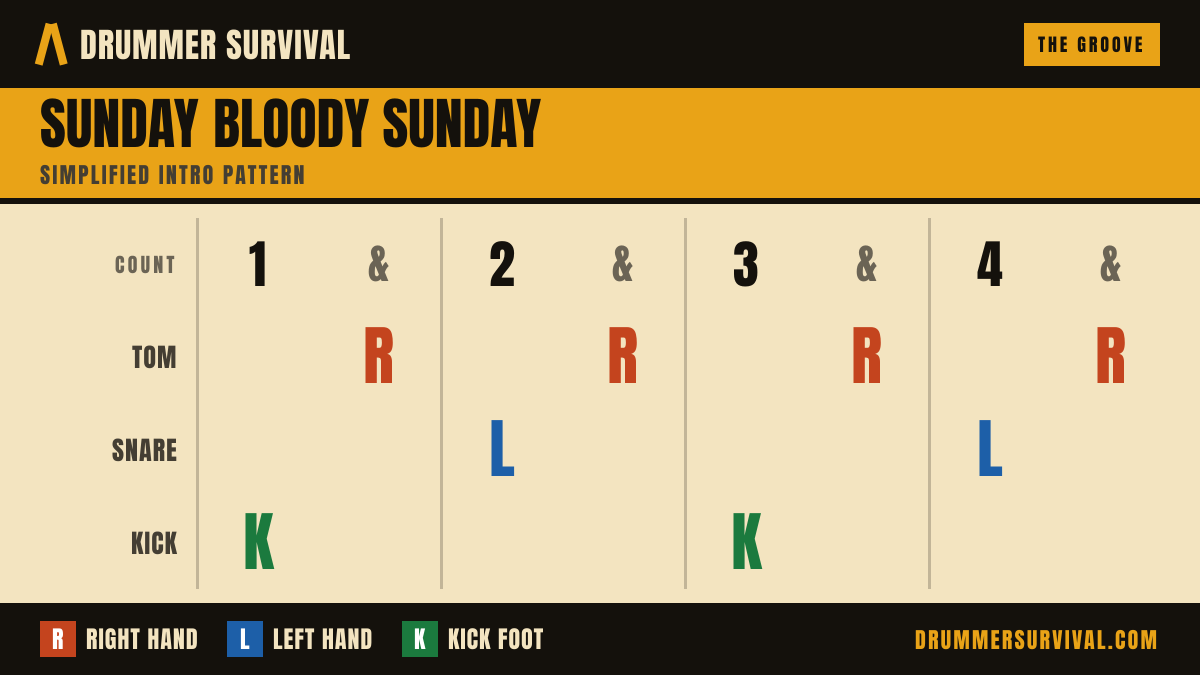
Here's a simplified beginner version of the feel — not a note-for-note transcription, just the shape of it so you can learn the mechanics.
The high tom holds a steady quarter-note pulse — that's your anchor. The snare fills in around it with an off-beat, syncopated pattern that gives the song its marching feel. The kick and floor tom just mark the downbeats, so they're the easiest part to lock in first.
Why there's no hi-hat pulse to lean on
Many beginner grooves use the hi-hat as a steady subdivision you can feel the beat against. This song doesn't give you that safety net in the main pattern — the pulse comes from the tom instead. If you're used to counting off the hi-hat, switch to counting off the tom hit instead: say the beat numbers out loud while you play just the tom part, then bring the snare in underneath.
Mapping the sections
- Intro — the tom/snare pattern starts alone, so this is where the pattern has to be the most exposed and steady. Practice this section on its own before you try to play through the whole song.
- Verse — same core pattern, played more sparsely under the vocal. Resist the urge to add extra hits here; simpler is more accurate to the part.
- Chorus — the pattern often opens up a little, sometimes with slightly fuller cymbal or ride work layered on top. Keep the tom pulse steady underneath whatever you add.
- Fills / transitions — short tom-based fills bridge sections. Keep these small at first: two or three tom hits that land you back on the pulse count more than a flashy fill played out of time.
The trouble spot
One common trouble spot for beginners isn't a fast section — it's the syncopated snare hits landing off the tom pulse. Your hands want to sync up and hit together, which flattens out the pattern into something that isn't the song anymore. Slow it down until you can hear the tom and snare as two separate layers, not one merged hit.
Practice plan
- Tom pulse only — play just the high tom quarter notes with a metronome until it feels boring. Boring means steady.
- Add the kick and floor tom — these land with the tom hits, so this step should feel like doubling up, not adding something new.
- Add the snare — start at a slow tempo, well under the recording's speed, and only speed up once the snare stays in its own spot without drifting toward the tom hits.
- Play through a full section — pick just the intro or verse, loop it, and don't move to the next section until this one is solid.
- Match tempo to the recording — once the pattern is automatic, play along with the actual song at low volume so you can still hear your own playing.
A practice pad is useful here since the pattern is really about hand independence between the tom and snare voices — you can drill that hand relationship without a full kit. If you're practicing at home, ear plugs or a low-volume setup on an electronic drum set with headphones will let you loop sections at a comfortable volume without wearing out your neighbors or your ears.
Gear notes
Nothing about this song demands special gear, but a few things make the marching-tom feel easier to nail:
| Focus area | Why it matters here |
|---|---|
| Stick choice | The pattern is mostly toms and rim-area snare hits — a pair of comfortable, beginner-friendly drum sticks is all you need, nothing specialized |
| Kick pedal feel | The kick is sparse and simple in this song, so a reliable, easy-to-control bass drum pedal matters more for consistency than power |
| Seating | Because your hands are doing most of the work, a stable, comfortable drum throne helps you stay relaxed through repetition |
None of this is required to learn the song — it's about comfort during the repetitive practice this pattern needs, not about the song being demanding on equipment.