The drum part in "Another One Bites the Dust" is a steady, syncopated groove built around a kick pattern that doesn't just land on the obvious beats. Once you get that kick pattern under your hands and feet, the rest of the song is mostly repetition — which is why it sits at a beginner-friendly difficulty. The hard part isn't speed. It's locking the kick to the bass line without losing the pulse.
The core groove
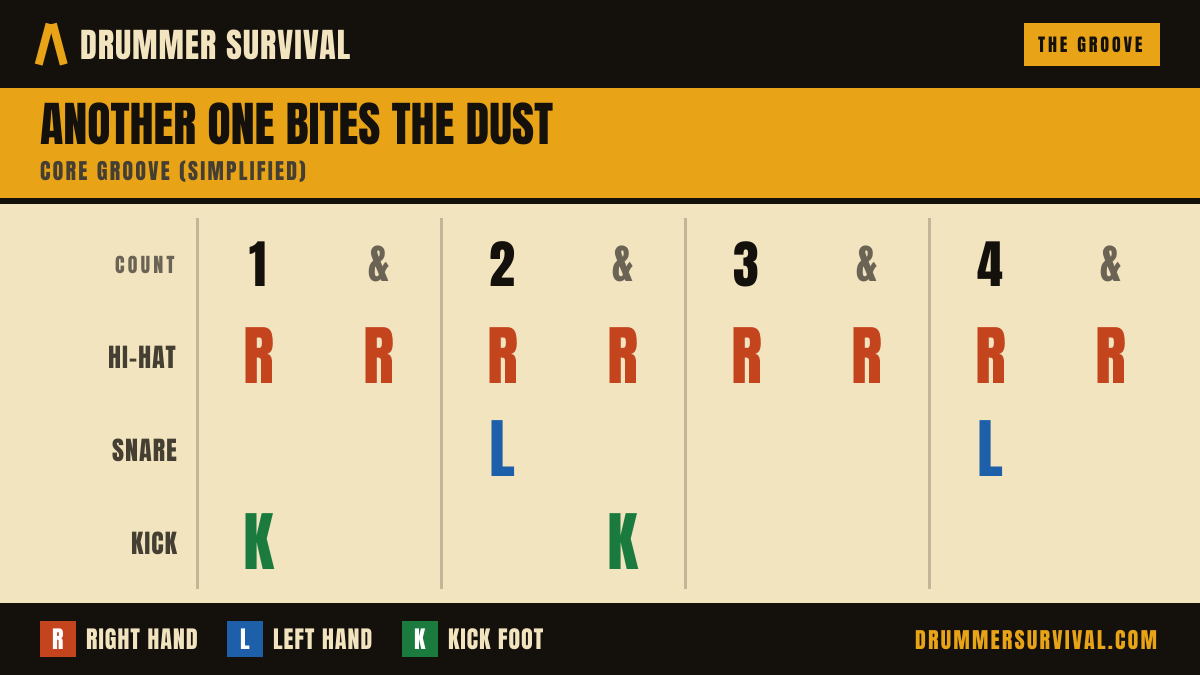
Here's a simplified beginner version of the feel. It's not a note-for-note transcription — it's built to teach you the same syncopated kick-and-backbeat idea in a shape you can actually learn first.
Count it as "1-and-2-and-3-and-4-and." The hi-hat plays every eighth note, evenly, and stays quiet in the mix — this song lives or dies on the hi-hat being steady and not too loud. The snare hits on beats 2 and 4, the same spot as many rock and pop grooves. The kick is the tricky part: it lands on beat 1, then again on the "and" of beat 2, then again on beat 3. That extra kick on the "and" is the syncopation that gives the groove its push-pull feel.
Why this groove trips people up
Many beginner rock beats put the kick on beat 1 and let it sit there. This groove asks your foot to play between beats, right where your body wants to rest. If you've mostly practiced simple kick-on-1-and-3 patterns, your foot will want to skip that extra hit or rush toward it. That's a coordination problem, not a sign you can't play the song — it just means this pattern isn't automatic yet at any real tempo.
A bass drum pedal that responds smoothly under a fast, light foot motion makes this pattern easier to feel — a heavy or stiff pedal can make the "and" hit feel like a lunge instead of a flick. If your pedal feels like a fight, it's worth checking whether the pedal itself is working against you (see our guide to beginner bass drum pedals).
Mapping the song's sections
You don't need different drum vocabulary for each section — this song mostly repeats the same groove and varies the arrangement around it.
| Section | What's happening | What to focus on |
|---|---|---|
| Intro | The groove starts sparse, often just kick and hats before the full band comes in | Getting the kick pattern locked in alone, since there's less to hide behind |
| Verse | Full groove: hi-hat, backbeat snare, syncopated kick | Keeping the hi-hat even — don't let it get louder or busier under the vocal |
| Chorus | Same groove, fuller arrangement | Staying steady even as the song feels bigger — resist the urge to hit harder or rush |
| Fills | Short, simple transitions between sections | Landing cleanly back on beat 1 of the next section — a short fill is fine |
The trouble spot: transitions
The verse-to-chorus and chorus-to-verse moments are a common spot where beginners lose the groove — often not because the fill itself is hard, but because coming back into the syncopated kick pattern after a fill takes a beat to re-lock. If you find yourself landing on the wrong part of the kick pattern right after a fill, that's worth practicing on its own: play two bars of groove, a one-bar fill (even four simple snare hits works), then two more bars of groove, and check that the kick pattern comes back exactly where it should.
How to practice it
- Isolate the kick. Loop just beat 1, and-2, beat 3 with your foot alone until it's steady and even.
- Add the snare. Kick and snare only — no hi-hat yet. Confirm the snare lands cleanly on 2 and 4 without your foot dragging it off time.
- Add the hi-hat. Once kick and snare feel solid together, layer in steady eighth notes on the hi-hat. Keep it quiet.
- Slow down further than feels necessary. Start well under the recorded tempo — there's no speed you have to prove on your first pass. Build up gradually once the pattern feels automatic, not rushed.
- Play along with the song. Once the groove is steady on its own, try it with the track. If you fall apart the moment the full band comes in, that's normal — it means the pattern isn't automatic yet, not that you did something wrong. Drop back a step and rebuild it slower.
A practice pad is useful for isolating just the snare-and-kick coordination away from a full kit, and a metronome or click track helps you notice if the syncopated kick is drifting — something that's genuinely hard to hear in the moment while you're also thinking about your hands.
What you don't need
You don't need a double kick pedal, blast beats, or anything past a basic rock groove to play this song. If you're practicing on an electronic kit with headphones, this is a good song to loop quietly late in the evening — the groove is repetitive enough that a few focused minutes with headphones beats a long unfocused session on an acoustic kit.