This PJ Harvey song sits at a beginner-friendly 2 out of 5, but not because the notes are simple to hit — it's because playing less convincingly is harder than it sounds. The core pattern is just kick, snare, and floor tom, with no hi-hat driving the pulse. Your real job here is holding the space between hits steady, not playing fast or busy.
The Groove You'll Play
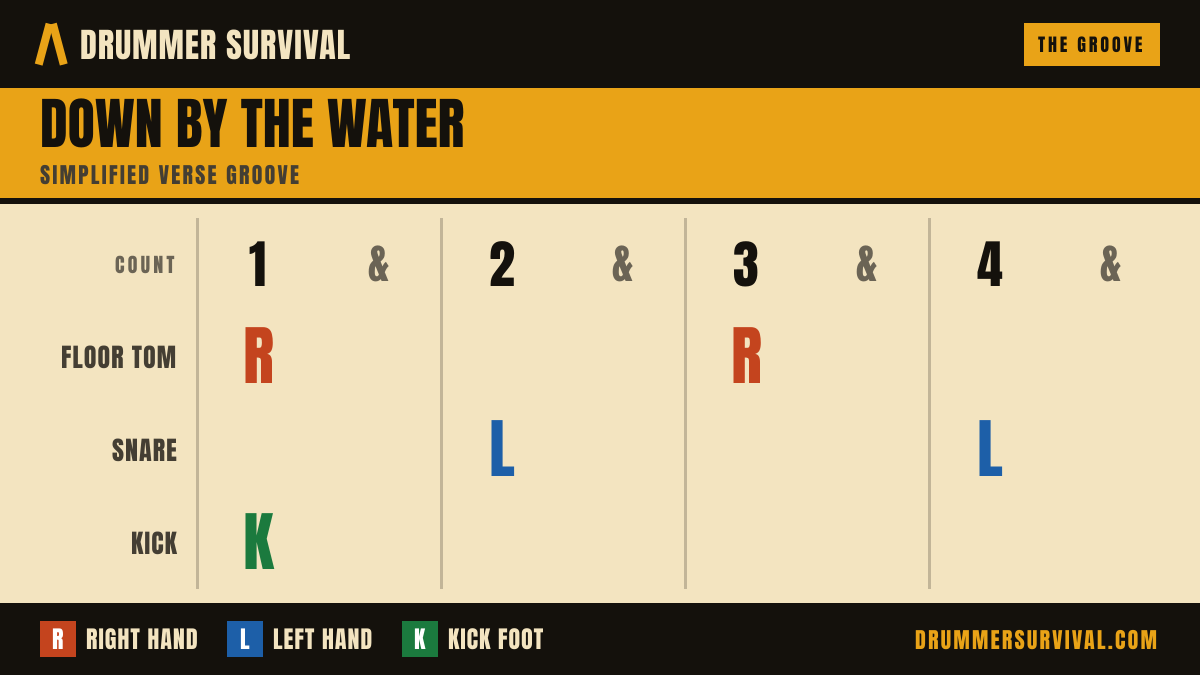
The simplified version taught here strips the pattern down to three pieces: kick, snare, and floor tom. There's no hi-hat pulse keeping time — the floor tom does that job instead, giving the groove its low, moody feel.
- Kick lands on beat 1 only. Resist the urge to add more — the empty space is part of the groove.
- Floor tom echoes on beats 1 and 3, giving a heartbeat-like pulse under everything.
- Snare falls on the backbeat, beats 2 and 4, same as most rock grooves you've already learned.
Practice it in this order: kick and snare alone first, slow, with a metronome. Once that backbeat feels boring and automatic, add the floor tom underneath. Adding a third limb to a pattern you already know well is much easier than learning all three at once.
Mapping the Sections
You don't need to memorize a strict form to play along — listen for these two feels and switch between them:
| Section | Dynamics | What changes |
|---|---|---|
| Verse / quiet parts | Soft, restrained | Same kick/snare/tom pattern, played gently |
| Chorus / build parts | Fuller, more attack | Same pattern, hit harder, maybe with a crash accent on beat 1 |
The notes barely change between sections — what changes is how hard you hit them. That's the actual skill this song is teaching you.
The Trouble Spot: Staying Steady in the Gaps
Sparse grooves like this one tempt you to rush. When there's a lot of silence between your hits, your body wants to fill it by speeding up toward the next note. This is common in songs built around space rather than constant subdivisions, and it's worth practicing against, not just powering through.
Count out loud through the rests — "1, 2, 3, 4" — even where you're not playing anything, so your internal clock has something to hold onto besides the next drum hit. A practice pad is a good place to drill the kick/snare/tom coordination quietly before you take it to a full kit.
Common Mistakes
- Rushing through the sparse sections because empty space feels uncomfortable.
- Adding a hi-hat pattern by habit, which crowds out the mood the song is going for.
- Treating the floor tom hits as filler instead of the main pulse — they're doing the job the hi-hat usually does.
- Playing every section at the same volume. The contrast between quiet and loud parts is most of what makes this song work.
Practice Plan
- Play kick (beat 1) and snare (beats 2 and 4) alone with a metronome, slow, until it's boring.
- Add the floor tom on beats 1 and 3 underneath.
- Practice at a whisper-quiet volume for the verse feel, then repeat louder for the chorus feel.
- Play along to the track at low volume first, focusing only on staying with the pulse, not on getting every accent perfect.
Because this song rewards quiet, controlled playing, it's also a good one to practice on an electronic drum set with headphones — you can focus on dynamics without worrying about volume. Good sticks with a comfortable grip help too, since playing quietly with control actually takes more hand discipline than playing loud.