Vibration is a back-and-forth motion of an object around a resting point — think of a drum head shaking after you hit it, or a floor trembling under a kick pedal. It's different from sound: sound is the vibration traveling through air to your ear, while vibration itself can travel through solid material like floors, walls, and furniture, which is exactly how it reaches your downstairs neighbor even when your door is closed and your kit sounds "quiet" to you.
This matters for apartment drumming because noise and vibration are two separate complaints. You can solve one and still have the other.
What Vibration Actually Is
In plain terms, vibration is a repeated motion of matter around an equilibrium point — it swings away and comes back, over and over. Three things describe any vibration:
- Frequency — how fast it repeats (more repeats per second feels different than fewer)
- Amplitude — how far it swings from rest (bigger swings often mean a stronger sensation)
- Energy — how much force is behind the motion
Vibration can also be steady and predictable — a metronome click makes a very regular, repeatable vibration — or messy and irregular, like the thump of a kick pedal landing slightly differently each time. Both types exist on a drum kit at once: your hi-hat has a fairly steady vibration pattern, while your kick drum hitting the floor is closer to a series of irregular jolts.
Why Your Neighbor Feels It Before They Hear It
Skin has dedicated sensors for vibration, sitting deep under the surface. That's part of why a bass note or a kick drum thump can register as a physical sensation — a "thud you feel in your chest" — even at a volume too low to clearly hear as a sound. This is one reason apartment noise complaints about drums are often really vibration complaints: your neighbor may not be able to point to a specific sound, but they can feel a rhythmic jolt through their wall or ceiling.
What Actually Creates Vibration on a Kit
Much of the vibration a drum kit sends into a building comes from parts that make direct, repeated contact with the floor:
- The kick pedal and bass drum — every beater strike is a hard, repeated impact transmitted straight down through the shell and hoop into the floor. Your choice of bass drum pedal affects how that impact feels under your foot, but the floor contact itself is the bigger factor.
- Your throne — a wobbly or poorly placed drum throne can rock or shift with your movement, adding its own vibration into the floor.
- Hardware stands — cymbal and hi-hat stands with metal feet resting directly on a hard floor carry vibration too, just with less energy than the kick.
A snare drum you're just working rudiments on doesn't send much vibration into a building at all — this is one reason a practice pad is such a good tool for late-night technique work.
Reducing Vibration Transfer (ranked by impact)
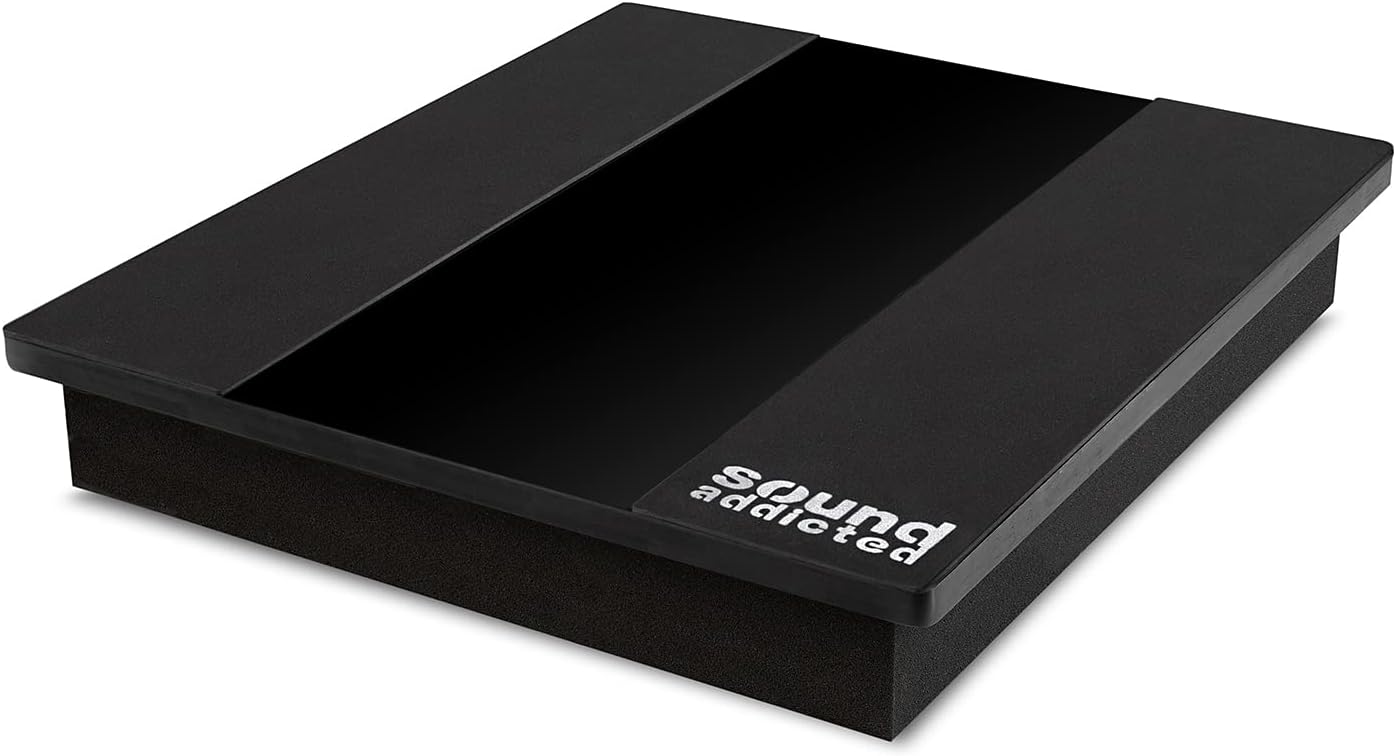
- Break the direct contact between kit and floor. An anti-vibration mat or riser placed under the whole kit — not just the kick — gives the impacts something to absorb before they reach the structure. This is often the most effective physical change you can make.
- Switch the kick strikes to an electronic source. An electronic drum set still has a pad and pedal making contact with the floor, but the impact is a rubber or mesh pad landing rather than a full-size bass drum shell resonating against a hoop — a meaningfully smaller amount of energy going into the floor. Pair it with headphones built for electronic drums and you also solve the airborne-noise half of the problem.
- Check your throne and hardware feet. A stable, well-placed throne that doesn't rock, plus rubber-footed stands, removes small extra sources of vibration that add up.
- Protect your own hearing while you work on the rest. Ear plugs don't reduce vibration transfer to neighbors, but they let you practice at a level where you can actually hear your own dynamics without cranking everything up — which indirectly keeps your playing, and the vibration it produces, more controlled.
What Won't Help Much
A thin foam pad or a folded blanket under the kick drum can take the edge off some rattle, but it rarely does much against a hard floor connected to a building's frame — the impact still finds a path through the wood or concrete underneath. If vibration complaints continue after small fixes, the direct-contact points (kick, throne, stand feet) are the places to keep addressing, not the room's general softness.
Vibration is a physical, measurable thing — frequency, amplitude, energy — not a mystery. Once you know where it's coming from on your kit, you can work down the list above one item at a time instead of guessing.