
The drum part here is a steady rock groove with a distinctive tom pattern up front — nothing about it is technically hard, but staying locked in through the quiet verses and bigger choruses takes some control. It's a solid pick for a beginner because the core beat repeats a lot, so once you learn it once, you've learned much of the song.
The Core Groove
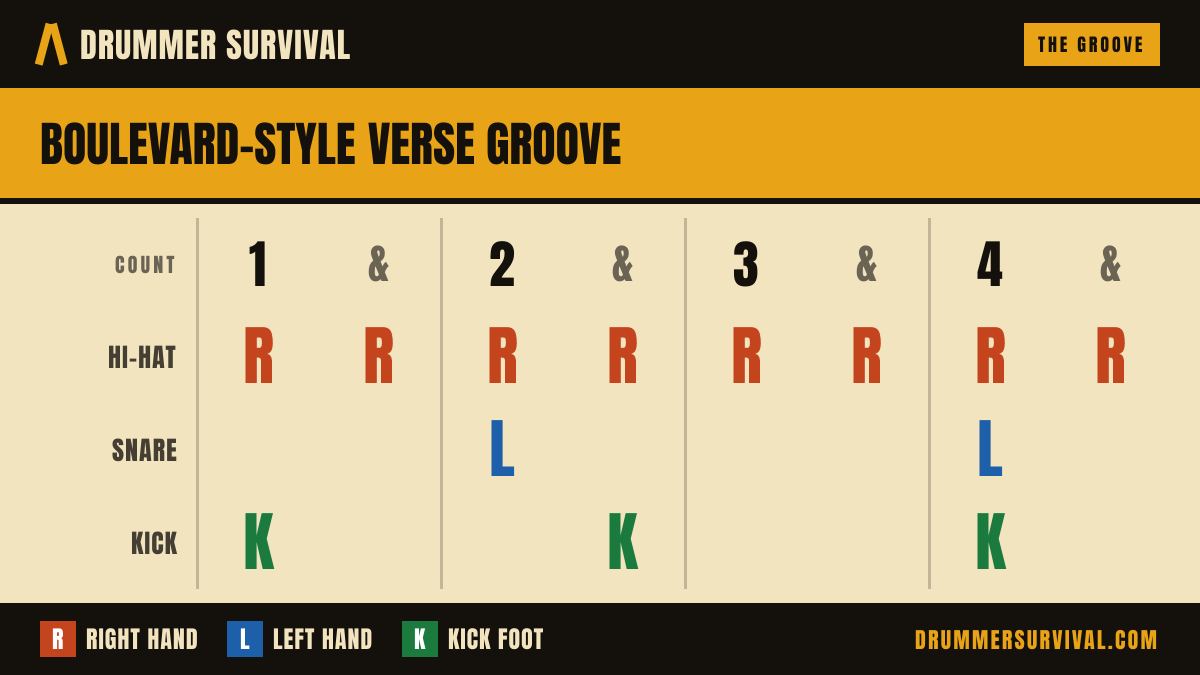
Here's a simplified version of the basic beat you'll use through much of the song. This isn't a note-for-note transcription — it's a beginner-friendly version of the same feel, built to get your hands and feet moving together.
Count it as "1-and-2-and-3-and-4-and," hi-hat on every count, snare on beats 2 and 4, kick on beat 1 and beat 3. If your hands and feet fight each other on this, slow it way down — there's no speed you have to prove before it feels natural.
Mapping the Song's Sections
Intro — The song opens with a tom-based pattern before the full kit kicks in. You don't need double bass or anything fast here; it's mostly about landing cleanly and building into the beat rather than rushing it.
Verse — This is where the core groove above lives. Keep it simple and let the hi-hat carry the steady pulse while the snare marks 2 and 4.
Chorus — The energy lifts. You'll likely open the hi-hat or move to the crash to make the section feel bigger, while the underlying kick-and-snare pattern often stays close to the verse. Focus on volume and feel changing, not on adding complicated new patterns.
Bridge/Outro — Songs like this often bring back the tom pattern from the intro to signal a section change. Treat it as the same skill as the intro fill — clean hits, steady tempo, land back on beat 1.
The Trouble Spots
- The tom pattern at the start and end. This is a part beginners often rush. Practice it completely separately from the rest of the song, slow, until you can play it the same way twice in a row.
- The jump from a quiet verse to a loud chorus. It's easy to speed up out of excitement. Keep a metronome or the recording running in your ear and check your tempo right as the chorus lands.
- Staying locked to the hi-hat. Because the verse groove is repetitive, it's tempting to drift on autopilot. Small drifts add up over a song this length.
Finding the Right Tempo
This song's exact tempo can vary depending on the recording or version you're following, so rather than memorizing a number, use a metronome app and match it by ear while listening. Start by practicing the core groove slower than the recording. Once it feels automatic, bring the tempo up in small steps until you can match the song comfortably.
A Simple Practice Plan
- Play the core verse groove alone with a metronome until it feels boring, not shaky.
- Add the tom pattern from the intro/bridge as its own exercise, separate from the groove.
- Practice the transition from verse groove to chorus energy at a slow tempo, checking that you don't speed up.
- Put it all together with the recording, starting slower than the song and working up.
A basic pair of beginner drum sticks and a bit of pad time on the tom pattern using a practice pad will get you through the trickiest section faster than trying to learn it live on the kit. If you're practicing on an electronic kit in an apartment, a decent pair of headphones makes it much easier to hear the click against the track.