The drumming itself is simple — a steady rock beat you can loop through almost the whole song. What makes this song worth the difficulty-2 rating isn't the groove; it's staying locked with the band through a few unison stops where the music drops out completely and you have to keep counting on your own.
Why This Song Works for Beginners
This is a good early song to learn because the verse and chorus share almost the same drum pattern. Once you have the core beat under your hands and feet, you're playing most of the song — you're not learning five different grooves back to back. The challenge is less about coordination and more about staying steady and listening.
The Core Groove (Simplified Beginner Version)
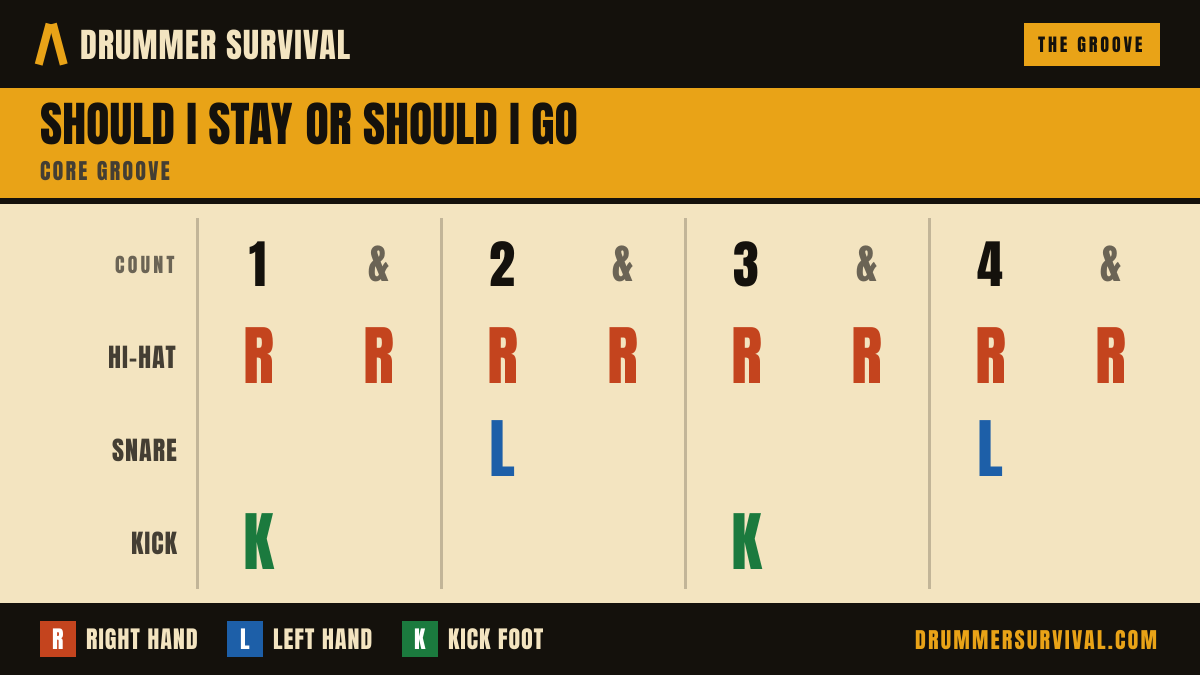
You don't need the exact recorded pattern to start. A simplified version that captures the feel:
- Hi-hat: steady eighth notes, played with your right hand if you're right-handed
- Snare: backbeat on beats 2 and 4
- Kick: land it on beat 1, and add a second kick hit somewhere in the bar once the basic beat feels solid
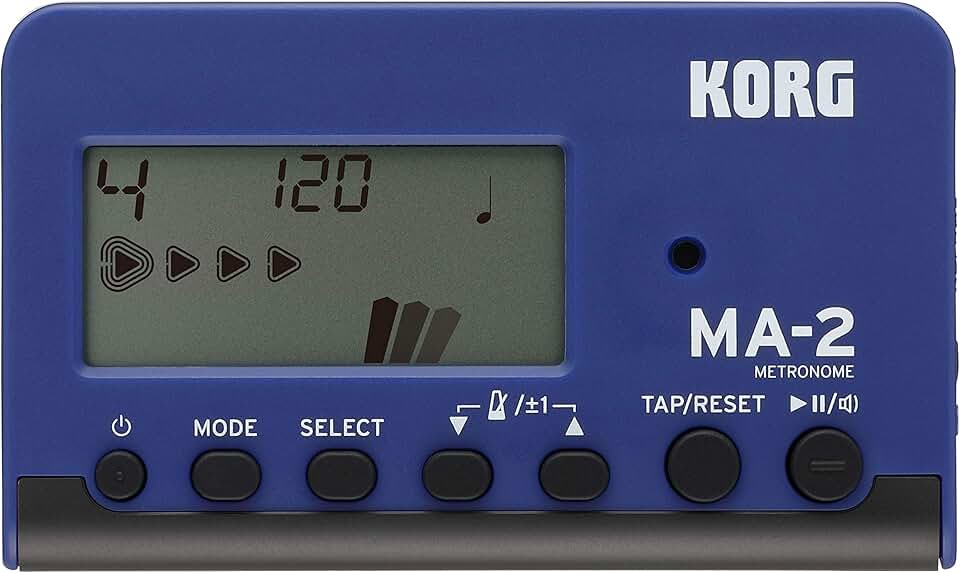
That's the whole pattern. Loop it slowly with a metronome before you try to match it to the recording. The full tab (linked separately from this page) shows the exact kick placement used on the record, which follows the bass line more closely — but you don't need that detail to start playing along.
Work the hands and feet separately first if the coordination feels new. A practice pad is useful here — you can drill the hi-hat/snare hand pattern without needing the kit, then add the kick once your hands feel automatic. A steady, comfortable bass drum pedal also makes a real difference on a beat like this, where the kick has to stay even and not drag.
Mapping the Song: Intro, Verse, Chorus, Outro
The arrangement is built around a recognizable guitar riff that opens the track, a verse that sits back a little in energy, and a chorus (the shout-along "should I stay or should I go" hook) that pushes the energy up without changing the core beat much. Play the same groove through both sections, but let your dynamics — how hard you hit — do the work of separating verse from chorus rather than changing the pattern itself.
The Tricky Spot: The Unison Stops
The hardest part of this song isn't a fill or a fast section — it's the moments where the whole band stops together and comes back in on a specific beat. When the guitar and bass drop out, you lose the thing you'd normally lean on to stay in time. You have to keep counting through the silence in your head and come back in exactly where the band does.
This is where some beginners lose the pulse, not because the beat is hard, but because counting silently is a different skill than playing along with a groove that's already there. Practice this by playing the section on your own, stopping at the same spot, counting one full beat (or whatever gap the song has) out loud, and coming back in — before you try it with the track.
Common Mistakes
- Speeding up during the chorus. It's easy to push the tempo when the energy goes up. Keep the same internal pulse; let dynamics, not tempo, carry the lift.
- Guessing the re-entry after a stop instead of counting it. If you come in late or early after a unison hit, one common cause is losing count during the gap rather than a general timing problem — but it's worth checking both.
- Rushing straight to full volume and full kit. Learn the pattern quietly and slowly first — on a pad or at low volume on an electronic drum set with headphones — before you try to match the record's energy.
Practice Plan
- Learn the simplified beat above on its own, slow, with a metronome — hands and feet only, no song.
- Loop the beat under the verse section of the track at a comfortable volume.
- Isolate the stop section by itself. Play up to the stop, count through the gap out loud, and come back in — repeat until it's automatic.
- Play the full song from the top, at a reduced tempo if your player allows it, focusing on staying steady through the chorus.
- Bring the tempo back up to the recording once the stop section feels reliable, not before.
If you're practicing at home and worried about noise, a drum throne that lets you sit comfortably for longer sessions, a decent pair of sticks, and ear plugs for acoustic kit practice are worth having before you work through a full song like this one.