Highway to Hell is a solid pick if you're a couple of months into playing: a steady rock beat, a simple kick-and-snare pattern, and one recognizable fill going into the chorus. You don't need fast hands or double bass — you need a groove that stays locked in and doesn't drift when the song picks up energy.
The core groove
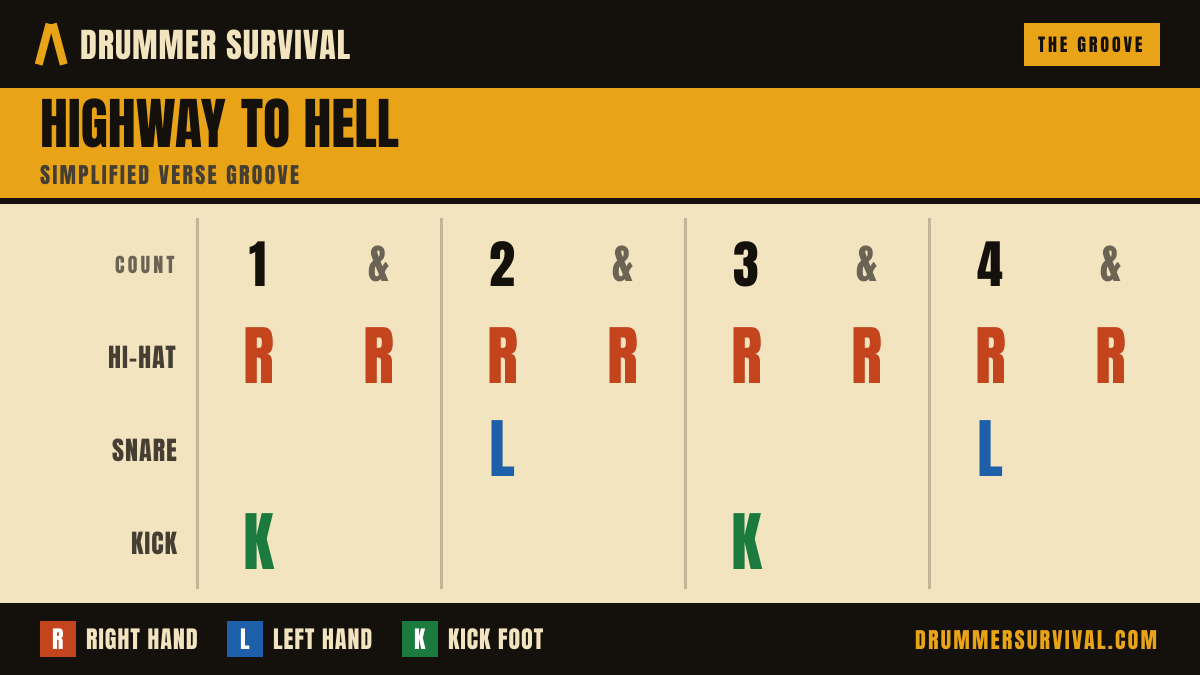
Here's a simplified version of the main beat, built for learning — not a copy of the exact recording. It's the same shape you'll hear on most of the verse: straight eighth notes on the hi-hat, snare on the backbeat (beats 2 and 4), and kick on beats 1 and 3.
Count it as "1 and 2 and 3 and 4 and." Your hi-hat hand plays every number and every "and." Your snare hand hits on 2 and 4. Your kick foot lands on 1 and 3. That's the whole engine of the song — everything else is variation on this.
Mapping the song
- Intro — mostly guitar and vocal build-up. Drums often stay out or play very sparse hits. Don't force a full beat in here — listen and come in with the band.
- Verse — the groove above, straight and steady. This is where you'll spend most of your practice time.
- Pre-chorus / chorus — same basic beat, but the song feels bigger. You don't need to change the pattern — just play with a bit more weight on the snare and kick so the energy lifts naturally.
- Fills — short fills lead into the chorus sections. Keep it simple: a beginner-friendly version is just three or four snare hits ending back on beat 1 of the next section. The goal is landing cleanly on 1, not playing something flashy.
Practice plan
Work in stages instead of jumping straight to full speed with the recording.
| Stage | What to do | Goal |
|---|---|---|
| 1. Slow and isolated | Play the groove alone with a metronome, well under the song's speed | Even hi-hat, no rushing |
| 2. Add the fill | Practice the fill by itself, then drop it into the groove every 4 bars | Land back on beat 1 cleanly |
| 3. Half-speed with track | Slow the recording down (many apps and players let you do this) and play along | Match the feel, not just the notes |
| 4. Full speed with track | Play along at normal speed | Hold the groove through verse and chorus without drifting |
A metronome or slowed-down track will expose any spot where you speed up — usually going into or out of the fill. That's normal early on; it's a coordination thing, not a sign you can't play the song.
Gear that helps with this one
You don't need anything special for this song, but a few things make practicing it easier:
- A pair of medium-weight drum sticks gives you enough control for the backbeat without feeling too light or too heavy.
- If you're working on the groove away from a full kit, a practice pad is enough to drill the hand pattern and the fill.
- Practicing on an electronic drum set with headphones lets you play along to the track at full volume in your ears without disturbing anyone else in the house.
- If you're on an acoustic kit, ear plugs are worth it for repeated practice at real volume.
Common mistakes on this song
- Rushing the hi-hat under a busy guitar part. The guitar can make the groove feel like it needs to speed up — it doesn't. Trust the click.
- Overplaying the fill. A short, clean fill that lands on 1 sounds better than a long one that falls apart.
- Skipping the slow-tempo stage. Jumping straight to full speed with the record is where most of the frustration comes from — build the groove first.