Basket Case runs on one simple, driving beat repeated with small variations — that's what makes it a solid early song to learn. Get the core eighth-note groove locked in, add one basic fill before the chorus, and you're most of the way there.
The Core Groove
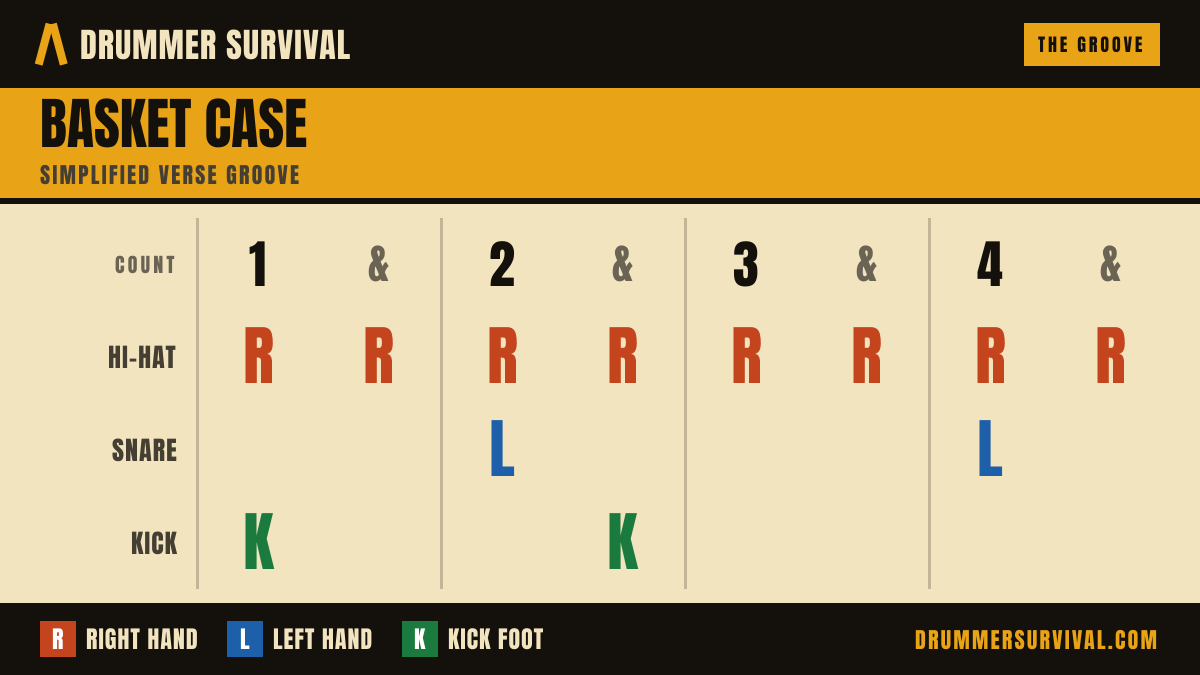
Here's a simplified version of the main beat, built from the eighth-note hi-hat and snare-on-2-and-4 pattern this kind of punk rock song uses:
Your hi-hat hand plays a steady eighth-note pulse the whole way through — no gaps. Your snare hand hits on beats 2 and 4 (the backbeat). Your kick foot lands on beats 1 and 3. That's the whole engine. The song's energy comes from playing this cleanly at a fast tempo, not from anything complicated.
Learning the Groove Hand-by-Hand
Don't try to play all three limbs together on day one. Build it in layers:
- Hi-hat only. Play steady eighth notes with your right hand (or left, if you're set up open-handed) at a slow, comfortable tempo. Keep the spacing even — this is harder than it looks once you speed up.
- Add the kick. Kick on beats 1 and 3 while the hi-hat keeps going. Say "1-and-2-and-3-and-4-and" out loud and drop the kick on the numbered beats.
- Add the snare. Snare on 2 and 4, on top of the hi-hat and kick you already have moving.
Only combine all three once each pair feels solid on its own. A shaky three-limb groove often means one of the two-limb combinations wasn't actually locked in yet.
If you're practicing quietly, a practice pad is good for drilling the hand pattern before you add the kick foot on a full kit.
Mapping the Sections
Songs like this usually follow a familiar shape, and Basket Case is no exception:
- Intro — a short build-up before the full band comes in. This is where a lot of beginners lose the beat because they're anticipating the "big" entrance instead of just counting through it.
- Verses — the core groove above, steady and unchanging.
- Choruses — same groove, usually with more energy — heavier hi-hat or a crash cymbal marking the first beat of the section.
- Bridge / breakdown — sections like this often simplify further or drop out entirely before building back in, so listen closely rather than assuming the pattern repeats exactly.
The Fill Before the Chorus
Transitions into the chorus usually get a short fill — something as simple as four snare hits leading back to beat 1, or a couple of tom hits followed by a crash. You don't need anything fancy:
The goal of any fill here isn't to impress anyone — it's to land cleanly back on beat 1 with the rest of the band. If a fill throws off your timing, simplify it further before trying to add more notes.
Where Beginners Often Trip Up
- Losing the hi-hat consistency at speed. The eighth notes need to stay even even when your arm gets tired. If they start to speed up or drag, slow the whole groove down and rebuild.
- Rushing into fills. The section right before a fill is where tempo tends to creep. Practice the bar before the fill and the fill itself as one connected phrase, not two separate things.
- Kick and snare fighting each other. If your foot copies your snare hand's rhythm instead of staying on 1 and 3, go back to the two-limb drills above and slow down further.
Practice Plan
- Play the hi-hat pattern alone for a minute at a slow tempo.
- Add the kick, then the snare, one at a time, at that same slow tempo.
- Loop just the verse groove for a few minutes until it feels boring — boring means automatic.
- Add the simple transition fill, played slowly, focusing on landing on beat 1.
- Only then try playing along with the actual track, starting with just the verse sections.
A solid pair of drum sticks with a bit of weight to them helps with the steady eighth-note hi-hat work this song relies on — thin, whippy sticks can make it harder to keep the pattern even at speed. If you're practicing on an electronic kit, a decent pair of headphones makes it much easier to hear your own timing against a click.