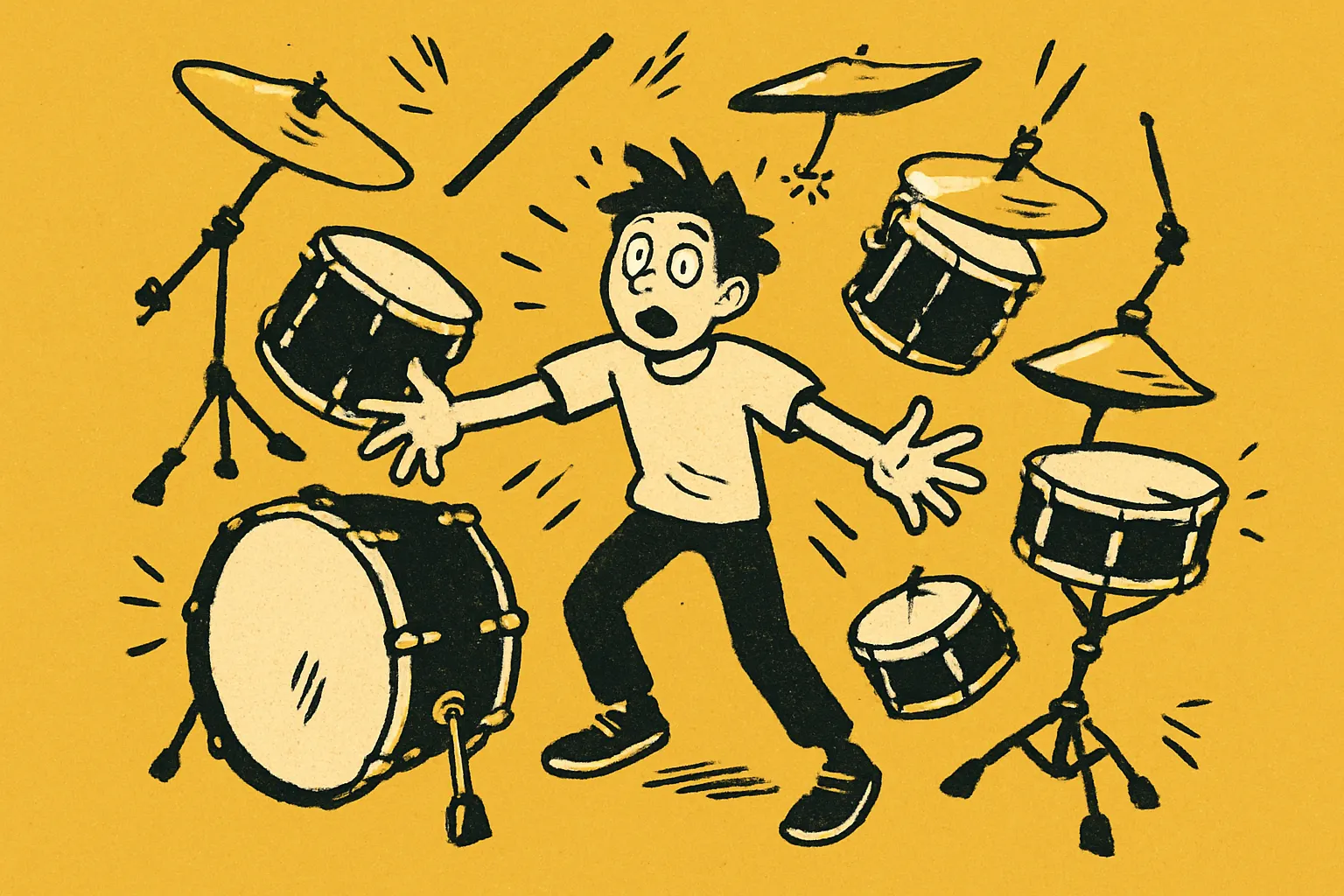
The drums, one by one
Bass drum (kick drum). The largest drum on the kit. It lies on its side on the floor and you play it with a foot pedal, not a stick. Its deep, resonant thud is the foundation of the groove. If someone asks what the big drum is called, this is it.
Snare drum. The cornerstone of the kit, sitting right in front of you between your knees. It's usually 36 cm (14 in) across. What makes it sound like a snare — that sharp, staccato crack — is a set of metal snare wires stretched along the bottom head. When you hit the top head, those wires rattle against the bottom one. A lever on the side called the throw-off drops the wires away from the head; flip it off and the snare suddenly sounds like a small tom. How tight the wires sit makes a big difference to the sound.
Rack toms (mounted toms). The smaller drums mounted above the bass drum, sometimes called hanging toms or just "the toms." Smaller shell, higher pitch. These are the drums your fills often travel across.
Floor tom. The bigger tom that stands on its own legs to your right (in a right-handed setup). Lowest-pitched tom, deep and round.
The snare, bass drum, and toms together are the heartbeat of the kit. Cymbals decorate; those drums carry the groove.
How kits are counted: 4-piece, 5-piece, 6-piece
Count the drums, ignore the cymbals.
| Kit Size | Drums Included |
|---|---|
| 4-piece | Bass drum, snare, one rack tom, one floor tom |
| 5-piece | Bass drum, snare, two rack toms, one floor tom |
| 6-piece | Same as 5-piece plus one extra tom (third rack tom or second floor tom) |
- 4-piece: bass drum, snare, one rack tom, one floor tom. Common in jazz and small rock setups.
- 5-piece: bass drum, snare, two rack toms, one floor tom. A common beginner and rock layout.
- 6-piece: the same as a 5-piece plus one extra tom — either a third rack tom or a second floor tom.
So "what are the five drums called?" — kick, snare, high tom, mid tom, floor tom. Drop the mid tom and you have the four drums of a 4-piece. Add one more tom and you have six.
A smaller drum in that lineup is usually called the high tom or small rack tom, and the snare is the small drum that does a lot of the work. Bigger kits just keep adding toms and cymbals to the same core.
The cymbals
Hi-hat. Two cymbals, typically 33–38 cm (13–15 in), stacked face to face on a stand with a foot pedal. The bottom cymbal is fixed. The top one — usually the lighter of the two — sits on a moving rod, so pressing the pedal squeezes the cymbals together and releasing lets them part. You play it by striking the edge (or the top) with a stick while your foot decides whether it's open or closed.
- Closed hi-hat: cymbals pressed together. Tight, controlled "tick." Start here — this is the sound in a lot of beginner grooves.
- Open hi-hat: cymbals apart when you strike. Loud, washy, explosive; used for variation and accents.
- Pedal hi-hat: no stick at all. Your foot closes the cymbals to make a short "chick" — a supporting sound rather than a lead voice.
Ride cymbal. The big cymbal usually to your right that you play steady patterns on, as an alternative to the hi-hat.
Crash cymbal. The one you hit for accents — the start of a chorus, the end of a fill.
Hardware: the parts that aren't drums
Hi-hat stand. A metal frame, a pull rod running up the middle, a clutch, and a pedal. The clutch is the small collar that grips the top cymbal and attaches it to the pull rod — get it wrong and your hi-hat won't open or close properly. The stand comes apart into a few sections so it can be carried, which is exactly why building it feels like a puzzle. Expect to reassemble sections rather than unfold one solid unit.
Bass drum pedal. A footboard, a chain or strap, and a beater that swings into the drum head. Pedals are one place where an upgrade can be genuinely felt underfoot — see our beginner bass drum pedal picks if the one that came with your kit feels sticky or sloppy.
Cymbal stands and tom mounts. Straight stands, boom stands (with an arm that reaches over the kit), and the clamps that hold rack toms above the bass drum. Each one uses a felt washer and a sleeve to stop metal touching cymbal metal.
Throne. The drum stool. It's a part beginners often skip and then regret, because your seat height sets your leg angle for both pedals. Our drum throne guide covers what actually matters here.
Sticks. Not part of the kit, but the part that touches everything. Start with one middle-of-the-road pair rather than a collection — see drum sticks for beginners.
Tuning parts: rim, tension rods, lugs, heads
On every drum, the head is a plastic film stretched over the shell. A metal rim (or hoop) sits over the head's edge, and tension rods pass through the rim and thread into lugs bolted to the shell. Turning a tension rod pulls the rim down, which pulls the head down over the shell's bearing edge — the sharp top edge of the wood. That's all tuning is: even tension all the way around.
Most drums have two heads. The batter head is the one you hit; the resonant head is underneath. On a snare, the wires run along that bottom resonant head.
On an electronic kit, the names still hold
An electronic kit uses the same map: a kick pad with a pedal, a snare pad in front of you, tom pads, and hi-hat, ride, and crash cymbal pads. Learn the parts on one and you can sit down at the other. The hi-hat is the usual difference — some electronic hi-hats are a pad plus a separate pedal, so "open" and "closed" come from how far the pedal is pressed. If you're playing an electronic kit, headphones made for drumming matter more than the module's speaker, and in a flat, an anti-vibration mat deals with the thump that travels through the floor.
Where your hands and feet go
In a standard right-handed setup: the hi-hat sits to the left of the snare, the floor tom to the right, the rack toms above the bass drum. Your left foot works the hi-hat pedal and your right foot works the bass drum pedal. A left-handed setup mirrors all of that.
Because the hi-hat is on the left and you usually play it with your right stick, your hands cross over: right hand on the hi-hat, left hand underneath it on the snare. That's the traditional rock and jazz position. It isn't a rule — some drummers play open-handed, with the left hand on the hi-hat and no crossing at all — but crossed hands is what you'll see in a lot of beginner videos.
A five-minute drill to make this stick
Sit down at the kit (or a table, if you don't have one yet) and do this once:
- Touch each drum and say its name out loud: kick, snare, high tom, floor tom.
- Flip the snare throw-off off and on, hitting the drum each time, so you hear what the snare wires actually do.
- Press the hi-hat pedal down and strike the edge, then lift your foot and strike again. Listen to closed versus open.
- Play four slow quarter notes on the closed hi-hat, counting "1, 2, 3, 4" out loud. Add the snare on 2 and 4. Add the kick on 1 and 3.
Start around 60 BPM. If that's messy, drop to 50 — there's no speed you have to prove here. If you don't have a kit yet, the same counting works on a practice pad with your feet tapping the floor.
Common beginner mix-ups
- Counting cymbals in the "piece" number. A 5-piece kit has five drums and however many cymbals you bought.
- Calling every tom a "tom-tom" and stopping there. Rack tom versus floor tom is worth learning, because tutorials tell you which one to hit.
- Blaming the hi-hat for sounding sloshy. If you want a tight closed sound, check that your foot is applying steady downward pressure rather than just resting on the pedal, and that the top cymbal has a slight tilt so the two cymbals close evenly around the whole edge.
- Overtightening tension rods on one side. Uneven tension can make a new drum sound choked or warbly. Go around the drum in small, even turns.
- Forgetting the felts and sleeves on cymbal stands. Metal on metal is rough on cymbals.
- Playing loud with no hearing protection. An acoustic kit in a small room is genuinely loud, and ear plugs made for musicians let you keep practising comfortably.
You don't need to memorise all of this today. Learn the four drum names and the three cymbal names first — the hardware vocabulary arrives on its own the first time you have to build a hi-hat stand.