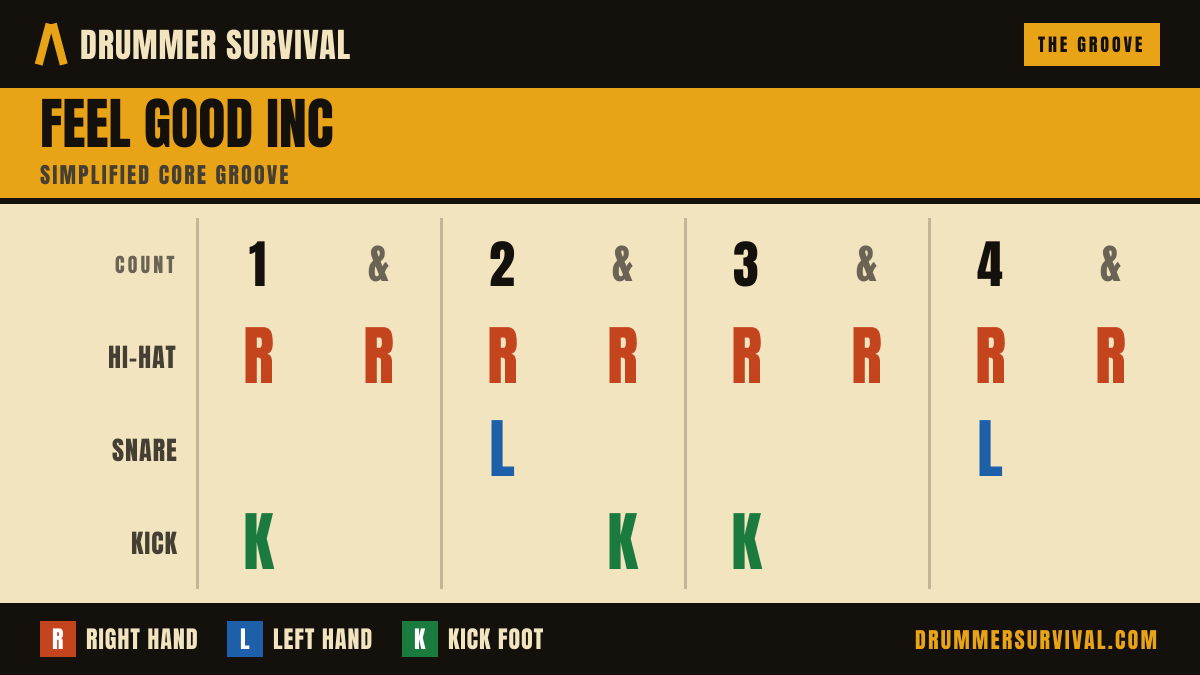
The drum part in Feel Good Inc is a repeating groove built from three pieces: steady eighth notes on the hi-hat, a snare hit on beats 2 and 4, and a kick drum pattern that lands on beat 1 plus one extra syncopated hit that falls off the beat. Once your hands and feet know their three jobs separately, layering them together is the whole task. Rated a 2 out of 5 for beginners, this is a solid early song because the pattern repeats for most of the track instead of constantly changing.
The core groove, simplified
Here's a beginner version that captures the feel without matching the record note-for-note:
- Hi-hat: steady eighth notes the whole way through (down-up-down-up), played on a practice pad or your hi-hat cymbal at a quiet, even volume.
- Snare: hit on beats 2 and 4, same as most beats you've probably already practiced.
- Kick: hit on beat 1, then again on the "and" of beat 2 — that off-beat kick is what gives the groove its bounce.
That's the whole pattern. It repeats through most of the verses. The actual recording has small variations and ghost notes layered on top, but this simplified version is enough to play along with the song and feel the groove.
How the sections differ
Songs built this way tend to change energy more than they change pattern, and this one is no exception:
- Intro: sparser than the rest — often just hi-hat and kick, with the snare dropping in a few bars later. Use this section to lock your hi-hat hand in before the full pattern arrives.
- Verse: the core groove described above, played fairly restrained.
- Chorus: the same skeleton but with more drive — you can open the hi-hat slightly or dig in a little harder on the snare to mark the lift in energy.
- Breakdown/bridge: a thinner section before the final chorus, often stripping back to just kick and hi-hat again.
You don't need to memorize exact bar counts on your first pass. Listen for the drop in intensity (thinner texture) and the lift (fuller, louder) and match your playing to it.
The trouble spot
The syncopated kick — the one that lands on the "and" of beat 2 instead of squarely on a beat — is a common place for beginners to lose the groove. Your foot wants to land with your hands, and this pattern asks it not to. If you rush or drag that kick hit, the whole groove feels off even though everything else is right.
A cheap way to isolate the problem: play just hi-hat and kick, no snare, on repeat, until the kick's placement stops feeling like a guess. Then add the snare back in. If your kick drum response feels sluggish or inconsistent, it's worth checking your bass drum pedal — a pedal that's too stiff or too loose for your foot makes syncopated kick patterns harder to control than they need to be.
We don't have a confirmed tempo for this track
Rather than guess a BPM number, use a metronome app or your electronic kit's built-in click, find the tempo by ear against the recording, and start noticeably slower than that until the pattern feels automatic. There's no speed you have to prove on your first attempt — locking in the feel matters more than matching the record's speed right away.
Practice plan
- Hands only. Play the hi-hat pattern alone on a practice pad or your kit until it's steady and quiet.
- Add the kick. Hi-hat plus the beat-1-and-the-and-of-2 kick pattern, no snare yet. Go slow enough that you're not guessing where the second kick lands.
- Add the snare. Full pattern, still slow, using a metronome to keep you honest about the syncopated kick's placement.
- Play along with the track, starting slower than the recording and working your way up as the pattern stops taking conscious thought.
If you're practicing on an electronic drum set to keep noise down, a decent pair of headphones makes it much easier to hear where your kick actually lands against the click. And if you're on an acoustic kit in a shared space, ear plugs protect your hearing during longer repeat-and-loop practice sessions like this one.
Common mistakes
- Rushing the syncopated kick — it tends to drift early because your body wants to land it on the beat. Slow down until it stops happening.
- Losing the hi-hat's steadiness once the kick comes in — practice the hi-hat alone first so it doesn't wobble when your foot joins.
- Playing every section at the same volume — the chorus lifting in energy is part of the song's shape; matching that with dynamics makes your playing sound more musical, not just more accurate.
- Sitting too rigidly — a groove this laid-back benefits from a relaxed posture. If your drum throne is at an awkward height, you'll tense up trying to stay balanced instead of feeling the pocket.
Once this pattern feels automatic, it's a good template for other hip-hop-influenced grooves — the same skill (steady hands, one off-beat kick) shows up all over that style of drumming.