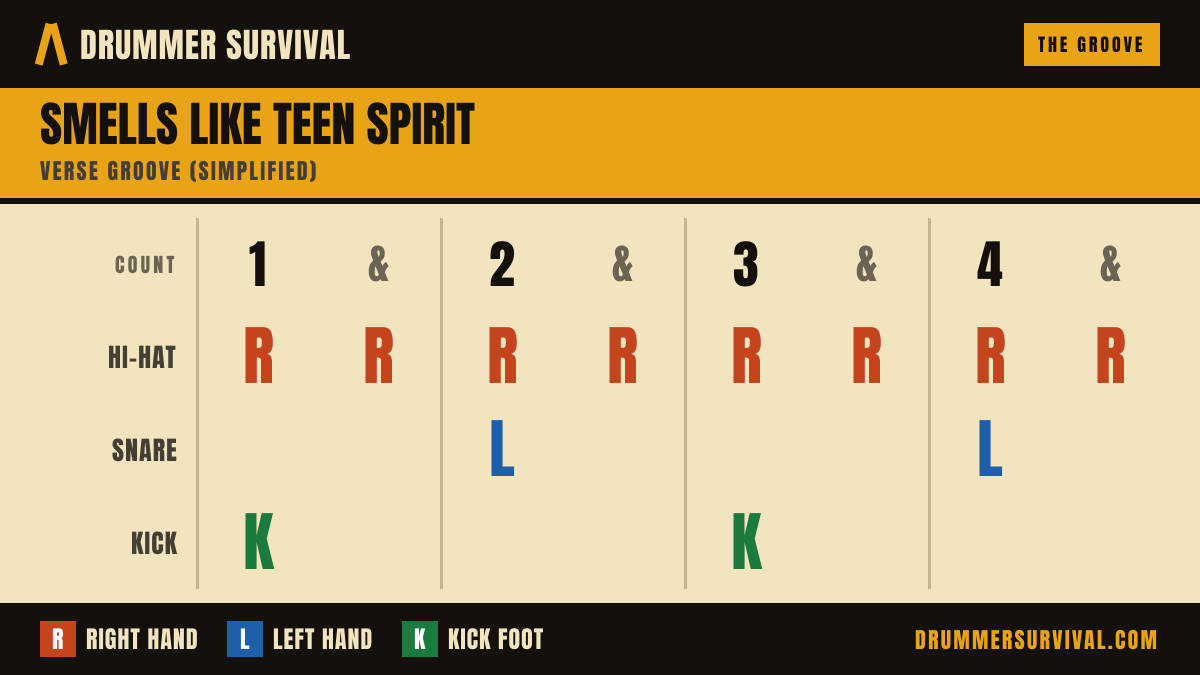
The drum part in "Smells Like Teen Spirit" is a straight eighth-note hi-hat groove with the snare on beats 2 and 4 and the kick on beat 1 — the same basic rock beat under both the quiet verses and the loud choruses. What makes the song feel hard isn't the notes; it's playing that simple pattern quietly, then hitting it much harder for the chorus without rushing or losing the beat.
The Song at a Glance
- Difficulty: 2/5 — a good early song once you can hold a basic beat for a few minutes without stopping.
- Structure: intro riff, quiet verse, loud pre-chorus build, loud chorus, repeat, with a guitar-solo section and outro.
- The real challenge: dynamics (quiet vs. loud), not complicated limb patterns.
The Basic Groove (Verse)
Count it in eighth notes: "1-and-2-and-3-and-4-and." Your hi-hat hand plays every one of those eighths, your snare hand hits on "2" and "4," and your kick foot hits on "1."
Play this quietly during the verse — light hi-hat taps, a controlled snare. Keeping it quiet on purpose is part of the part, not a sign you're playing it wrong.
The Chorus Is the Same Beat, Louder
When the chorus hits, most beginners play a busier pattern because it sounds more complicated on the record. Really, it's the same skeleton with more energy and often one extra kick hit for drive:
Switch from hi-hat to crash-then-hi-hat, or ride if you have one, to mark the change. The main job is volume: hit harder across the board, especially the snare, so the section actually feels like it lifted off.
| Section | Hi-hat | Snare | Kick | Feel |
|---|---|---|---|---|
| Verse | quiet, closed | light, on 2 & 4 | on beat 1 | held back |
| Chorus | open/crash, loud | hard hits, on 2 & 4 | 1 and 3-and | driving, full volume |
The Turnaround Fill
Going into the chorus, keep the fill simple — four snare hits leading back to beat 1 works fine, or two snare hits and a crash. Don't reach for a big tom fill around the kit until the basic groove and the volume switch feel automatic; a clean, simple fill that lands on beat 1 will sound better than a rushed fancy one.
Common Mistakes
- Playing the verse too loud — it should sound noticeably quieter than the chorus, not just "a bit less."
- Rushing into the chorus — the tempo doesn't change, only the dynamics and the extra kick hit do.
- Overcomplicating the fill — a simple fill that lands cleanly beats a busy one that doesn't.
- Losing the kick foot when volume goes up — playing louder tends to make your foot tense and speed up; keep it relaxed.
How to Practice It
- Play the verse groove alone, hands only, very slow, until it's steady.
- Add the kick foot at the same slow tempo.
- Loop the verse groove for a full minute without stopping.
- Switch to the chorus version and practice the volume jump between the two, back and forth.
- Add the simple turnaround fill last, once both grooves feel comfortable.
- Play along to the track only after steps 1–5 feel solid on their own.
Because the choruses get loud, a decent pair of drum sticks that can take hard hits helps, and if you're practicing at home, ear plugs are worth having for a song built around volume swings. If you're on an electronic drum set, a solid pair of headphones makes it much easier to actually hear the dynamic difference between verse and chorus while you practice.