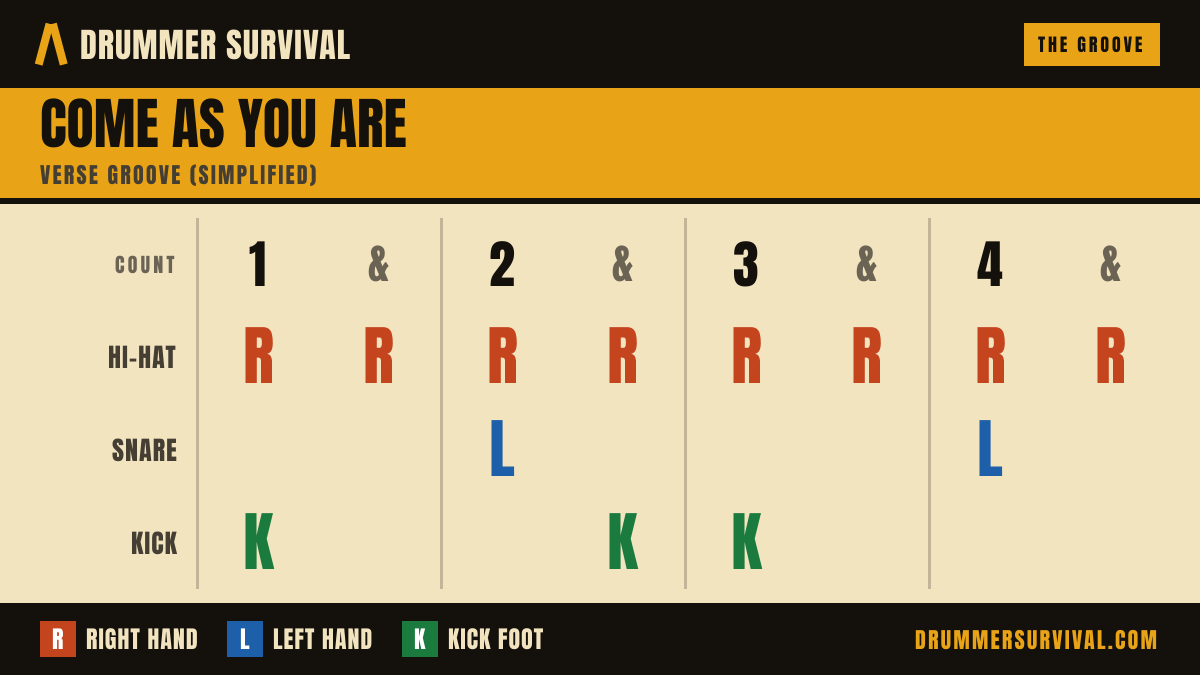
The drum part in "Come as You Are" is a steady rock groove built on eighth-note hi-hat, a backbeat snare, and one syncopated kick hit that lands just before beat 2. That syncopation is the only tricky part — everything else is a beginner-friendly, repetitive groove you can lock in fast.
The Core Groove (Simplified)
Here's a simplified version of the main beat, built to teach the feel without copying the exact recorded part:
Read it left to right as eight even eighth notes. Your right hand (or left, if you play open-handed) rides the hi-hat the whole way through — no breaks. Your snare hand drops in on beat 2 and beat 4, the standard backbeat. Your kick foot plays on beat 1, then again on the "and" right after beat 1 — that early second kick is what gives the groove its lean-forward push.
Learning It Hand-by-Hand, Foot-by-Foot
Don't try to play all three limbs at once on your first attempt. Build it in layers:
- Hi-hat only. Play steady eighth notes with your hand. Keep it quiet and even — this is your foundation, not the star of the beat.
- Add the snare. Keep the hi-hat going and drop your snare hand in on beats 2 and 4. Say "1-2-3-4" out loud and hit the snare on the numbers 2 and 4.
- Add the kick. This is where it gets real. Keep counting "1-2-3-4" and add the kick on beat 1, then again on the "and" right after it — count it as "1-and-2-3-4." Play the kick alone against the count first, no hands, until it's automatic.
- Put all three together, slow. Use a metronome set well under the song's real speed. There's no minimum tempo to prove here — if it falls apart, drop the tempo further until it's clean.
If you're practicing on a practice pad away from a full kit, you can work the hand pattern (hi-hat plus snare) there and just tap your foot on a table for the kick timing — it's a decent way to drill the coordination before you're behind the kit.
Mapping the Song's Sections
- Intro — stays sparse. Come in light, mostly hi-hat and kick, saving the full backbeat energy for later.
- Verses — the core groove above, played controlled and a bit restrained. This is where you'll spend most of your practice time.
- Choruses — the same basic groove, but pushed harder — more volume, sometimes a crash cymbal instead of hi-hat to open things up. The pattern doesn't change much; the dynamics do.
- Transitions and fills — short fills connect the sections. Keep any fill you add simple — a few snare hits that land you cleanly back on beat 1 of the next section beats more than a busy fill played out of time.
Trouble Spots to Practice Separately
- The syncopated kick. Loop just beat 1 and the "and" after it on the kick alone until you don't have to think about it.
- Quiet-to-loud transitions. Practice going from the verse groove into the chorus groove without a tempo bump. Playing along with the record with headphones for electronic drums makes this easier to judge, since you can hear yourself against the track clearly.
- Kick pedal control at low volume. The kick needs to be heard but not overplayed in the verses. A responsive bass drum pedal makes it easier to control that dynamic range, especially if your current pedal feels stiff or inconsistent.
A Simple Practice Plan
- Clap or tap the snare backbeat alone with a metronome until it's boring-easy.
- Add the kick pattern alone, no hands.
- Combine hi-hat, snare, and kick at a slow, comfortable tempo.
- Play along to the song at a reduced volume, focusing only on staying with the recording — don't chase speed yet.
- Once the groove is solid, add the section changes (verse to chorus) and practice keeping the tempo steady through them.
Common Mistakes
- Playing the kick pattern as straight beat-1-and-3 instead of the syncopated "and of 1" hit.
- Speeding up during the louder chorus sections.
- Overplaying fills between sections instead of keeping them simple and landing cleanly on beat 1.
- Practicing at full song tempo before the groove is clean at a slower speed.
If you're working this out on an electronic kit at home, a solid electronic drum set and a comfortable pair of drum sticks make the slow, repetitive layering work above a lot less tedious.