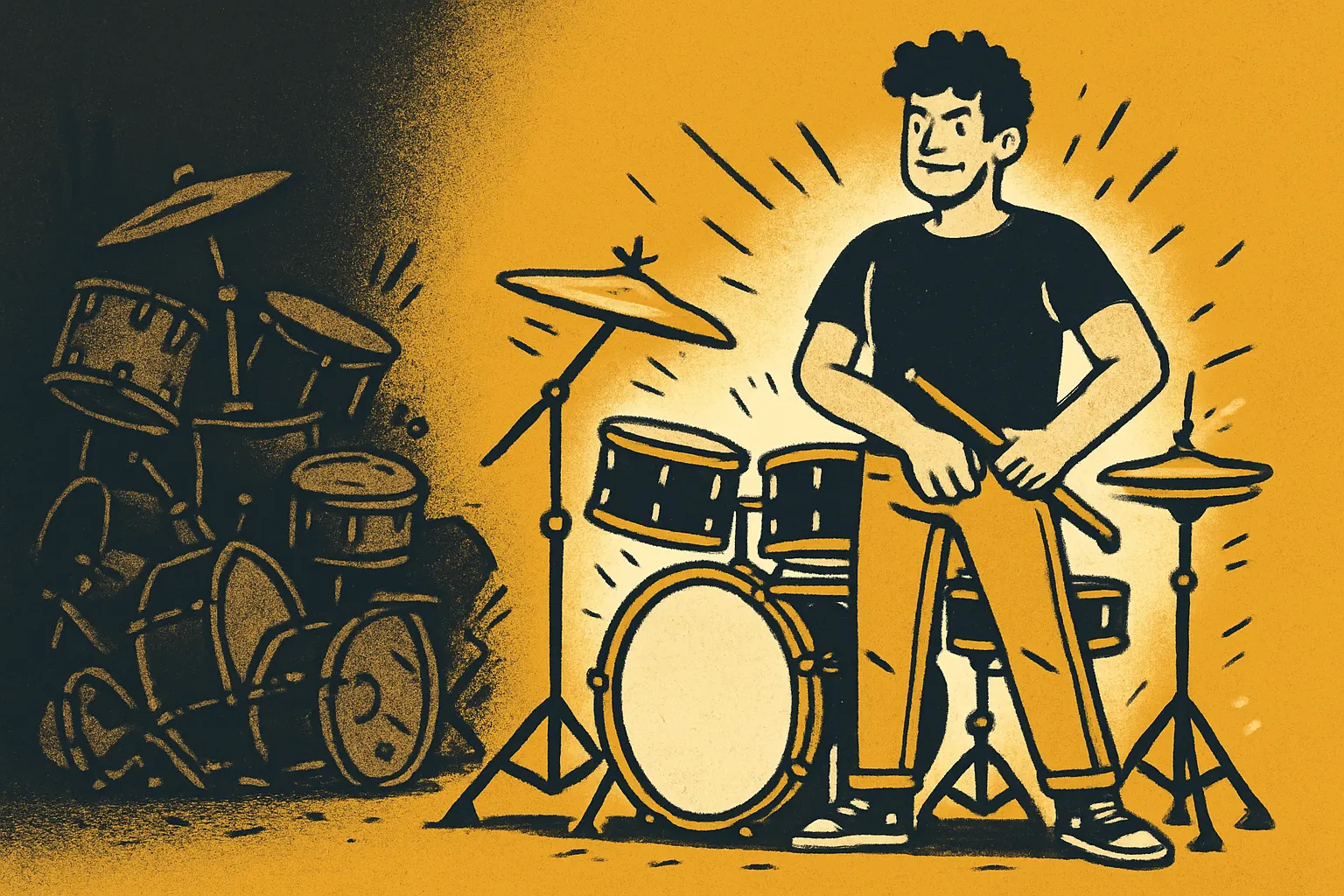
A solid starter kit for an adult beginner is a complete 5-piece shell pack from an established brand — think Pearl, Tama, Yamaha, or Gretsch — that already includes drum heads and hardware, and often cymbals too. You don't need a professional kit to learn on. You need something that stays in tune, holds together under regular practice, and fits your space and budget.
Here's what actually matters when you're picking one, and a few real options worth looking at.
Who This Is For
This guide is for an adult who wants to start playing drums at home or in lessons and needs a first kit — not a premium setup, not a toy. If you're not sure yet whether you'll stick with drums, that's normal. A mid-range starter kit is built to answer that question without wasting your money either way.
What Actually Matters (and What Doesn't)
Completeness. A "5-piece shell pack" generally means bass drum, snare, two toms, and a floor tom, sold with the hardware (stands) needed to set them up. Beginner packages typically come with everything needed to start playing, though cymbals are sometimes sold separately or as an upgrade option — check the listing carefully before you buy.
Heads. Many adult 5-piece beginner kits ship with Remo drum heads already installed, which is one less thing to think about early on.
Bass drum size. Beginner shell packs commonly use a 22-inch bass drum — the Yamaha Rydeen 5-Piece Shell Pack is one example, marketed specifically as a beginner-friendly kit built around that size. A 22-inch bass drum is a standard size that fits comfortably for many adults and many rooms.
Brand reputation, not brand hype. You don't need a boutique brand for your first kit. Mapex, Pearl, Gretsch, and Premier all come up repeatedly as beginner-friendly options, and the Pearl Export in particular has a long track record as a starter kit that holds up. Beyond entry level, Ludwig, Tama, and DW are names you'll keep seeing as you get more serious — but that's a later purchase, not a first one.
Budget range. Starter kits at general retailers commonly span from entry-level to mid-range. At the low end you're often trading away hardware quality and cymbal quality; kits in the middle of that range tend to be the sweet spot for someone serious about learning but not ready to spend pro money.
Acoustic vs. Electronic
Beginner drum packages come in both acoustic and electric versions, and the right choice depends more on your living situation than your skill level. An acoustic kit sounds and feels like a "real" drum set and is often the cheaper entry point, but it's loud — something to think about if you live in an apartment or share walls. An electronic drum set lets you play through headphones at almost any hour, which matters a lot if noise is a real constraint for you, not just a minor annoyance.
Neither option is the "serious" one and the other the "toy" one — plenty of drummers learn entirely on electronic kits. Pick based on where you'll actually be practicing.
Starter Kits Worth Looking At
A few names come up consistently as good options for adult beginners:
- Pearl Export — a long-standing, well-regarded beginner kit that shows up in recommendations across the board.
- Pearl Roadshow — often mentioned alongside the Export as a solid, more budget-friendly entry point.
- Tama Imperialstar — frequently recommended as a mid-range complete kit.
- Yamaha Rydeen 5-Piece Shell Pack — built around a 22-inch bass drum and marketed specifically for beginners.
- Gretsch beginner packages — another established name that turns up in first-kit recommendations.
- Ludwig Accent, Donner DDS-520, and PDP Center Stage — other budget complete kits commonly recommended for beginners.
- Gammon 5-Piece — a lower-cost option that's often suggested for someone who wants to try drums without a big upfront investment.
This isn't a ranked list — it's a set of reasonable starting points. Any of these will let you learn real technique; the differences show up more in hardware durability and cymbal quality than in whether you can actually learn to play on them.
What You'll Still Need to Buy
Even a "complete" kit rarely covers everything:
- Sticks. Many kits don't include a pair worth keeping — see our guide to drum sticks for beginners.
- A throne. Some packages include a basic seat, but it's often the first thing worth upgrading — check our drum thrones for beginners guide.
- A pedal, if you're upgrading later. Kits often include one, but if yours doesn't hold up, see bass drum pedals for beginners.
- Headphones, if you go electronic. Not all electronic kits include a pair worth using — check headphones for electronic drums.
- Hearing protection. Acoustic kits are loud up close, even at home volumes — see ear plugs for drummers.
- Something under the kit. If you're on a wood or tile floor in a shared building, an anti-vibration mat can help contain the rumble, even though it won't fully silence an acoustic kit.
- A practice pad. Useful for quiet stick-technique practice away from the kit — see practice pads for beginners.
Trade-offs and When to Skip a Full Kit
If you're genuinely unsure whether you'll stick with drums, it's reasonable to start with a practice pad and sticks alone, or an entry-level electronic kit, before committing to a full acoustic setup and everything that comes with it — hardware, cymbals, space, and noise management. There's no rule that says your first purchase has to be a complete 5-piece kit.
If you do go with a full acoustic kit, the cheapest options in that entry-level to mid-range range often cut costs on hardware (stands, pedal) and cymbals first, since those wear out or reveal quality issues faster than the shells themselves. Spending a bit more in the middle of that range, on a known name like Pearl, Tama, or Yamaha, tends to buy you a kit that holds up while you're still learning, rather than one you outgrow — or that falls apart — in the first few months.