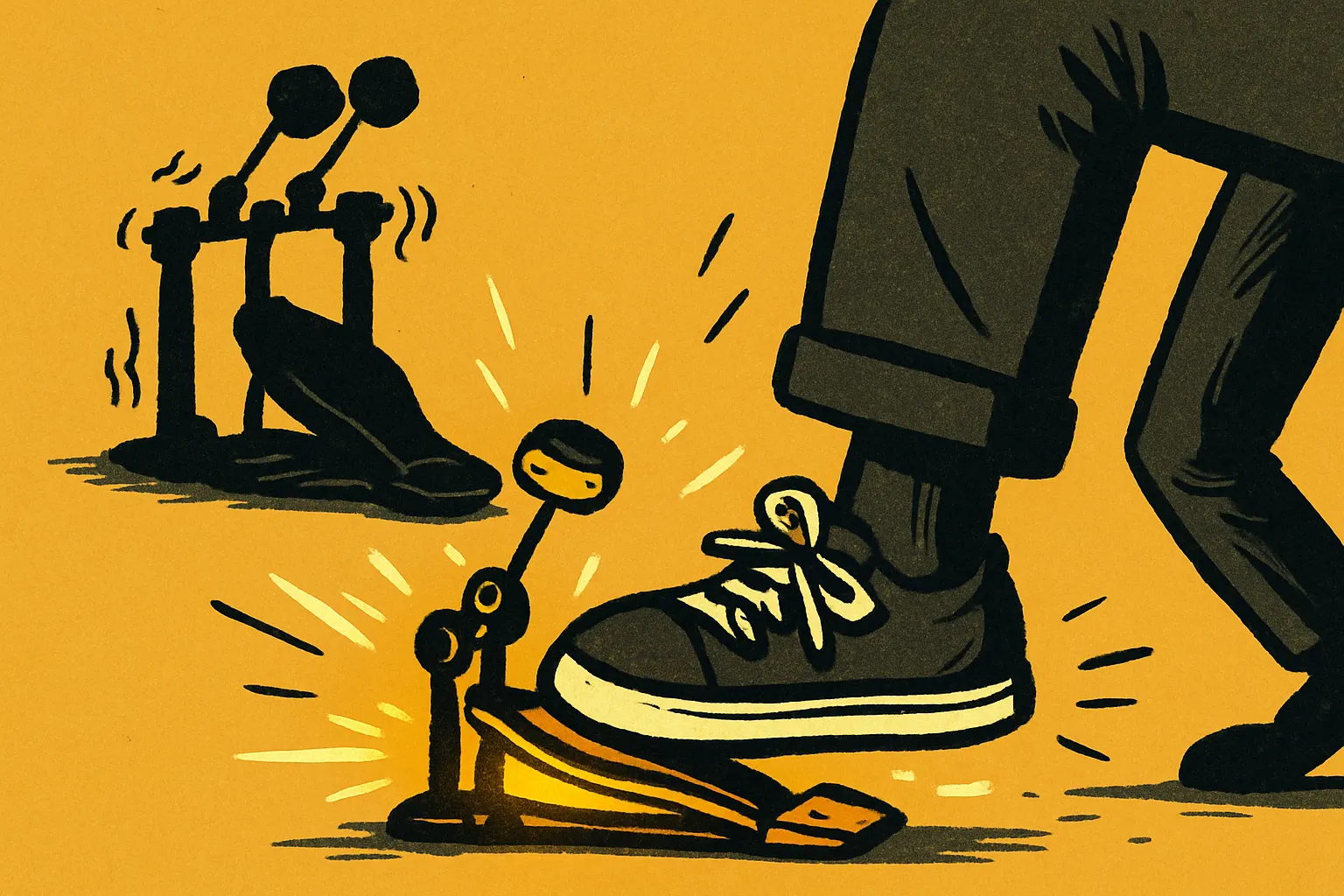
If you're picking your first bass drum pedal, get a single chain-drive pedal, not a double pedal, and don't overspend on features you can't use yet. A bass drum pedal is the mechanism that lets you play the bass drum with your foot instead of a stick. For many beginners, a solid, simple single pedal covers everything you need for the first year or more.
What a Bass Drum Pedal Actually Does
You press the footboard, a beater swings forward, and it strikes the bass drum head. That's the whole job. Everything else — drive type, spring tension, beater material — just changes how that motion feels under your foot. None of it changes what the pedal fundamentally does.
Single Pedal vs Double Pedal
A single pedal plays one beater with one foot. A double pedal adds a second beater, controlled by a second footboard, so you can play two hits with two feet on the same bass drum — common in metal and some rock styles.
As a beginner, start with a single pedal. Double bass technique builds on control you don't have yet with a single foot. Trying to split your attention across two pedals before your right foot (or left, if you're left-handed) has steady timing can just add frustration without adding skill.
What Actually Matters When Choosing a Pedal
Drive type. Pedals connect the footboard to the beater with a chain, a strap, or a direct-drive linkage. Chain-drive is a common choice and tends to be beginner-friendly — it's durable, forgiving, and doesn't require you to nail a particular technique to feel consistent.
Beater. Many pedals come with a single or multi-surface beater (often felt on one side, plastic or wood on another), which lets you change your kick drum's tone without buying a separate part. This isn't something to obsess over early — just know the option exists.
Footboard feel. Springs and cams affect how much resistance you feel and how the pedal responds to a light versus hard press. This is personal preference more than a beginner-versus-pro issue — what feels good under your foot matters more than any spec sheet.
Left- or right-footed setup. If you're left-handed, some pedals — including left-handed and convertible models — let you mirror the footboard and beater angle. You don't have to use a standard right-handed layout if it feels backward to you.
What Doesn't Matter Yet
Skip dual-chain drives, adjustable cams, tour-grade hardware, and anything marketed around speed for advanced double bass playing. Those features solve problems you haven't run into yet. For many beginners, the bigger bottleneck is timing and control, not the pedal's top-end responsiveness.
Pearl Pedal Names You'll Run Into
Pearl makes both single and double chain-drive pedals, so you'll see a range of model names while shopping. A few worth knowing:
- Eliminator and Demon Drive — long-running Pearl pedals that are popular with working drummers, which is part of why they show up often in used listings.
- Elimin8R — one of Pearl's chain-drive single pedals, a straightforward option if you're starting simple.
- Powershifter — Pearl markets this as one of its fastest and most powerful pedals. Take that as the manufacturer's own description, not a beginner recommendation — it's aimed at drummers who already know what

