The hard part of "Good Times Bad Times" isn't the beat itself — it's the fast kick drum bursts John Bonham plays with a single bass drum pedal instead of a double pedal. Learn the basic groove first with a simplified kick pattern, then work the fast bursts slowly on their own before trying to combine them with the rest of the kit.
Why This Song Trips Up Beginners
On paper, the drum part is a straightforward rock groove: hi-hat or crash on top, snare on the backbeat, kick filling in underneath. What makes it hard is speed and independence. Bonham plays quick triplet-style kick bursts using just one foot and one pedal, and he does it while keeping the snare and hi-hat steady on top. Your hands stay on a fairly simple pattern — it's your kick foot that has to do the unusual work. That's why this song is rated moderate rather than easy: it's not new information, it's a coordination and speed problem.
If your kick drum pedal feels sluggish or hard to control at speed, that fights you before the song does. A pedal that responds evenly to light, fast strokes makes a real difference here — see our best bass drum pedals for beginners if yours feels stiff or inconsistent.
The Basic Groove (Simplified Beginner Version)
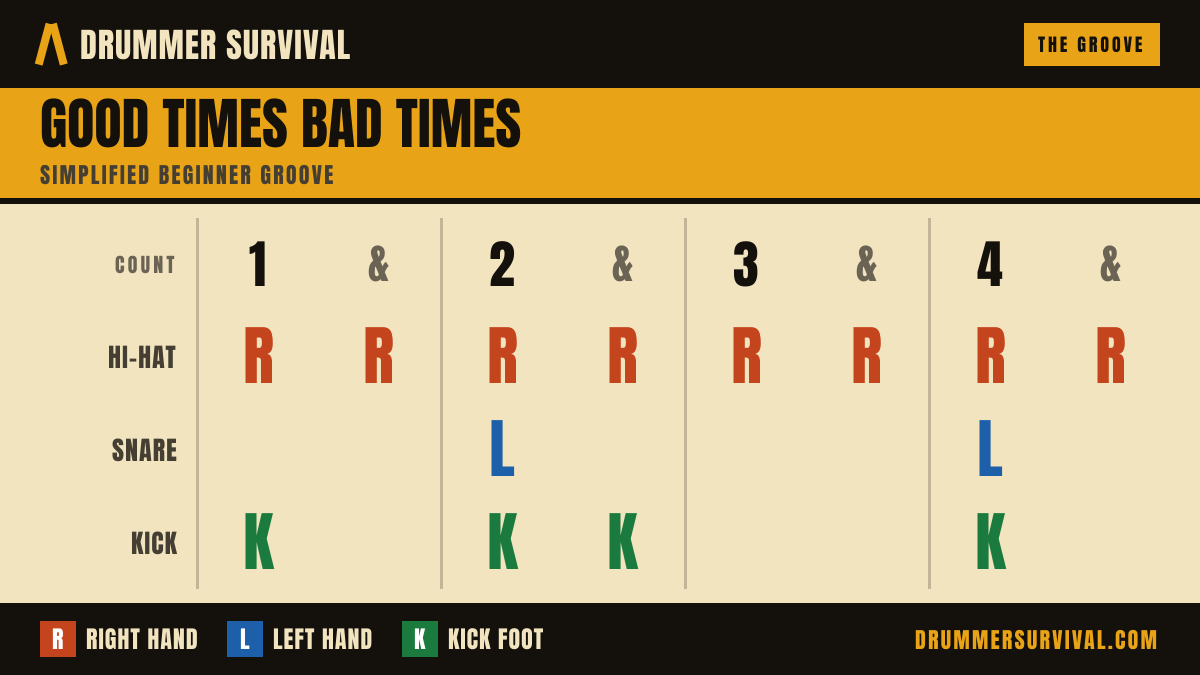
Start by ignoring the fast kick bursts completely. Play a plain rock beat: hi-hat (or ride) with your right hand on a steady pulse, snare on beats 2 and 4, and kick on beat 1 only. Get that locked in and relaxed before you add anything from the real part.
Once that's steady, add one extra kick hit — a single note just before beat 1, instead of the full burst Bonham plays. This gives you the shape of the groove (kick leading into the downbeat) without demanding the full-speed foot work yet. This simplified version won't sound exactly like the record, but it teaches your hands and foot to work independently, which is the actual skill this song is testing.
Practice this simplified groove on a practice pad or your kit with a metronome before worrying about matching the recording note-for-note.
Mapping the Song
- Intro — the drums come in with accents that outline the main riff, including some of those fast kick bursts right away. This is a rough spot to start on; skip it at first and come back once the verse groove feels solid.
- Verse — settles into the more repetitive groove described above: hi-hat, backbeat snare, and kick filling the gaps.
- Chorus — similar feel to the verse but with more energy — often the hi-hat opens up or moves to crash-and-ride territory, and the kick activity increases.
- Fills and transitions — short fills connect sections rather than long drum solos. Keep any fill you add simple at first — even a few snare hits landing back on beat 1 is enough while you're learning the song.
The Kick Drum Problem (And How to Approach It)
The famous part of this track is that Bonham plays fast double-stroke-sounding kick bursts with a single pedal, not a double pedal. You don't need to reproduce that at full speed to say you can play this song — you need a plan to grow into it.
- Isolate the foot. Sit at your kit (or an electronic set if you're practicing quietly) and practice just the kick pattern with no hands at all. Go slow — half speed or slower is fine.
- Build the double stroke in your ankle. The burst relies on a quick heel-toe or bounce technique rather than two separate full leg movements. This takes time; there's no shortcut speed to prove early on.
- Add hands back in gradually. Once the foot pattern feels close to automatic on its own, layer the hi-hat and snare back in at a slower tempo than the record, then build up.
If your foot fatigues quickly or you're sliding on the pedal, check your seating height and posture — a stable, adjustable drum throne helps you keep consistent leg position, which matters more than it seems for pedal control.
Trouble Spots
- The intro kick bursts — one of the faster, more exposed parts of the song. Leave this for last.
- Matching hand and foot at the same time — many beginners can play the hands alone or the foot alone well before they can combine them at speed. That's normal; it's an independence problem, not a sign you're doing something wrong.
- Staying relaxed under speed — tension in the ankle or wrist makes fast repeated notes harder, not easier. If your foot locks up, slow down until it loosens.
A Practice Plan
- Learn the simplified groove (steady hi-hat, backbeat snare, single kick on beat 1) until it's comfortable.
- Practice the fast kick pattern alone, slowly, away from the hands.
- Combine hands and a slowed-down version of the kick pattern.
- Gradually increase speed only once the slow version is clean and relaxed.
- Add the intro and any fills last, once the main groove feels solid.
If you're practicing at home, ear plugs or headphones for an electronic kit let you loop the track and play along at a lower volume for longer stretches without your ears — or your neighbors — getting worn out.
