You Don't Need a Kit to Start
It's a common worry for beginners: can you actually learn anything before you own a drum set? Yes — there are several ways to practice away from a kit, and plenty of people start this way before they ever buy or set one up. The goal early on isn't playing full songs. It's training your hands, your sense of timing, and your coordination, all of which transfer once you do sit behind a kit.
The Closest Thing to Real Drumming: A Practice Pad
A practice pad is the closest you can get to drum set practice without an actual kit. It gives you a real surface to strike with real sticks, so you're training the same hand motion, grip, and rebound control you'll use on a snare drum. Pads are small, quiet enough for an apartment, and let you work on rudiments, stick control, and hand speed at any hour.
Other Ways to Practice Without a Kit
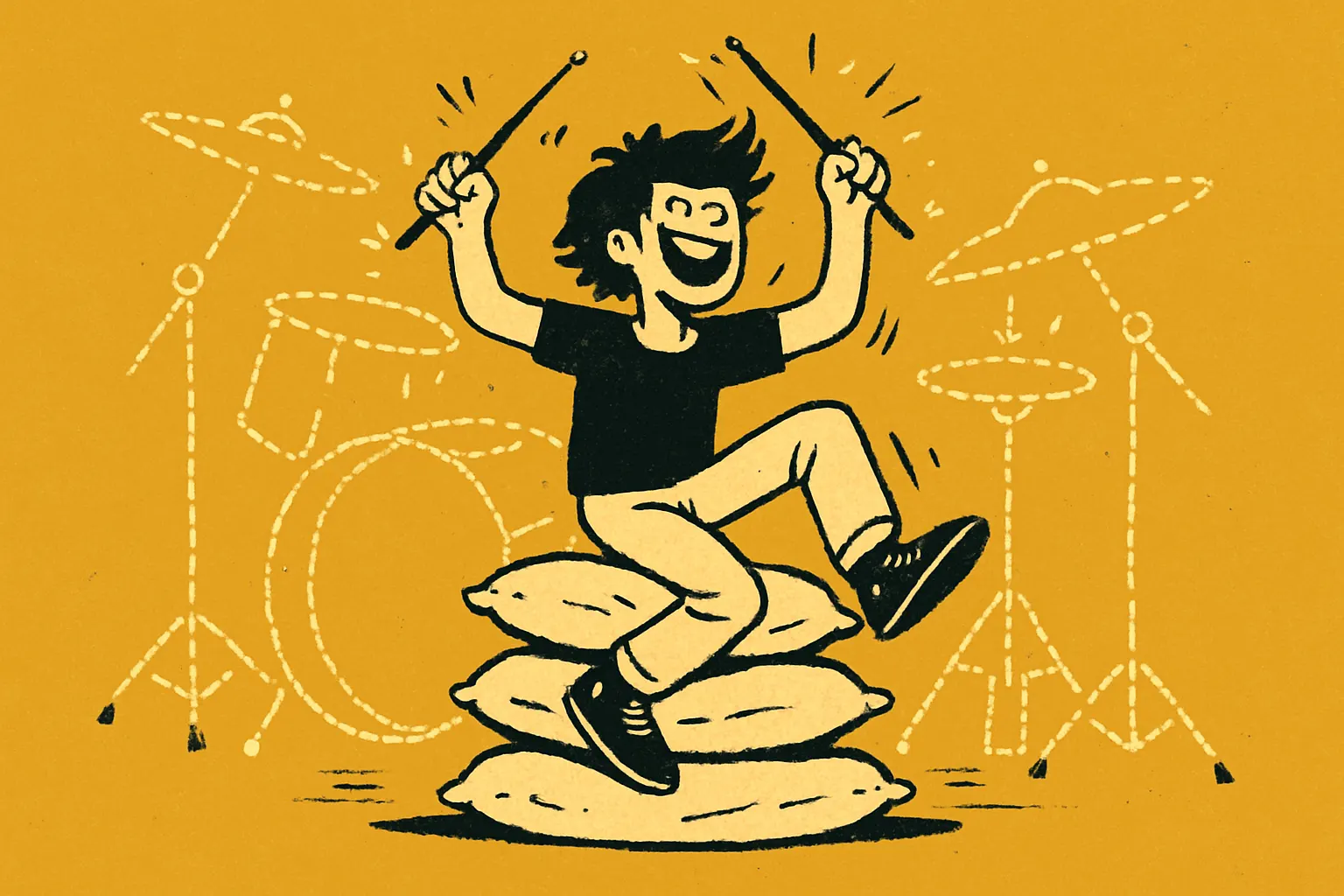
A pillow. A regular pillow works as an improvised, quiet surface. It won't give you the rebound feel of a real drumhead, so it's not a substitute for pad time, but it's fine for warming up your hands or working through a sticking pattern when you don't have a pad nearby.
Air drumming. Playing with no surface at all — sticks and hands moving through the air — is a real practice method, not just goofing around. It's useful for locking in the pattern of a beat or fill in your muscles, though you lose the feedback of actually hitting something, so it works best alongside pad or pillow practice, not instead of it.
Virtual drum apps or software. Apps that simulate a kit can stand in when you have zero physical gear on hand. They're a reasonable backup, especially for working on timing against a click, but they don't replicate the physical feel of sticks and surfaces the way a pad does.
Mental rehearsal. Simply thinking through a beat or fill — sticking, foot pattern, counting — is a legitimate way to practice when your hands are busy elsewhere. It won't build technique on its own, but it can help you internalize a pattern before you play it.
A Simple Away-From-the-Kit Routine
You don't need a long session to make this useful. Try this:
- Pick one sticking pattern you're working on — even something as simple as right-left-right-left.
- Play it slowly on a practice pad for a few minutes. Start at whatever tempo keeps it clean — there's no speed you have to prove.
- Switch to air drumming for the same pattern, focusing on keeping the motion even without the surface to guide you.
- Finish by mentally running through it once more, counting out loud.
This mix covers physical technique, timing, and memory without needing a kit in the room.
Common Mistakes
Skipping timing entirely. It's tempting to just bash away on a pad or pillow without counting or using a metronome. Do this and you're training your hands but not your sense of pulse, which is just as important once you're playing a full kit.
Treating air drumming as your main method. Air drumming is a useful add-on, not a foundation. Without a surface, you get no feedback on control or consistency, so lean on the pad or pillow first.
Waiting to "really" practice until you own a kit. The hand technique and timing you build now carry over directly. Time spent on a pad isn't wasted time — it's just a different part of the same skill.
When You're Ready for More
At some point, pad practice stops being enough — you'll want to add feet, cymbals, and full coordination to the mix. If space or noise is the reason you don't have a kit yet, an electronic drum set paired with headphones is a common next step, since it keeps volume low while giving you every limb to work with. If noise for others in the room is more the issue than volume for you, a set of ear plugs is worth having either way once you're playing a real kit.


