
The drumming in "Zombie" is more about control than speed. The verse groove is a beat you probably already know — steady hi-hat, backbeat on the snare — and the real challenge is playing it quiet and tight, then opening it up for the chorus without rushing. Get the dynamics right and the song plays itself.
The Core Groove (Simplified)
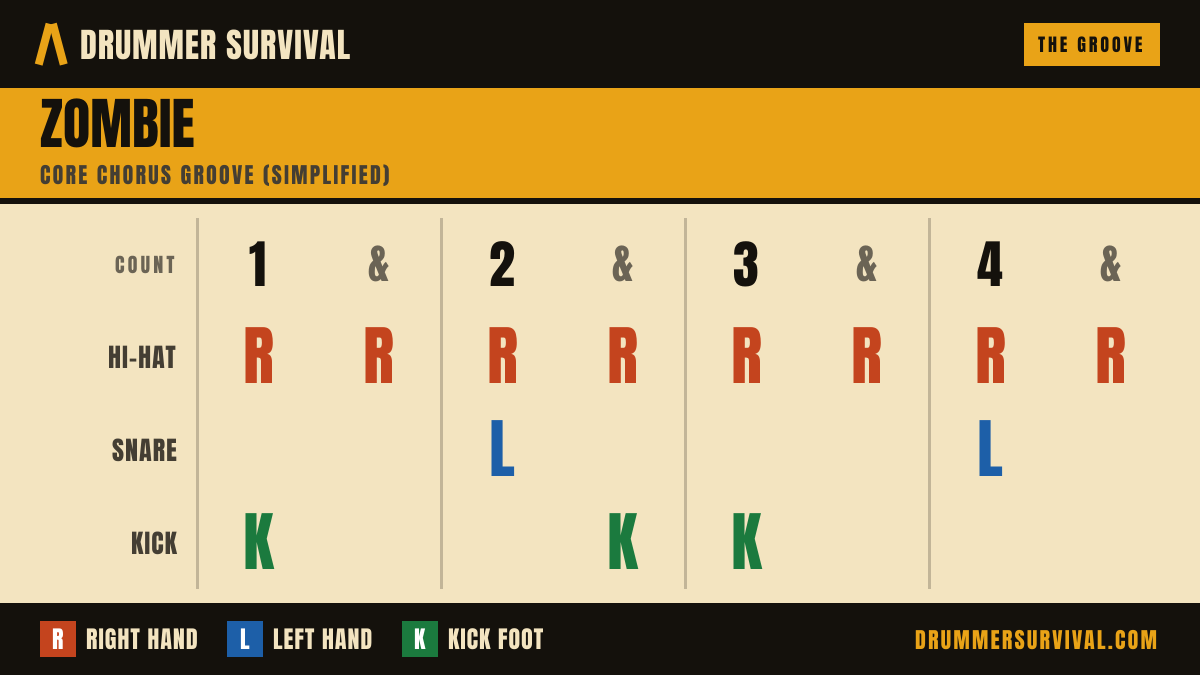
Here's a beginner-friendly version of the basic beat that carries most of the song. This isn't a note-for-note transcription — it's the pattern to learn first so your hands and feet know the shape before you add any personality to it.
That's kick on beats 1 and 3, snare on 2 and 4, hi-hat running straight eighth notes the whole way through. Once that feels automatic under your hands, the song is mostly about when to play it softly and when to dig in.
Mapping the Song's Sections
"Zombie" is built on contrast — quiet parts that build into loud parts — so knowing the shape of the song matters as much as knowing the beat itself.
- Intro — guitar-led and drum-free at first. Come in on the groove above once the drums enter, and don't rush the entrance just because you've been waiting.
- Verse — the core groove, played light. Keep the hi-hat even and let the snare sit back rather than cracking hard.
- Pre-chorus / build — the energy starts climbing here. This can be where a beginner's tempo creeps up before the chorus even arrives — stay locked to your internal pulse, not your excitement.
- Chorus — the same basic pattern, but bigger. Open the hi-hat up or move to the ride if you have one, and let the snare hit harder. The contrast with the verse is the whole point.
- Fills into the chorus — short tom or snare fills mark the transition. Keep it simple: a basic four-hit fill that lands you back on beat 1 works fine. You don't need anything fancy here.
The Tricky Spot: Loud-to-Quiet, Quiet-to-Loud
For many beginners, the trouble isn't losing time on the groove itself — it's losing the dynamic contrast. It's easy to let the verse creep up in volume until it sounds the same as the chorus, which flattens the whole song. Practice the verse and chorus back to back, deliberately playing the verse too quiet and the chorus too loud, then find the middle ground. Exaggerating the difference while you're learning makes it easier to feel later.
The other common trip point is the short fill going into the chorus. If you rush it, you'll land the first chorus hit early. Practice the fill on its own, slowly, until landing back on beat 1 feels automatic — then drop it back into the groove around it.
A Practice Plan
- Play the core groove alone with a metronome, soft, for a few minutes before touching the song.
- Play the same groove loud, same tempo, so you feel the difference in effort.
- Loop the transition from verse to chorus (with the fill) slowly, without the track, until it's clean.
- Add the track at a reduced speed if your player allows it, focusing only on section changes.
- Play the whole song through at full speed, accepting some rough spots — smoothing them out is the next session's job.
A practice pad is useful for step 1 and 3 if you want to drill quietly without setting up the full kit. If you're working this out on an electronic drum set, a decent pair of headphones makes it much easier to hear the dynamic contrast in the track while you play along.
Common Mistakes
- Playing the verse too loud. If the verse and chorus sound the same, the arrangement loses its impact.
- Rushing the pre-chorus. Building energy is not the same as speeding up — keep the pulse steady even as the song feels bigger.
- Overcomplicating the fill. A simple fill that lands cleanly beats a busy one that throws off the downbeat.
- Skipping the quiet practice. If you only ever play loud, you'll struggle to control your dynamics when it counts.
Using a matched pair of beginner drum sticks that feel comfortable at both low and high volume also helps — some sticks make it hard to play quietly with control, which is most of this song's challenge.