
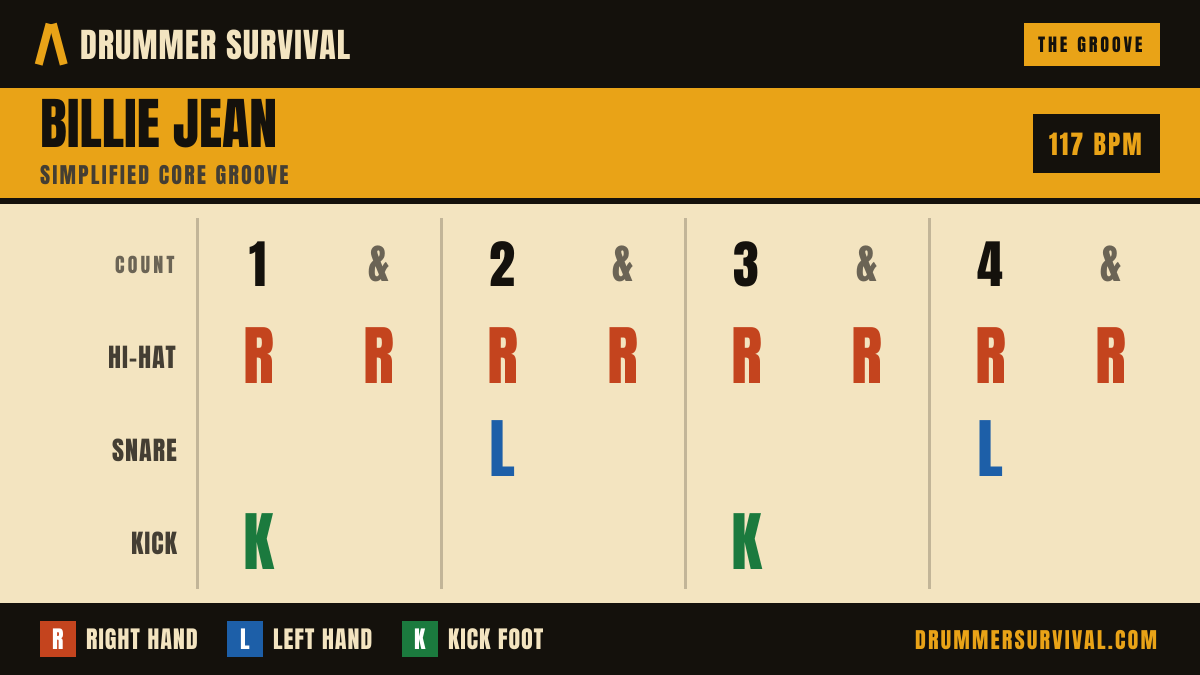
The core of "Billie Jean" is a steady eighth-note hi-hat, the snare on 2 and 4, and the kick on 1 and 3 — the plainest beat on this whole site. The difficulty is not in the notes. It is holding them dead even for five minutes at 117 BPM, because a groove this bare hides nothing. Everything else in the song sits on top of that same pattern, which is why it's a solid early song to learn.
The Core Groove (Simplified)
Here's a beginner-friendly version of the main pattern. This isn't a full transcription — it's the groove stripped down to the parts that matter for learning it.
Read it as eight even eighth notes per bar, counted "1-and-2-and-3-and-4-and."
- Hi-hat plays every eighth note, no gaps. This is your steady pulse — it keeps going under everything else.
- Snare hits on beats 2 and 4, the standard backbeat.
- Kick hits on beats 1 and 3, straight down the middle. Nothing in this groove lands off the beat.
Learning It Hand by Hand
Build it in layers instead of trying to play all three limbs at once.
- Hi-hat alone. Set a metronome to a slow tempo — 70–80 BPM is fine to start — and play steady eighth notes with your right hand (or left, if you're left-handed) until it feels boring. Boring is good; it means it's automatic. A practice pad works fine for this if you want to drill it away from the kit.
- Add the kick. Keep the hi-hat going and drop the kick in on 1 and 3. Count out loud: "1-and-2-and-3-and-4-and," and say "kick" on 1 and on 3, so the foot follows the count instead of chasing your hand. An even foot matters more here than a fast one, and a bass drum pedal that returns predictably makes an even foot easier to keep.
- Add the snare. Once the hi-hat/kick combo is steady, layer in the snare on 2 and 4. This is the easy part — many beginners already have a backbeat snare down from other songs.
- Bring the tempo up slowly. Once all three limbs are solid together, nudge the metronome toward 117 BPM in small steps. If it falls apart, drop back 10 BPM and rebuild.