The core of this beat is restraint, not speed: one heavy snare hit per bar on beat 3, a syncopated kick that lands just ahead of it, and a steady hi-hat holding the time underneath. The hard part isn't the notes — it's playing them slow, spaced out, and dead in the pocket without rushing.
The Groove: What Makes This Beat Different
Most beginner rock beats put the snare on beats 2 and 4. This one drops to a half-time feel — the snare only lands once per bar, on beat 3. That single hit has to carry the whole groove, so it needs to sit exactly on the beat, not early.
The kick is the tricky part. Instead of just hitting on beat 1, it also lands on the "and" just before beat 3 — a syncopated push that leads into the snare hit. Because that kick note falls between the steady hi-hat clicks, it's easy to either rush it or flatten it out so it lines up with the hi-hat instead of sitting slightly ahead.
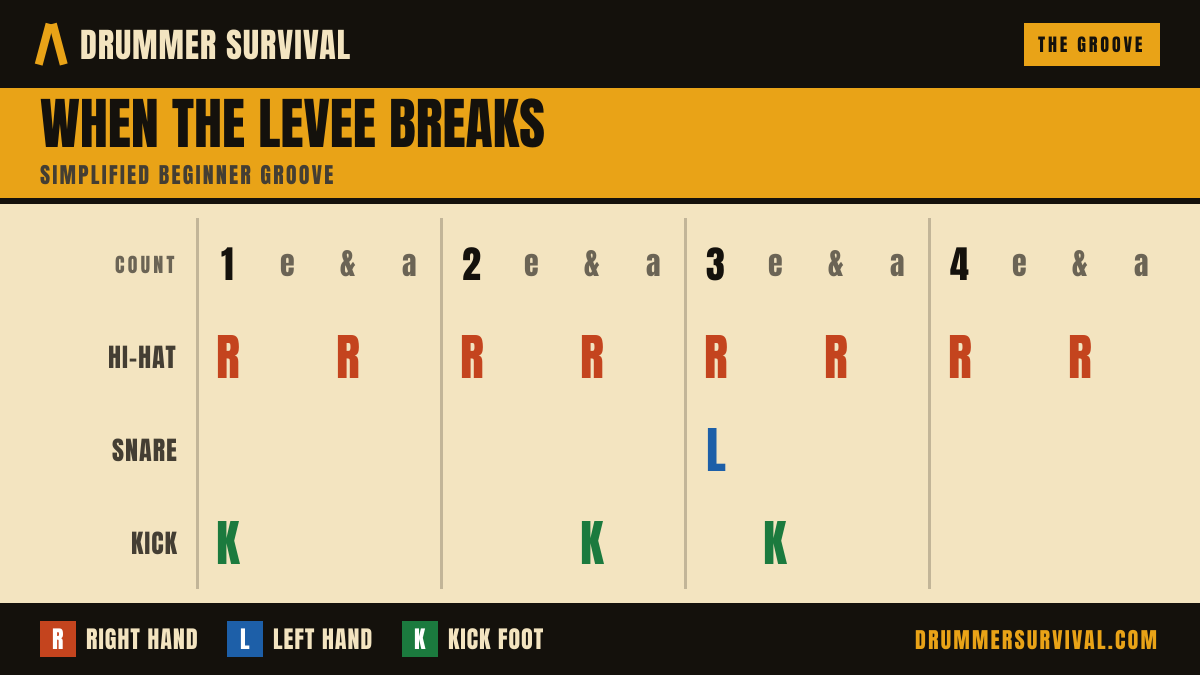
Here's a simplified beginner version of the pattern, one bar:
Hi-hat holds steady eighth notes throughout. Kick plays on beat 1, then again on the "and" before beat 3, then once more near the end of the bar. Snare plays a single big hit on beat 3 — and that's the only snare note in the whole bar.
| Element | Original recording | Beginner version here |
|---|---|---|
| Hi-hat | Very sparse, sometimes almost absent | Steady eighth notes, to help you hold time while learning |
| Snare | One massive hit on beat 3, huge natural room sound | Same placement, normal volume |
| Kick | Syncopated push landing just before beat 3 | Same syncopation, played at a slower, manageable tempo |
Section Map
The song opens with an extended drum-and-guitar groove before the vocal ever enters, so you get a long stretch to lock the pattern in before anything else is layered on top. Once the vocal comes in, the drum pattern itself doesn't change much — the challenge is consistency, not variety. You're repeating the same half-time groove for most of the song while everything else in the mix shifts around it, which is a different skill than switching between verse and chorus patterns.
Trouble Spots
- The syncopated kick before beat 3. This is the one note in the bar that isn't locked to an obvious hi-hat click, so it's the easiest place to drift.
- Staying slow. A half-time groove at a relaxed tempo exposes any tempo drift much faster than a busy, fast beat does — there's nowhere to hide between hits.
- Playing it for a long time without changing it. Because the pattern repeats so much, fatigue and boredom can creep in and quietly speed the tempo up over several bars.
How to Practice It
- Play just kick and snare together, slowly, with a metronome. No hi-hat yet.
- Once that syncopation feels solid, add the eighth-note hi-hat on top.
- Loop one bar for a few minutes at a time rather than trying to play the whole song start to finish.
- Once it's steady, try playing along with the actual recording at a comfortable, reduced volume.
Set your metronome to something you can control fully — this beat rewards patience far more than raw speed. There's no tempo you need to prove here.
Common Mistakes
- Turning it back into a normal backbeat by accenting beat 2 as well as beat 3.
- Adding extra hi-hat notes or fills to make it feel more "active" — the space is the point.
- Rushing the syncopated kick so it collapses onto the surrounding hi-hat notes instead of sitting slightly ahead.
Gear Notes
A firm, even snare hit matters a lot in this groove since it only happens once per bar — a comfortable, well-balanced pair of drum sticks makes it easier to keep that hit consistent night after night. If you're practicing the kick syncopation on an electronic kit, a responsive bass drum pedal helps you feel exactly when the beater strikes relative to the click. And because this song is loud and recorded with a huge, reverberant drum sound, it's worth practicing at a sensible volume — a set of ear plugs protects your hearing whether you're playing along to the record or drumming for a while at full volume.