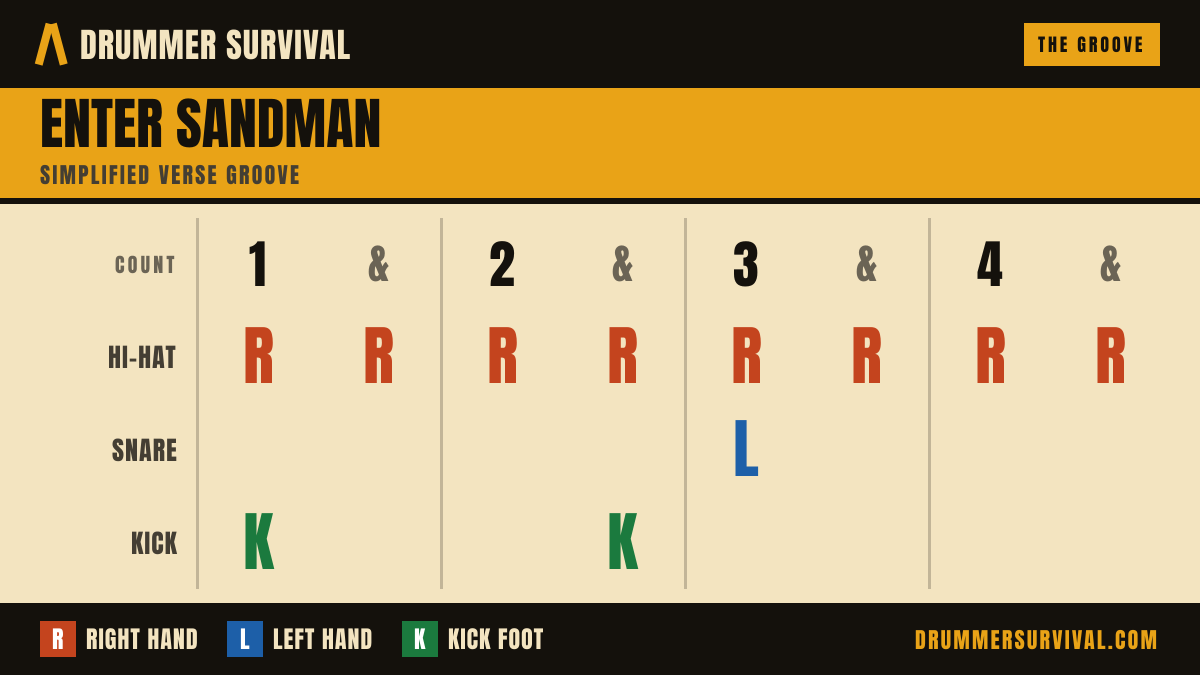
The core of Enter Sandman is a mid-tempo rock beat with one twist: the kick drum doesn't just sit on beat 1 and 3, it sneaks in an extra hit that locks with the guitar riff. Learn that kick placement first, keep your hands steady on the hi-hat, and the rest of the song opens up. Below is a simplified version of the groove you can practice right now — not a note-for-note transcription, just the pattern that makes the song feel right.
Read it left to right as "1 & 2 & 3 & 4 &." The snare stays simple — beats 2 and 4, the standard backbeat. The kick is the part that trips people up: it lands on beat 1, then again on the "and" of 2, then again on beat 3. That gap between the second and third kick hit is what gives the groove its lean-forward feel.
Why the Kick Pattern Is the Hard Part
Many beginner rock beats put the kick on 1 and 3 and leave it there. This one adds a hit in between, so your foot has to move somewhere your ear isn't expecting yet. That's a timing and coordination problem, not a sign you're bad at this — it just needs isolated reps before it goes on the kit with your hands.
A bass drum pedal with a bit of adjustability helps here, since you can soften the spring tension while you're still finding the pattern, then firm it up once your foot is confident.
Mapping the Song's Sections
You don't need to play the whole song the same way from start to finish. Enter Sandman moves through distinct sections, and each one asks something slightly different of the drums:
- Intro — the guitar riff runs mostly alone. Drums come in with accents and cymbal hits that punctuate the riff rather than a full groove.
- Verse — the core groove above, played with restraint. Keep the dynamics low here so the chorus has somewhere to go.
- Pre-chorus build — energy rises. This is often where a fill leads into the next section.
- Chorus — the same groove, but louder and more driving. Some drummers open the hi-hat or switch to a ride/crash pattern here for contrast.
- Guitar solo — the groove continues underneath, often with more consistent energy to support the lead.
- Outro — often mirrors the intro, winding back down.
Treat each section as a separate practice target rather than trying to nail the whole song in one pass.
Full Song vs. Beginner-Safe Version
| Section | What the record does | Beginner-safe version |
|---|---|---|
| Kick pattern | Syncopated kick weaving around the riff | Kick on 1, the "and" of 2, and 3 — the groove above |
| Fills | Fast tom runs with cymbal crashes | A simple four-hit snare fill landing back on beat 1 |
| Dynamics | Quiet verses, loud choruses, full-band swells | Play the same groove softer or louder — don't add extra notes yet |
The simplified fill matters more than it sounds. A fill's job is to get you back to beat 1 cleanly — it doesn't need to be impressive to be correct. Four snare hits leading into the downbeat will hold the song together just as well as a flashy tom run while you're still learning.
The Trouble Spots
The syncopated kick. Covered above — isolate it before adding hands.
Matching the intro accents to the riff. During the intro, the drums are reacting to the guitar rather than holding a steady groove. Listen closely and count along so you know where each hit falls before you try to play it.
Holding back in the verses. It's tempting to play everything at full volume because the song is heavy. Save some dynamic range for the chorus, or the song will feel flat all the way through.
Stamina. This is a full-length song at a driving tempo. Your arms may tire before your timing does. That's normal — it means you need more reps at tempo, not that something is wrong with your technique.