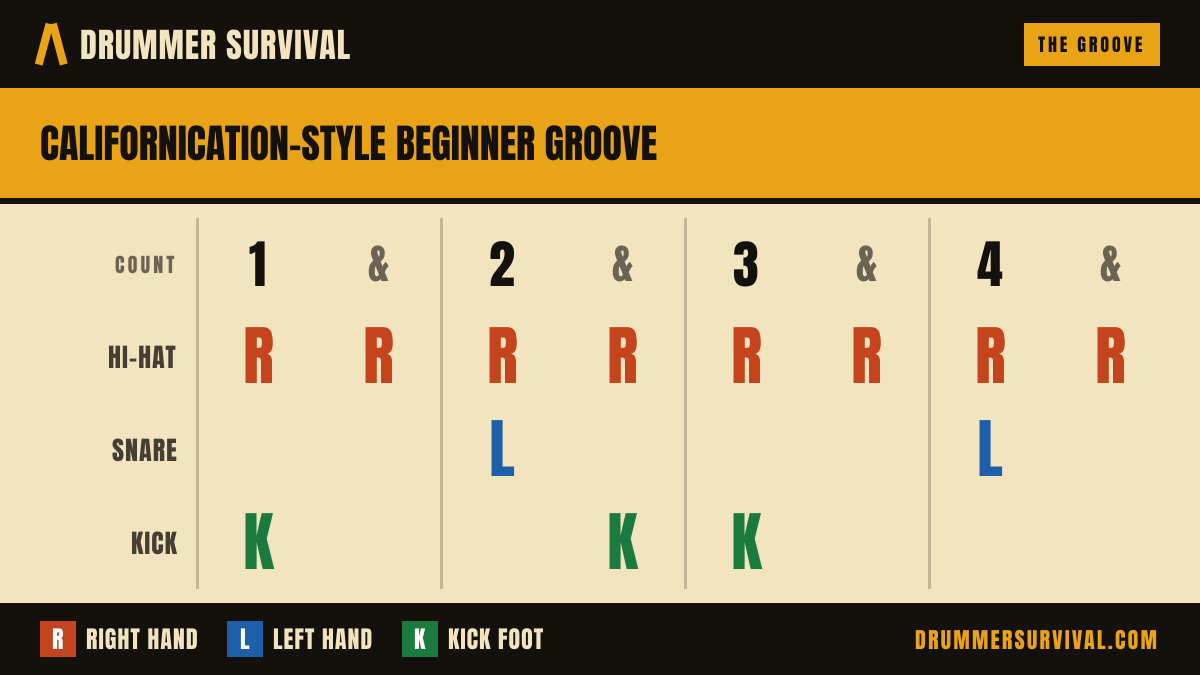
Californication is a good first "real song" because the groove barely changes across the track — you're locking into a repeating pattern, not memorizing constant variation. The core beat is steady hi-hat eighth notes with a backbeat on 2 and 4, plus one syncopated kick hit that takes a bit of practice to feel natural. That's really the whole song at beginner level.
Why This Song Works for Beginners
At a beginner difficulty of 2 out of 5, Californication asks for consistency more than complexity. There's no blast of 16th notes around the kit, no odd time signature, and no fill that needs advanced hand speed. The challenge is holding a simple groove steady for four minutes and landing the kick pattern the same way every time it repeats. That's a fair test for someone a few months into playing — hard enough to be worth learning, easy enough not to get discouraging.
The Core Groove, Simplified
Here's a stripped-down version to learn the feel — not a note-for-note transcription of the recording (the full tab covers the exact part, including ghost notes and variations).
- Hi-hat: steady eighth notes, right hand, the whole way through.
- Snare: a clear backbeat on beats 2 and 4.
- Kick: one hit on beat 1, plus a second kick hit that falls slightly ahead of or behind a main beat rather than squarely on it. That second hit is the part that trips people up, because your hi-hat hand wants to keep going in a straight, predictable pattern while your foot does something slightly off from it.
Start by playing hi-hat and snare alone until the backbeat feels boring-easy. Then add the kick on beat 1 only. Only once that's solid should you add the second kick hit — trying to learn all three limbs at once is how people give up early. If your foot and hand start copying each other's rhythm instead of staying independent, that's normal at this stage — it's a coordination problem, not a sign you're bad at this.
A practice pad is useful here even though this is a groove song, not a rudiment song — you can drill the hand pattern on the pad while you work out the kick foot separately, then combine them on the kit.
Mapping the Song's Sections
Like many Red Hot Chili Peppers songs, Californication follows a fairly standard structure: an intro that's sparser than the verse, a verse groove that repeats, a chorus that's built on a similar feel but sits bigger (often with a crash accent or fuller cymbal work), and a bridge or solo section before the song returns to the chorus and winds down.
What matters for your practice is this: the sections don't ask you to learn a completely new pattern each time. They ask you to play the same pattern with different dynamics and small fills between sections. Practice the plain groove first, then practice the moment right before a section change — that transition can be where beginners lose the beat, more than the groove itself.
Trouble Spots to Watch For
- The syncopated kick hit. This is the one part of the groove that isn't a straight downbeat. Slow it down until you can feel exactly where it lands relative to the hi-hat, rather than guessing.
- Section transitions. Any small fill or accent leading into the chorus is a common place to speed up or lose the pulse. Practice two bars before the transition and two bars after, on a loop, before playing the full section.
- Staying steady over time. Because the groove doesn't change much, it's easy to drift tempo without noticing, especially over a four-minute song. Playing along with the actual track (or a metronome) helps you catch that drift early rather than after you've sped up the whole second half.
A Practice Plan
- Play hi-hat and snare only, no kick, until it's steady and boring-easy.
- Add the kick on beat 1 only.
- Add the second kick hit slowly, checking it against a metronome or the recording at reduced speed.
- Loop the transition into the chorus on its own before playing start to finish.
- Play along to the full track once the groove feels automatic, not something you have to think about.
There's no minimum speed you need to prove before this counts as "playing the song." Getting the groove locked at a slower tempo is more useful than rushing through it messy at full speed.
Gear That Helps
You don't need anything special to learn this song, but a few things make practice smoother. A comfortable pair of drum sticks makes it easier to keep that steady hi-hat pattern relaxed instead of tense. If you're working the kick pattern on an actual kit, a reliable bass drum pedal gives you more control over that syncopated hit than a pedal that's sticky or inconsistent. And if you're practicing on an electronic drum set so you can play along to the track through headphones without bothering anyone, that's a solid way to drill this groove at any hour.