The drum part in "Smoke on the Water" is a steady, mostly straightforward rock beat — the hard part isn't the beat itself, it's locking that beat in around the famous guitar riff without rushing or dragging. If you can already play a basic beat with hi-hat, snare, and kick, you're close. The two spots that trip up beginners are staying steady through the riff's gaps and landing the short fill that leads into the chorus.
Why This Is a Good First Full Song
This song shows up on a lot of beginner song lists for a reason: the drum part doesn't move around much. There's no fast double-kick, no odd time signature, and the pattern barely changes between verse and chorus. What makes it feel tricky at first is that the guitar riff has its own rhythm and gaps in it, and your job is to hold a steady pulse underneath that riff instead of copying its rhythm with your hands and feet.
That's actually a useful skill on its own. A lot of songs ask you to keep time against a riff, not with it, and this is a gentle place to practice that.
The Groove: A Simple Rock Beat That Locks with the Riff
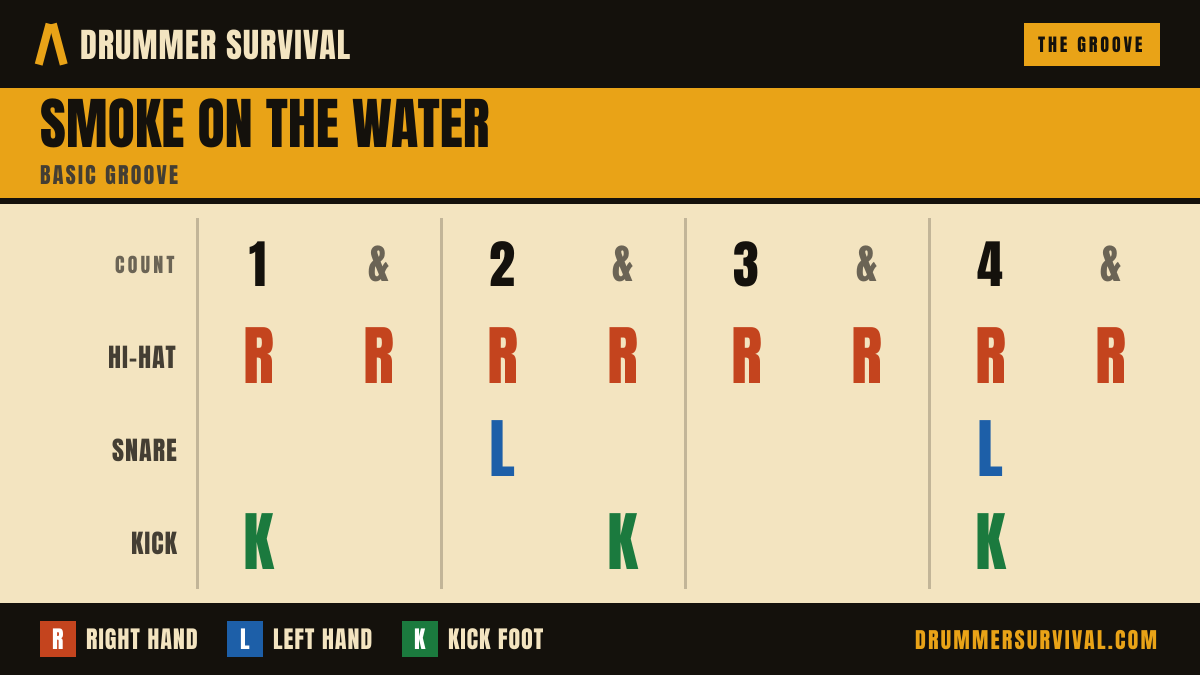
Strip the part down and it's a basic rock beat: hi-hat (or ride cymbal in places) keeping a steady pulse, snare landing on beats 2 and 4, and kick drum filling in the rest. If you've practiced a standard beginner rock beat on a practice pad or kit already, this will feel familiar.
Start even simpler than you think you need to:
- Hi-hat: steady quarter notes (one hit per beat) to start, moving to eighth notes once that feels solid.
- Snare: hit on beats 2 and 4, the classic backbeat.
- Kick: on beat 1, with one extra kick tucked in later in the bar once the basic version feels automatic.
Don't add the extra kick hits or busier hi-hat pattern until the simple version feels boring to play. That boredom is the sign you're ready to add detail, not a sign you're behind.
Mapping the Song: Intro, Verse, Chorus, Solo, Outro
The song is a good one to learn section by section rather than top to bottom:
- Intro — the riff plays a few times before the full band comes in. Use this time to find the tempo in your head and get your hi-hat pulse going before you have to add snare and kick.
- Verse — this is your basic beat, played steadily under the vocal.
- Chorus — the beat stays close to the verse groove but can feel a little bigger, often with the ride cymbal or crash instead of hi-hat, plus a short fill going into it.
- Guitar solo — same core beat, played with a bit more energy since there's no vocal to sit under.
- Outro — winds down similarly to how it started, often back toward the riff-only feel.
You don't need to play the whole song end to end on your first attempt. Loop the verse until it's boring, then loop the chorus, then connect them.
The Trouble Spots
A couple of things commonly cause struggle with this song:
Staying steady through the riff's rhythm. The guitar riff has space in it — beats where nothing obvious is happening. Beginners often unconsciously slow down or speed up to match the riff's phrasing instead of holding their own pulse. Practice with a metronome or the original recording and focus on keeping your hi-hat hand completely even, independent of what the riff is doing.
The fill into the chorus. This doesn't need to be fancy. A simple snare or snare-and-tom fill that lands you back on beat 1 does the job. If you try to copy something more elaborate before the basic beat is solid, you can lose the beat right where the fill happens — right at the moment you need it most.
A Practice Plan
- Play the basic beat alone (no riff, no song) at a slow, comfortable tempo until your hands and foot don't need to think about it.
- Add a metronome and hold the beat for a full minute without speeding up.
- Play along with just the verse section of the recording, looping it a few times.
- Add the chorus fill, practiced separately at first, then dropped into the loop.
- Play the full song slower than the recording before trying full speed — there's no rule that says you have to match the original tempo right away.
A basic setup is enough here — a pair of drum sticks sized for a beginner and a reliable bass drum pedal matter more than anything fancy. If you're practicing on an electronic drum set, a decent pair of headphones makes it much easier to hear yourself against the track. Practicing on an acoustic kit at home for a while? Ear plugs are worth having before you're deep into looping sections at volume.
Common Mistakes
- Rushing the intro. Since it's riff-only at first, it's easy to come in too fast once the beat starts. Set your tempo in your head before you play a single note.
- Copying the riff's rhythm with the kick. The kick doesn't need to mimic every accent in the guitar riff — it has its own simpler job.
- Skipping straight to the full-speed version. This song can reward patience more than beginners expect, given how simple the beat looks on paper.
- Ignoring your seating and setup. An unstable drum throne or awkward pedal position makes it harder to stay relaxed through a whole song, and tension shows up as rushing.