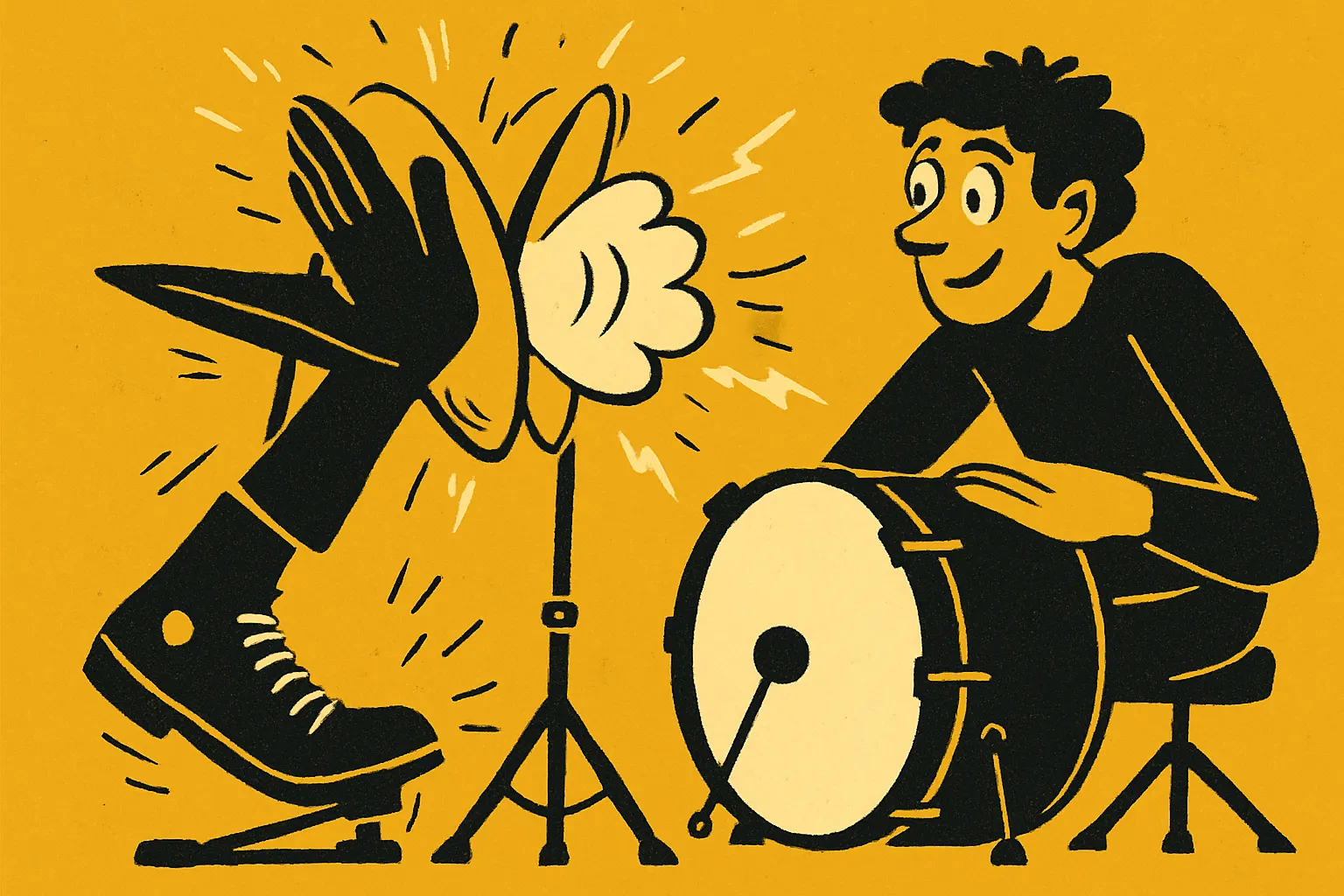
A hi-hat is two matching cymbals mounted face-to-face on a stand, closed and opened with a foot pedal, and struck with drum sticks, brushes, or fingers. It's a standard part of every drum kit and usually the piece you play the most, since it keeps the beat going through most of a groove.
What a Hi-Hat Actually Is
Think of it as one instrument made of three parts: a bottom cymbal, a top cymbal, and a spring-loaded pedal connecting them through a metal stand. Press the pedal down and the cymbals clamp shut for a tight, short "chick" sound. Let the pedal up and the cymbals separate, giving a looser, washier sound when struck. Your foot controls that gap the whole time you're playing — it's part of the groove, not a separate task.
Why the Hi-Hat Matters in a Groove
In most basic patterns, the hi-hat carries the steady pulse while the snare and kick drum lay down the backbeat underneath it. It's the cymbal you'll lean on most as a beginner because it's what makes a beat sound like a beat instead of scattered hits. Get comfortable keeping your hi-hat hand even, and the rest of the groove has something solid to sit on top of.
Open vs Closed: The Sound You Control With Your Foot
A closed hi-hat (foot pressed down) sounds short and controlled. An open hi-hat (foot lifted) sounds longer and washier, and you can close it again mid-ring by stepping down to "choke" the sound off. Early technique work is mostly about learning to control that open/close gap on purpose instead of by accident — your foot needs to do its own thing while your hands keep playing.
This is also a common coordination wall for beginners: the hi-hat foot wants to copy whatever the hands or kick foot are doing. That's normal at first and it settles with slow, repeated practice, not by rushing the tempo.
Hi-Hat Sizes: What the Inches Mean
Hi-hat cymbals are sold by diameter, most commonly 13, 14, 15, 16, or 17 inches. 14 inches is the size you'll see on most standard kits and most beginner setups. Smaller hi-hats tend to feel quicker and sound tighter; larger ones sound fuller and heavier. As a beginner you don't need to chase a specific size — get comfortable on whatever your kit came with before worrying about swapping it out.
Compared to other cymbals on the kit, hi-hats are usually smaller in diameter than a crash and much smaller than a ride, and they sound crisper and less resonant — more of a tight "chick" or "tss" than a long, ringing wash.
Materials and Brands (What You'll See Listed)
Hi-hat cymbals come in a range of materials, weights, and finishes, and you'll see them sold individually or as a matched top-and-bottom pair. Major cymbal brands making hi-hats include Paiste, Sabian, Meinl, and Zildjian. As a beginner, the brand name matters far less than simply having a hi-hat you can practice on consistently — differences in tone between brands are something you'll start to care about later, once your foot and stick control are solid.
What Beginners Actually Need to Practice
Start with the basics: play a steady closed hi-hat pattern with your stick while your foot just holds it shut. Once that feels stable, practice opening the hi-hat for a beat or two and closing it again on a specific count — that's the open/close control every groove eventually asks for. There's no minimum speed you need to hit here; a slow, even hi-hat pattern at a comfortable tempo is worth more right now than a fast one that falls apart.
More advanced hi-hat playing — things like Moeller technique or fast finger control for busy patterns — comes later, once basic open/close control and steady timing feel automatic. Don't feel behind if that's not you yet; it isn't a beginner skill.
Buying a Hi-Hat: What to Look For
If you're building or upgrading a kit, a hi-hat is a cymbal pair plus a stand — check that the stand is sturdy enough not to wobble when you press the pedal, and that the pedal action feels smooth under your foot rather than sticky or loose. If you're on an electronic drum set, the hi-hat is usually a pad-and-pedal combo built into the kit, and the same idea applies: you want a pedal that responds cleanly to a light or hard press so open/close control doesn't feel like guesswork.
A proper drum throne also matters more than people expect here — your hi-hat foot needs a stable, comfortable base to work from, and sitting too low or too high makes pedal control harder than it needs to be. See our guide to drum thrones for beginners if yours is uncomfortable or unstable.
Trade-offs and When to Skip Upgrading
Acoustic hi-hat cymbals are genuinely loud, especially with the lid open, so if you're in an apartment or shared space, pair practice sessions with ear plugs and consider an anti-vibration mat to cut down on what travels through the floor. If noise is the real blocker, an electronic kit with headphones built for electronic drums lets you practice hi-hat control at any hour without upgrading anything else.
As a total beginner, don't spend money swapping hi-hat cymbals or stands just because a size or brand sounds fancier. Your hands and foot need reps far more than your gear needs an upgrade — put practice time in first, and let a real gear limitation (not boredom) tell you when it's time to change something.
Related Gear
A solid hi-hat pattern also depends on what's in your hands and under your kick foot. If your grip or stick control feels shaky, start with our beginner drum sticks guide. If your bass drum pedal feels inconsistent, that's worth checking too — see bass drum pedals for beginners. And if you're still building basic stick control away from a full kit, a practice pad is a quiet place to work on hand evenness before you bring it to the hi-hat.